By St. Thomas Aquinas
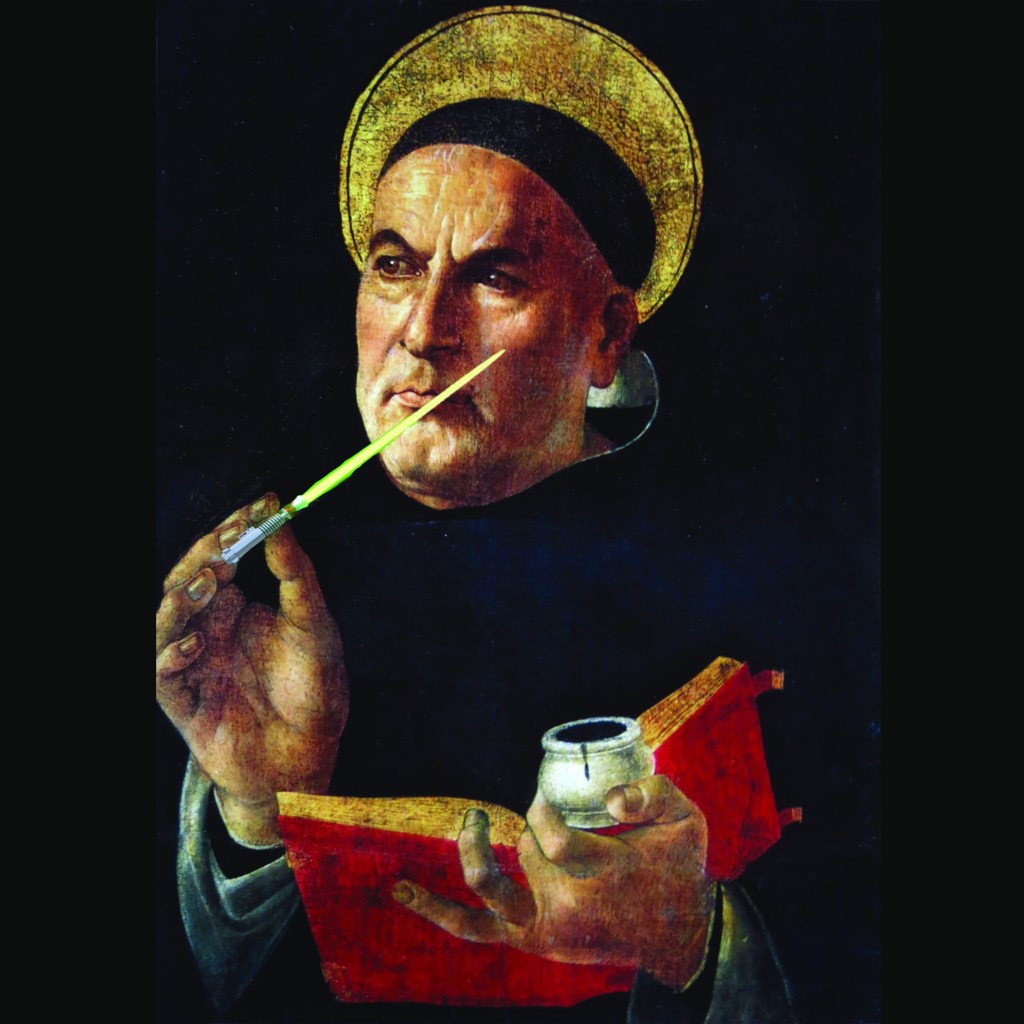
St. Thomas Aquinas, Summa Theologiae, Supplement, Question 38. Article 2:
Whether heretics and those who are cut off from the Church can confer Orders?
Objection 1: It would seem that heretics and those who are cut off from the Church cannot confer Orders. For to confer Orders is a greater thing than to loose or bind anyone. But a heretic cannot loose or bind. Neither therefore can he ordain.
Objection 2: Further, a priest that is separated from the Church can consecrate, because the character whence he derives this power remains in him indelibly. But a bishop receives no character when he is raised to the episcopate. Therefore he does not necessarily retain the episcopal power after his separation from the Church.
Objection 3: Further, in no community can one who is expelled therefrom dispose of the offices of the community. Now Orders are offices of the Church. Therefore one who is outside the Church cannot confer Orders.
Objection 4: Further, the sacraments derive their efficacy from Christ’s passion. Now a heretic is not united to Christ’s passion; neither by his own faith, since he is an unbeliever, nor by the faith of the Church, since he is severed from the Church. Therefore he cannot confer the sacrament of Orders.
Objection 5: Further, a blessing is necessary in the conferring of Orders. But a heretic cannot bless; in fact his blessing is turned into a curse, as appears from the authorities quoted in the text (Sent. iv, D, 25). Therefore he cannot ordain.
On the contrary, When a bishop who has fallen into heresy is reconciled he is not reconsecrated. Therefore he did not lose the power which he had of conferring Orders.
Further, the power to ordain is greater than the power of Orders. But the power of Orders is not forfeited on account of heresy and the like. Neither therefore is the power to ordain.
Further, as the one who baptizes exercises a merely outward ministry, so does one who ordains, while God works inwardly. But one who is cut off from the Church by no means loses the power to baptize. Neither therefore does he lose the power to ordain.
I answer that, on this question four opinions are mentioned in the text (Sent. iv, D, 25). For some said that heretics, so long as they are tolerated by the Church, retain the power to ordain, but not after they have been cut off from the Church; as neither do those who have been degraded and the like. This is the first opinion. Yet this is IMPOSSIBLE, because, happen what may, no power that is given with a consecration can be taken away so long as the thing itself remains, any more than the consecration itself can be annulled, for even an altar or chrism once consecrated remains consecrated for ever. Wherefore, since the episcopal power is conferred by consecration, it must needs endure for ever, however much a man may sin or be cut off from the Church. For this reason others said that those who are cut off from the Church after having episcopal power in the Church, retain the power to ordain and raise others, but that those who are raised by them have not this power. This is the fourth opinion. But this again is IMPOSSIBLE, for if those who were ordained in the Church retain the power they received, it is clear that by exercising their power they consecrate validly, and therefore they validly confer whatever power is given with that consecration, and thus those who receive ordination or promotion from them have the same power as they. Wherefore others said that even those who are cut off from the Church can confer Orders and the other sacraments, provided they observe the due form and intention, both as to the first effect, which is the conferring of the sacrament, and as to the ultimate effect which is the conferring of grace. This is the second opinion. But this again is inadmissible, since by the very fact that a person communicates in the sacraments with a heretic who is cut off from the Church, he sins, and thus approaches the sacrament insincerely and cannot obtain grace, except perhaps in Baptism in a case of necessity. Hence others say that they confer the sacraments validly, but do not confer grace with them, not that the sacraments are lacking in efficacy, but on account of the sins of those who receive the sacraments from such persons despite the prohibition of the Church. This is the third and the true opinion.
Reply to Objection 1: The effect of absolution is nothing else but the forgiveness of sins which results from grace, and consequently a heretic cannot absolve, as neither can he confer grace in the sacraments. Moreover in order to give absolution it is necessary to have jurisdiction, which one who is cut off from the Church has not.
Reply to Objection 2: When a man is raised to the episcopate he receives a power which he retains for ever. This, however, cannot be called a character, because a man is not thereby placed in direct relation to God, but to Christ’s mystical body. Nevertheless it remains indelibly even as the character, because it is given by consecration.
Reply to Objection 3: Those who are ordained by heretics, although they receive an Order, do not receive the exercise thereof, so as to minister lawfully in their Orders, for the very reason indicated in the Objection.
Reply to Objection 4: They are united to the passion of Christ by the faith of the Church, for although in themselves they are severed from it, they are united to it as regards the form of the Church which they observe.
Reply to Objection 5: This refers to the ultimate effect of the sacraments, as the third opinion maintains.
Comment
It is not my custom to post entire articles from other people–however eternally eminent in learning and holiness–for the reason that I think it is kind of cheap. If you wanted to know St. Thomas Aquinas’s thoughts on heretics and holy orders, then you would have consulted the Summa to find out what they were. Nevertheless, after Laura read to me some pertinent parts of Teresa Benns’s most recent article, “A summary of epikeia and intention in Traditionalist orders,” I thought that a complete quotation of an applicable article from Aquinas might settle some doubts and confusion on the point of heretics and holy orders.
This is not a new idea with Benns. She has promoted this invalidity theory for seemingly as long as BetrayedCatholics has been on the web. Old opinions die hard, and the potency of the evergreen opinion of Teresa resides in her complete incomprehension of the two-fold power of orders, the sacramental and jurisdictional powers. As the BC explains:
984. The Church possesses and confers on her pastor, the power of orders and the power of jurisdiction; that is, the power to administer the Sacraments and sanctify the faithful, and the power to teach and make laws that direct the faithful to their spiritual good. A bishop has the full power of orders and the Pope alone has the full power of jurisdiction.
If, as simple children of the faith, we read and understand our catechism, and assent to the teachings found in it, we will not be daunted or confused by the wild world around us which insists upon confusion as burglars insist upon the cover of night. And, if St. Thomas is a little difficult for you to read, no matter. The BC is here to help:
1004. Bishops, priests and other ministers of the Church cannot exercise the power they have received in Holy Orders unless authorized and sent to do so by their lawful superiors. The power can never be taken from them, but the right to use it may be withdrawn for causes laid down in the laws of the Church, or for reasons that seem good to those in authority over them. Any use of sacred power without authority is sinful, and all who take part in such ceremonies are guilty of sin.
Thus, when the two-fold distinction of sacramental and jurisdictional power in holy orders is maintained, confusion is diffused, and we begin to see and think and believe as commonsensical Catholics again. Are the Thuc consecrations doubtful? Probably. Are they unlawful? Absolutely. Are all Sedevacantist sacraments invalid because a papal legislative act seemingly nullifies them in their sacramental and not just their jurisdictional power? Well, St. Thomas Aquinas, who was about as good with a pen as Luke Skywalker was with a lightsaber, said: “That’s IMPOSSIBLE!”
Powered by

 Catholic Eclipsed
Ok so are you arguing here that the “trad orders” are valid but illicit? I think that’s my view of them.
Generally it seems like the broad consensus is the Thuc orders are valid but illicit as well (not necessarily doubtful). To consider them as doubtful, almost opens up a can of worms akin to considering any orders doubtful in Catholic history because maybe we weren’t witnesses to them, in my view.
I thought BetrayedCatholics was arguing that since there is no pope to supply jurisdiction that therefore the orders are invalid, something like this. This view would only be able to be stated as an opinion though, given the possibility of there being a hidden papal lineage unknown to us, or of a conclavist election that successfully elected a pope who could supply jurisdiction (or whatever else was being alleged was deficient, in a vacancy).
I was also thinking of another direction for objecting to the “sede churches”, of doing research on “vagrant clergy”. Here’s what I found:
I searched “vagrant clergy” in the search engine. I’ve heard the phrase “vagrant clergy” before but it’s only been used so much. While SSPX and others call themselves “sacramental clergy” or have been dubbed that, in reality they may just be repeating previously condemned history and have simply renamed their status.
I found “episcopi vagantes” and “cleri vagantes” articles (wandering bishops, wandering clergy). Then found a Catholic encyclopedia article on “cleric” which mentioned “cleri vagantes”.
https://infogalactic.com/info/Episcopi_vagantes
https://infogalactic.com/info/Clerici_vagantes
https://www.newadvent.org/cathen/04049b.htm
From the encyclopedia:
“Regionary clerics
Regionary clerics, who are also called clerici vagantes and acephali, were those who were ordained without title to a special church. They were received into the sacred ministry by the bishops for the purpose of supplying the dearth of the clergy in the outlying districts of the dioceses where no benefices existed. Here they were to act as missionaries and in course of time, if possible, to gather together congregations who would build and endow a church. Many of these clerics became mere wanderers without settled occupation or abode, sometimes supporting themselves by filling temporary chaplaincies in the castles of noblemen. In course of time, numbers of these untitled clerics returned to the settled portions of their dioceses and acted as assistants to such beneficed clergymen as chose to accept their help. Owing to the abuses arising from the unsettled state of these vagrant clerics, the Council of Trent (Sess, XXIII, c. xvi, De ref.) forbade the ordaining in future of any candidate who was not attached to a definite church or pious institute.”
It notes there were abuses. This also mirrors some of the abuses, or discontent, surrounding the present “vagrant sedevacantist clergy”.
Since it mentions Trent, here’s what’s referenced:
https://history.hanover.edu/texts/trent/ct23.html
“CHAPTER XVI.
Those who are ordained shall be assigned to a particular church.
Whereas no one ought to be ordained, who, in the judgment of his own bishop, is not useful or necessary for his churches, the holy Synod, adhering to the traces of the sixth canon of the council of Chalcedon, ordains, that no one shall for the future be ordained without being attached to that church, or pious place, for the need, or utility of which he is promoted; there to discharge his duties, and not wander about without any certain abode. And if he shall quit that place without consulting the bishop, he shall be interdicted from the exercise of his sacred (orders). Furthermore, no cleric, who is a stranger, shall, without letters commendatory from his own Ordinary, be admitted by any bishop to celebrate the divine mysteries, and to administer the sacraments.”
So does Trent condemn their practice? I don’t recall reading them deal with this objection.
But then also, this condemnation of their practice may be even stronger, because the bishops or priests who wandered, probably were consecrated or ordained by those with “ordinary jurisdiction” (not sure if that concept existed back then, but they probably weren’t receiving orders from excommunicated “clergy” and turning around and then acting as Catholic clergy).
More could have been said since then, because the chapter before it seems to condemn confessions unless approved:
“CHAPTER XV.
No one shall hear confessions, unless he be approved of by the Ordinary.
Although priests receive in their ordination the power of absolving from sins; nevertheless, the holy Synod ordains, that no one, even though he be a Regular, is able to hear the confessions of Seculars, not even of priests, and that he is not to be reputed fit thereunto, unless he either holds a parochial benefice, or is, by the bishops, after an examination if they shall think it necessary, or in some other manner, judged capable; and has obtained their approval, which shall be granted gratuitously; any privileges, and custom whatsoever, though immemorial, to the contrary notwithstanding.”
“AMEN, amen I say to you: He that entereth not by the door into the sheepfold, but climbeth up another way, the same is a thief and a robber.” John 10:1
I think our instinct here is they’re trying to make a backdoor deal to prop up orders, and maybe it’s just not straightforward enough. I would have liked a bishop with permission from the pope to have consecrated bishops and to have carried on a lineage by permission, or to have then elected a pope so that it’s all done “legal” and in a straightforward way. I know they’re mostly “in good faith” as far as I can tell, but I think a lot of us have doubts about their ability to act as Catholic or “half-Catholic” “clergy”.
Another closely related concept to the top links:
https://infogalactic.com/info/Acephali
LikeLike
Another comment, general comments regarding the linked article from BetrayedCatholics.
Their position is unique over there in attacking the validity of orders – I don’t know if anyone else has argued thus, and almost everyone argues to the contrary. I have not seen an article directly addressing the arguments put forth, therefore I find this topic somewhat inconclusive until there is more informal “peer review” of it. What I have done in the past at times is just take the article and email someone at CMRI, SSPX, and so on, and get their side of the story. Frequently I then find they mention some counter-argument or complaint that has not been brought up yet in response to the new argument that has not yet been addressed.
One argument does not stand though I believe: “Either way, des Lauriers intention in receiving orders and Thuc’s intention in conveying them, one or both, were affected because no conditions are to be placed on the reception of orders by either the consecrator or the one consecrated/ordained.”
In my view, it would be somewhat reasonable from their perspective for holding the view of sedeprivationism as being necessary for consecration. It is not a “condition” so much as a statement of communion. This is because sedeprivationism is arguably a schism of its own. The SSPX follows Francis as pope; sedevacantists in theory could have followed a conclavist pope, or won’t follow Francis if he abjures any heresies or errors, while the sedeprivationist would then consider him to be pope (since he removed “formal” impediments to being pope). Therefore, they are kind of their own schism, even though they currently and historically have passed themselves off as “sedevacantist”. In other words, in my view, the sedeprivaionist viewpoint is on its own as a halfway point between R&R and sedevacantism, and in another way is as distant from sedevacantism as R&R is, and I wouldn’t expect a sedeplenist or sedevacantist to be in communion with a sedeprivationist.
As such, Francis would not authorize the consecration of a sedevacantist or sedeprivationist bishop: It would be a “condition” required for consecration, that they would not be consecrating a schismatic (from their view). Hence, I find this argument to be less strong or to be rejected. This is why I believe for example that a greater “peer review” is needed of all kinds of traditionalist viewpoints to give a greater sense of consensus on what view is correct.
The other arguments however would probably need to be examined more closely.
The argument about Pius XII strongly preventing bishops from consecrating or electing a pope without cardinals seems curious, almost like Pius XII was trying to prevent sedevacantists from electing a pope (as if he knew this was the correct thing needed, and was an occult modernist himself). I had wondered if this legislation suggested “conclavism” then was the correct response. The alternative interpretation is he may have known about the coming modernist takeover and was trying to prevent “conclavism” or the “vagrant clergy operations” that exist today.
I am not entirely sure of the motivations of BetrayedCatholics on this topic though. Is this issue necessary for us to hash out? Isn’t it sufficient to know such orders are illicit, for us to avoid them? Is it necessary for BetrayedCatholics to prove they are also invalid? Is the motivation to avoid having to go to such illicit but valid “clergy” for sacraments? Is it implicitly accepting the other side’s argument, and then trying to invent a new argument against it? Does BetrayedCatholics hold that Catholics must receive sacraments from valid but illicit “clergy”, and so is arguing they are invalid and illicit so as to have to avoid any obligation to such “clergy”? I thought that it was sufficient to show such “clergy” are illicit by the letter of the law, regardless of their validity.
I guess I just think probably some of these articles are more “experimental” than finished pronouncements, and a conversation needs to develop before more definite conclusions can be reached. Or perhaps they have already been addressed by the other side. I think some simply rejected the need to follow Pius XII’s law so strictly since it was “merely” an ecclesiastical law, and in cases of necessity it is possible to reject following such laws so strictly. Hence the other side has ignored this article’s objection, perhaps for this reason?
LikeLike
Hopefully this reply doesn’t get lost, I had another thing or two to add.
I remember “pope” Michael had written that Thuc’s justification for consecrating bishops, was simply to preserve orders for a “conclavist” kind of election. Fr. Saenz y Arriaga on the other hand was trying to get some (Pius XII appointed?) cardinals together to have an “alternative” papal election but it never happened. There were other talks apparently in the SSPX about electing a pope. This kind of relates to why “pope” Michael eventually ended up having an election and holding to it, there were actual reasons and he wasn’t just doing it “randomly” because he is “crazy”, although ultimately his view may have been incorrect.
I mention this because perhaps des Lauriers, in requiring holding to the sedeprivationist view for consecration, would necessarily reject such “conclavist” elections (of like sedevacantist bishops). Thus again my basic argument here is that this does not seem like some kind of “invalidating condition” attached to consecration, but was out of a statement of faith of which Church the person adhered to. If a papal election had happened that had gained more popularity, the sedeprivationist was not going to accept it, and that would illustrate that there was a schism – but I argue that the sedeprivationist position is in schism before such an incident. Hence if Thuc was a sedevacantist, he would be in schism with the sedeprivationist, and there would be reasonable grounds to deny a consecration from that viewpoint that does not constitute some kind of “invalidating condition”, I wouldn’t think.
LikeLike
Hopefully none of your replies have gotten lost. I have approved all that have come across my desk.
LikeLike
So, the validity of the Trads and Sedes consecrations and ordinations is almost a moot point. What is important for Catholics to know is that these consecrations and ordinations are UNLAWFUL and Catholics must stay away from these priests and bishops and not receive any sacraments from them or they are committing sin. Which is why, my conscience tells me, staying at home is the best and safest option for Catholics during these End of Days!
LikeLike
Absolutely true, which is why I have insisted that the question of invalidity of holy orders not only violates the tenets of sound theology of the sacraments, but is, as you said, a moot point.
LikeLike