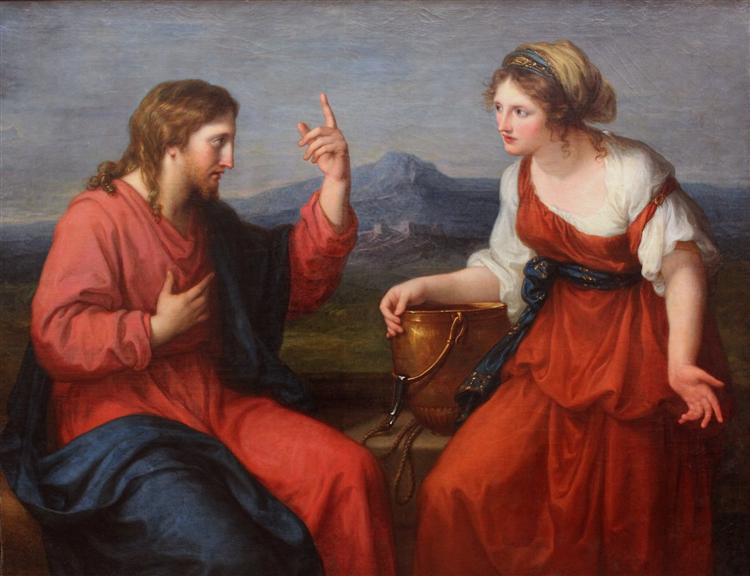
(1796)
Angelica Kauffman
Name Tags
Ninety nine percent of the world’s population could be saved by right reason and thinking out things in terms of categories. The remaining one percent I leave to the Devil on account of their desire to be brainless and so morally base.
There will always be, I suppose, that one percent of people who prefer not to think at all because their thoughts are all wicked and the deeds darker still. But for the most part (I am an optimist), people are good and tend toward good thoughts and sincerely believe their thinking is sound enough. But what I have found, after any extended conversation with my fellow man, is that people tend to think in terms of association instead of kind. Words become, not the depository or home of being or nature, but tags that people can place on things and ideas according to their own inclination, education, social class, or religious preference–or, more than likely–their romantic preference.
If we were honest, we would say to the sister “married” five times over, “You have no husband,” and we should hear from Heaven the words echoing in our ear, “Thou hast said well, she as no husband: For she hath had five husbands: and he whom she now hast, is not her husband.”
Thus, divorced and remarried people place the tag “husband” or “wife” on the person they happen to be living with at that particular moment in time, but tags fall off and get misplaced, and new tags are found, or new people to “marry.”
Likewise other words for other things. “God” is a good one, though what people mean by the tag I don’t really have an idea. Some people will say God is an artist who paints the sky every day. Okay, but then, if God is an artist, does that mean he made you as well as the sky? And if he made you, does that mean he has a plan for your life, a way to go about living it, and one which accords with reason, morals, and law? If God is an artist, he is also a legalist, because all art is a matter of law, insofar as law concerns itself with action in accord with right reason, and all art is a matter of right action. In other words, Art is action in accord with right reason to achieve an end.
But, people content themselves with calling God an artist and then go on with their lives without asking after moral theology or anything remotely constituting an inquiry into the purpose of their lives or how they ought to live or whom they ought to marry. “Artist” and “God” are just tags they place on fleeting feelings of sentimentality or movements of aesthetic appreciation of a colorful sunset. In a way, Chesterton was wrong when he said, “The worst moment for an atheist is when he is really thankful and has no one to thank.” Maybe that was true in Chesterton’s day when atheists actually existed, that noble race of thinking men who stuck to their rationality like a shoe sticks to chewing gum, and deduced that God couldn’t possibly exist because evil did exist, or that, because the world was by all empirical account merely material, there was no room for an immaterial deity. But today, that happy lot of atheists does not exist for the simple reason that imagination has replaced reason as the modus operandi of cognition.
Anything can be God, just as anyone can be one’s spouse, by an act of imagination, or the ability to see what is not actually there. This is done, again, to return to my idea of name tags, by placing a word on things or ideas or people that doesn’t belong, by the force of will, not by intellectual inquiry or discernment in the nature and cause of things.
What is the Church
Finally, then, we come to the idea or thing that is the Church, which is the best example of this kind of thing. People will call the Church a body of believers, or all the baptized, or all those subject to the pope. But the truth is, the Church is all these things.
Q. 489. What is the Church?
A. The Church is the congregation of all those who profess the faith of Christ, partake of the same Sacraments, and are governed by their lawful pastors under one visible Head.
This definition is not a tag we place on an institution. The definition discloses the essence, or what a thing is. Thus there are elements (formal components of a thing’s nature) that make up the Church:
The Church is:
- Congregation
- All who profess faith in Christ
- Partake of same sacraments
- Governed by lawful pastors
- Under one Head
The element of Congregation is pretty easy to figure out, and many churches or groups of people qualify under this element except for, perhaps, the Home Alone adherents, but that is to be expected, since,
“Strike the shepherd, and the sheep shall be scattered: and I will turn my hand to the little ones. And there shall be in all the earth, saith the Lord, two parts in it shall be scattered, and shall perish: but the third part shall be left therein. And I will bring the third part through the fire, and will refine them as silver is refined: and I will try them as gold is tried. They shall call on my name, and I will hear them. I will say: Thou art my people: and they shall say: The Lord is my God,” (Zech. 13: 7-9).
The next element, Profession of Faith, is a great sifter of false followers of Christ.
Q. 156. How shall we know the things which we are to believe?
A. We shall know the things which we are to believe from the Catholic Church, through which God speaks to us.
Q. 157. What do we mean by the “Church, through which God speaks to us”?
A. By the “Church, through which God speaks to us,” we mean the “teaching Church”; that is, the Pope, Bishops, and priests, whose duty it is to instruct us in the truths and practices of our religion.
Q. 158. Where shall we find the chief truths which the Church teaches?
A. We shall find the chief truths which the Church teaches in the Apostles’ Creed.
Q. 159. If we shall find only the “chief truths” in the Apostles’ Creed, where shall we find the remaining truths?
A. We shall find the remaining truths of our Faith in the religious writings and preachings that have been sanctioned by the authority of the Church.
Notice that the Church does not say that we should learn what we are to believe by following bloggers like Michael Matt or Steve Skojec or Mario Derksen or Robert Robbins, for that matter. We are to find those truths of the faith in the religious writings that have been sanctioned by the Church; and none better for basic instruction than the BC.
The next element is Partake of the Same Sacraments, which means what it says, and doesn’t mean more or less. For those who say Home Alone people are not Catholic because they don’t go to the Sacraments, they don’t know what they are talking about. Home Alone Catholics still get married and baptized, and those are the Same Sacraments that Catholics have always enjoyed the spiritual fruits of. True, not all the Sacraments are received by Home Alone Catholics, but that is not required by the definition of Church.
The last two elements are really one, Governed by Lawful Pastors Under One Head, because the pastors cannot be lawful without being under one head. For anyone who has read this blog long enough, you will know that the lawful pastors requirement really eliminates all the Novus Ordo clergy altogether, which may sound ironic, since the Novus Ordo clergy are farther from the Catholic faith than the Traditionalists and Sedevacantist clergy.
Q. 494. What do we mean by “lawful pastors”?
A. By “lawful pastors” we mean those in the Church who have been appointed by lawful authority and who have, therefore, a right to rule us. The lawful pastors in the Church are: Every priest in his own parish; every bishop in his own diocese, and the Pope in the whole Church.
No SSPX or Sede priest fits this definition of lawful pastor. Not one. Moving on.
The objection to Home Alone Catholics is that they must be governed by Pastors, otherwise they are not members of the Church. I think this is a worthy criticism, and it has led one very sincere and thinking individual back to the Novus Ordo because of it, Mr. Eric Hoyle, for whom I have only the highest respect. Still, I think that the necessity of “pastors until the end of time” and the element here of being subject to lawful pastors is conditioned on their actually being pastors in the first place. God doesn’t demand the impossible, and one cannot reason from what is in definition to what is in reality. In other words, essence does not prove existence. That one ought to be subject to lawful pastors in order to belong to the Church does not imply or prove that there are lawful pastors to be subject to. This is actually philosophical common sense, but, alas, too many people have exchanged their faculty of intellect for imagination and volition.
The second part of the last element is Under One Head, which the BC states as follows:
Q. 495. Who is the invisible Head of the Church?
A. Jesus Christ is the invisible Head of the Church.
Q. 496. Who is the visible Head of the Church?
A. Our Holy Father the Pope, the Bishop of Rome, is the Vicar of Christ on earth and the visible Head of the Church.
Thus, it is easy to see that Home Alone Catholics are still subject under the Invisible Head of the Church, Jesus Christ, High Priest in Heaven, but are not subject to the Visible Head of the Church, the Roman Pontiff, simply because there is no pope at this time; were there a pope, Home Alone Catholics would be subject to him foremost, because it is their devotion to the papacy which really separates them from the rest of the world. Novus Ordo people do not have any respect for the papacy as is evidenced by what low men they claim to be and to have been popes. The Traditionalists have no esteem for the papacy, because, in addition to accepting heretics as popes like the Novus Ordo people, they go beyond and bash the man in one breath and in the next call him Holy Father. And the Sedevacantists have so little regard for the Roman Pontiff that they usurp his authority and make bishops without his mandate, and exercise his universal authority throughout the world by operating mass centers and missions across the globe, just as if they were little wandering popes.
So, to conclude this post, I contend that what we need more than ever today is a return to categorial cognition, that is, to think of things in terms of what they are in themselves quite apart from what we imagine them or will them to be. This requires the use of the speculative faculty to be sure, to that part of our soul called the intellect whereby we discover the qualities of things as we observe them with our senses, and, connect those qualities to categories that have a definitive order or essence. Sound difficult? It isn’t, at least not as difficult as going through life with one’s head cut off or in the sand or in an iPhone.
Oh, and here is a quick primer on the Categories to get a sense of what I mean by categorial cognition.
 Catholic Eclipsed