The Politics of God

Tomorrow is Super Tuesday, or the day on which the majority of the United States holds its primary elections. Here in Illinois, where I live and work and vote, there are several races at the local and state level which are of interest. As a reporter, it is my job to be informed and to report on political movements within the territory I reside, and to have a sense of the issues, the people, the egos, the platforms, in a word, the politics of the place. But I can tell you with complete honesty, that after several months of being on the local political beat, even having a chance to sit down and talk to an incumbent U.S. Representative and his challenger, I go to the polls tomorrow with a sinking feeling in my gut, because I really haven’t a clue who it is I should vote for.

Cause of Voter Ignorance

The democratic system doesn’t work, at least not as it is practiced today. That is a shame to say, but it is true. In order for a democratic system to work today, there must be an informed voting body. Otherwise, the outcome to any election in which the man elected is unknown is a sham election, because the man voted for does not actually represent the people who voted for him. How does this happen? Simply put, this happens because newspapers are dying, and there aren’t enough reporters to talk about all the candidates.

Of course, I am not talking about Trump or Biden. Every news agency in the country talks about those two. But does your local newspaper talk about those running in your state senatorial race? What about your county commissioner race? Thought not. I know first hand, because of the handful of news publications in southern Illinois, I am one of two reporters in the newsroom, and I am the only one who has written a handful of political pieces in the recent past leading up to the primaries.

If voters are not getting their information about local politicians at the local level, where are they getting it? The answer is they are not. So the typical voter probably doesn’t even look down-ballot after the president and U.S. races. Maybe they know something of those who are running for state offices, but I seriously doubt it, because the Big Media isn’t really covering state news. Regional news outlets are, and those media outlets at the state level are stretched thin, and as you get down to the regional level, even more so, until you get to the town level, where there is usually an empty lot, and old sign, in other words, a mere memory of a paper long since dead.

Rendering Unto Caesar

I am currently reading a very fascinating account of Cicero’s life written by Plutarch, a Greek political biographer. In the book, you get a sense of just how corrupt men are, how back-biting, benighted by self-serving interests over and against the state, and how every man, including Cicero, were in the end either cowards or wicked villains. Cicero died within a few decade of the birth of Christ.

The point is, men are still like that. Politicians are still like that. Nothing new under the sun. If we are truly to render the just fruits unto Caesar, it should probably be with a sharpened sword. But the one among us without sin may thrust his dagger into Caesar first.

I know there are probably those reading this who think we should not vote. Presently, I think I am making the case we may have a good reason not to vote, at least not until we have educated ourselves about who it is we are going to vote for, since newspapers can’t do that for us anymore. Here I would like to offer a few practical moral considerations to answer the question how are we suppose to vote.

Who Should Receive Your Vote

The candidate who should receive your vote, in my own opinion–this is opining on the Apocalypse, not pontificating on the Apocalypse–is the candidate, be it at the county, state, or federal level, who you have researched to the degree that you can, which means you should be able to answer a few fundamental questions about that politician’s platform. For instance:

  • Does the candidate believe in the sanctity of life?
  • Does the candidate believe in the sanctity of marriage?
  • Does the candidate believe in the sanctity of the sexes, “Male and female He created them.”
  • Is the candidate reasonable, i.e., just, equitable, consistent in policies?
  • Does the candidate seem to support foreign interest more than national?
  • What is a basic recap of the politician’s voting record?
  • Is the candidate divorced? (Could the candidate govern a state or country well without looking after his own house?)

You will note that I do not ask you to consider the candidate’s political party. Democrats and Republicans, as they have been given to recently, are both morally bankrupt. Consider the scramble from the Right to quickly assure their American conservative constituency that they will work as hard as they can to ensure Americans can still have their cake and eat it, too, by having children through IVF while they let their unwanted children die in the refrigerator.

Nor am I saying one could ever really vote Democrat in good conscience. Is there even one Democratic candidate at any level of government who doesn’t support the sin that cries to heaven or the murder of babies? I don’t think so.

But vote we must as Americans. It is our civic duty to do so. Those who think it is not or will not vote because the 2020 election was a charade of democracy, you have my sympathy, because I agree it was. The evidence of widespread election fraud is undeniable to anyone who has watched the hearings actually airing out the evidence of physical voter manipulation or the data dump analysis and statistically impossible anomalies. But, still, to the best of our ability, we must vote in the primary and in the general elections.

We must, not because I think so, not because the constitution empowers and encourages us to do so, but because God Himself told us to.

Render therefore to Caesar the things that are Caesar’s, and to God the things that are God’s

Mark 12:17

The Vote

The vote is a piece, as it were, of the commonwealth. It is a share in the decision making power of a community. Imagine, then, members of a prodigiously large household having to take a vacation to one of three different but all very enticing resort destinations, say, one to the Bahamas, another to Alaska, and a third to Ireland, were each given a vote. Each then has a share in the good of the family, but only if exercised. If a member abstains, then they forfeit their share in determining the good of the family.

But, whereas we might be indifferent as to whether we go to Ireland or the Bahamas, we cannot be indifferent as to whether we allow open borders. We have to get off the fence and decide if fences or walls and borders make good neighbors or not. I am a member of that ever-dwindling body of believers who reason that if there weren’t borders, then there jolly-well needn’t be a country.

But, if you want a country, you need to have a border. Perhaps that is too subtle for the Left. If human zygotes are left in the freezer, that’s murder. Perhaps that’s too subtle for the Right. But Left or Right, we have to make a decision between the lesser evil. Since borders are man’s and babies are God’s, I know which side of the fence I stand on.
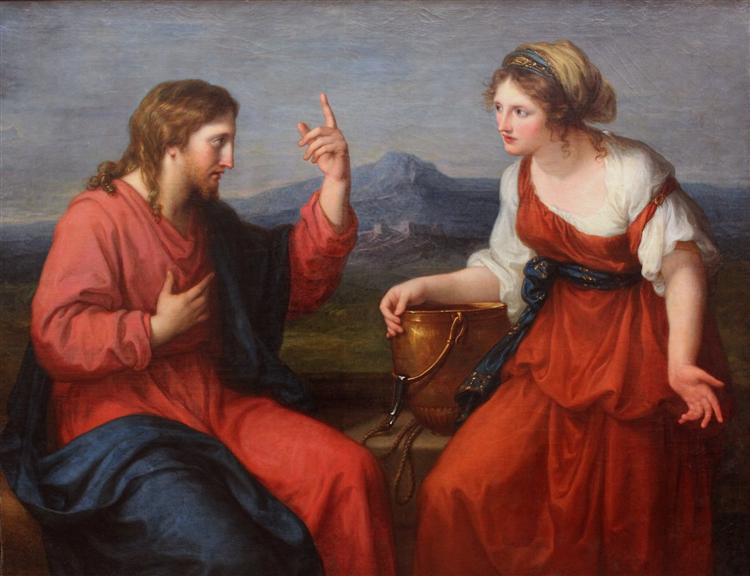
Wanted: Categorical Thinking

Christ and the Samaritan Woman at the Well
(1796)
Angelica Kauffman

Name Tags

Ninety nine percent of the world’s population could be saved by right reason and thinking out things in terms of categories. The remaining one percent I leave to the Devil on account of their desire to be brainless and so morally base.

There will always be, I suppose, that one percent of people who prefer not to think at all because their thoughts are all wicked and the deeds darker still. But for the most part (I am an optimist), people are good and tend toward good thoughts and sincerely believe their thinking is sound enough. But what I have found, after any extended conversation with my fellow man, is that people tend to think in terms of association instead of kind. Words become, not the depository or home of being or nature, but tags that people can place on things and ideas according to their own inclination, education, social class, or religious preference–or, more than likely–their romantic preference.

If we were honest, we would say to the sister “married” five times over, “You have no husband,” and we should hear from Heaven the words echoing in our ear, “Thou hast said well, she as no husband: For she hath had five husbands: and he whom she now hast, is not her husband.”

Thus, divorced and remarried people place the tag “husband” or “wife” on the person they happen to be living with at that particular moment in time, but tags fall off and get misplaced, and new tags are found, or new people to “marry.”

Likewise other words for other things. “God” is a good one, though what people mean by the tag I don’t really have an idea. Some people will say God is an artist who paints the sky every day. Okay, but then, if God is an artist, does that mean he made you as well as the sky? And if he made you, does that mean he has a plan for your life, a way to go about living it, and one which accords with reason, morals, and law? If God is an artist, he is also a legalist, because all art is a matter of law, insofar as law concerns itself with action in accord with right reason, and all art is a matter of right action. In other words, Art is action in accord with right reason to achieve an end.

But, people content themselves with calling God an artist and then go on with their lives without asking after moral theology or anything remotely constituting an inquiry into the purpose of their lives or how they ought to live or whom they ought to marry. “Artist” and “God” are just tags they place on fleeting feelings of sentimentality or movements of aesthetic appreciation of a colorful sunset. In a way, Chesterton was wrong when he said, “The worst moment for an atheist is when he is really thankful and has no one to thank.” Maybe that was true in Chesterton’s day when atheists actually existed, that noble race of thinking men who stuck to their rationality like a shoe sticks to chewing gum, and deduced that God couldn’t possibly exist because evil did exist, or that, because the world was by all empirical account merely material, there was no room for an immaterial deity. But today, that happy lot of atheists does not exist for the simple reason that imagination has replaced reason as the modus operandi of cognition.

Anything can be God, just as anyone can be one’s spouse, by an act of imagination, or the ability to see what is not actually there. This is done, again, to return to my idea of name tags, by placing a word on things or ideas or people that doesn’t belong, by the force of will, not by intellectual inquiry or discernment in the nature and cause of things.

What is the Church

Finally, then, we come to the idea or thing that is the Church, which is the best example of this kind of thing. People will call the Church a body of believers, or all the baptized, or all those subject to the pope. But the truth is, the Church is all these things.

Q. 489. What is the Church?

A. The Church is the congregation of all those who profess the faith of Christ, partake of the same Sacraments, and are governed by their lawful pastors under one visible Head.

This definition is not a tag we place on an institution. The definition discloses the essence, or what a thing is. Thus there are elements (formal components of a thing’s nature) that make up the Church:

The Church is:

  • Congregation
  • All who profess faith in Christ
  • Partake of same sacraments
  • Governed by lawful pastors
  • Under one Head

 The element of Congregation is pretty easy to figure out, and many churches or groups of people qualify under this element except for, perhaps, the Home Alone adherents, but that is to be expected, since,

“Strike the shepherd, and the sheep shall be scattered: and I will turn my hand to the little ones. And there shall be in all the earth, saith the Lord, two parts in it shall be scattered, and shall perish: but the third part shall be left therein. And I will bring the third part through the fire, and will refine them as silver is refined: and I will try them as gold is tried. They shall call on my name, and I will hear them. I will say: Thou art my people: and they shall say: The Lord is my God,” (Zech. 13: 7-9).

The next element, Profession of Faith, is a great sifter of false followers of Christ.

Q. 156. How shall we know the things which we are to believe?

A. We shall know the things which we are to believe from the Catholic Church, through which God speaks to us.

Q. 157. What do we mean by the “Church, through which God speaks to us”?

A. By the “Church, through which God speaks to us,” we mean the “teaching Church”; that is, the Pope, Bishops, and priests, whose duty it is to instruct us in the truths and practices of our religion.

Q. 158. Where shall we find the chief truths which the Church teaches?

A. We shall find the chief truths which the Church teaches in the Apostles’ Creed.

Q. 159. If we shall find only the “chief truths” in the Apostles’ Creed, where shall we find the remaining truths?

A. We shall find the remaining truths of our Faith in the religious writings and preachings that have been sanctioned by the authority of the Church.

Notice that the Church does not say that we should learn what we are to believe by following bloggers like Michael Matt or Steve Skojec or Mario Derksen or Robert Robbins, for that matter. We are to find those truths of the faith in the religious writings that have been sanctioned by the Church; and none better for basic instruction than the BC.

The next element is Partake of the Same Sacraments, which means what it says, and doesn’t mean more or less. For those who say Home Alone people are not Catholic because they don’t go to the Sacraments, they don’t know what they are talking about. Home Alone Catholics still get married and baptized, and those are the Same Sacraments that Catholics have always enjoyed the spiritual fruits of. True, not all the Sacraments are received by Home Alone Catholics, but that is not required by the definition of Church.

The last two elements are really one, Governed by Lawful Pastors Under One Head, because the pastors cannot be lawful without being under one head. For anyone who has read this blog long enough, you will know that the lawful pastors requirement really eliminates all the Novus Ordo clergy altogether, which may sound ironic, since the Novus Ordo clergy are farther from the Catholic faith than the Traditionalists and Sedevacantist clergy.

Q. 494. What do we mean by “lawful pastors”?

A. By “lawful pastors” we mean those in the Church who have been appointed by lawful authority and who have, therefore, a right to rule us. The lawful pastors in the Church are: Every priest in his own parish; every bishop in his own diocese, and the Pope in the whole Church.

No SSPX or Sede priest fits this definition of lawful pastor. Not one. Moving on.

The objection to Home Alone Catholics is that they must be governed by Pastors, otherwise they are not members of the Church. I think this is a worthy criticism, and it has led one very sincere and thinking individual back to the Novus Ordo because of it, Mr. Eric Hoyle, for whom I have only the highest respect. Still, I think that the necessity of “pastors until the end of time” and the element here of being subject to lawful pastors is conditioned on their actually being pastors in the first place. God doesn’t demand the impossible, and one cannot reason from what is in definition to what is in reality. In other words, essence does not prove existence. That one ought to be subject to lawful pastors in order to belong to the Church does not imply or prove that there are lawful pastors to be subject to. This is actually philosophical common sense, but, alas, too many people have exchanged their faculty of intellect for imagination and volition.

The second part of the last element is Under One Head, which the BC states as follows:

Q. 495. Who is the invisible Head of the Church?

A. Jesus Christ is the invisible Head of the Church.

Q. 496. Who is the visible Head of the Church?

A. Our Holy Father the Pope, the Bishop of Rome, is the Vicar of Christ on earth and the visible Head of the Church.

Thus, it is easy to see that Home Alone Catholics are still subject under the Invisible Head of the Church, Jesus Christ, High Priest in Heaven, but are not subject to the Visible Head of the Church, the Roman Pontiff, simply because there is no pope at this time; were there a pope, Home Alone Catholics would be subject to him foremost, because it is their devotion to the papacy which really separates them from the rest of the world. Novus Ordo people do not have any respect for the papacy as is evidenced by what low men they claim to be and to have been popes. The Traditionalists have no esteem for the papacy, because, in addition to accepting heretics as popes like the Novus Ordo people, they go beyond and bash the man in one breath and in the next call him Holy Father. And the Sedevacantists have so little regard for the Roman Pontiff that they usurp his authority and make bishops without his mandate, and exercise his universal authority throughout the world by operating mass centers and missions across the globe, just as if they were little wandering popes.

So, to conclude this post, I contend that what we need more than ever today is a return to categorial cognition, that is, to think of things in terms of what they are in themselves quite apart from what we imagine them or will them to be. This requires the use of the speculative faculty to be sure, to that part of our soul called the intellect whereby we discover the qualities of things as we observe them with our senses, and, connect those qualities to categories that have a definitive order or essence. Sound difficult? It isn’t, at least not as difficult as going through life with one’s head cut off or in the sand or in an iPhone.

Oh, and here is a quick primer on the Categories to get a sense of what I mean by categorial cognition.

A New Year as Dies Irae Draws Nigh

“The Last Judgment,” by Flemish painter Hans Memling in 1471.

Echoes of Former Glory

The other day I was watching my son play a new video game he got for Christmas, Halo Wars. For anyone who doesn’t know, Halo was the platform video game for the original X-Box, which came out when I was as old as my son, and has since produced a whole line of games associated with the first in plot, design, and music.

What is very interesting about the game is its nomenclature. There is the Covenant, Heretics, Prophets, the Flood, and other details and plot points which suggest an allegorical parallel with the Christian true-myth, as JRR Tolkien called it. But what most strikes one is the music.

The first theme that one hears as a galactic scene opens up on the menu is the Gregorian chant melody and orchestra theme. Here it is.

It is no exaggeration to say that video games are the new main medium of entertainment and high art, more so than paintings in museums, theaters, opera or drama works, novels, concert halls, etc. The reason is video games, like Halo, are all those things plus the immersive experience of being a part of the plot. Video games are the cultural repository of art and beauty.

While I watched my son play Halo Wars, I was struck by the music. The tune was so haunting and beautiful and seemed to suggest something directly to my soul I could not consciously articulate. Here it is.

I loved the key it was written in, which put me into a reflective and moody mood, contemplating the end of the world, end of everything good and bad and, had I really articulated my emotional response by intelligible words, I would have said I was pondering Judgment Day.

As it turns out, this song was written in e-flat minor, Dorian mode, which was also the same musical setting for the original plainchant melody of the Dies Irae sequence for requiem masses, which is here.

After doing a little digging, I discovered that this ancient melody was literally everywhere. It was to be found in classical music, of course, but also in popular works. Here is a list.

From Disney’s Frozen hit song “Into the Unknown” to “Making Christmas” in Nightmare Before Christmas, the medieval melody of Dies Irae is to be heard just about everywhere—well, almost everywhere. There is one place (apparently) where it doesn’t belong, and that is at funeral masses in Vatican 2 churches.

That’s because, following the reforms of the Second Vatican Council, the Dies Irae was removed from the funeral sequence of the requiem mass, supplanted, no doubt, by some banal Beetles-like pop music which bespoke of happier days ahead for the dearly departed.

Anyway, Archbishop Annibale Bugnini said why the sequence of happy and immemorial status in the liturgy was stricken from the hearts and minds of the faithful.

“They got rid of texts that smacked of a negative spirituality inherited from the Middle Ages,” Bugnini said, because Dies Irae “…overemphasized judgment, fear, and despair. These they replaced with texts urging Christian hope and arguably giving more effective expression to faith in the resurrection, (source).

Whether what replaced the text of Dies Irae is more effective in inculcating the virtue of faith in the resurrection is perhaps proved by the general collapse of faith in the resurrection since the Council. But what concerns me here is the utter inanity of the reformers to replace what has been called one of the most quoted pieces of music in history. Why would they do such a thing? If the text offended, rewrite the text. They rewrote other texts merrily and freely.

No, the reformers hated the influence that the majestic and powerful and beautiful Dies Irae had on the people, which infused into their hearts in an unconscious way what that Halo music infused into my soul—the sense of the world’s end and judgment.

The reforms of Vatican Two have taken away the mass, the music, and the Catholic culture, but they haven’t taken away our faith. We can still discover the beauty and richness of our birthright as Catholics by studying history and looking out for embers like the Dies Irae that still burn with Divine love in the darkness of this world, enflaming our hearts to faith in the resurrection of the dead to judgment.

Folk Music is No Shortcut to Culture

Nota Bene: Not designed by the “slime” of society.

Laura Wood of the ThinkingHouseWife blog posted this from a folk song book compilation. In it, the author asserts many things, but the point I want to address goes something like this: folk music is superior to today’s popular, commercial music, because yesterday’s music was made to be sung, whereas today’s music is merely made to be listened to.

Setting aside the devices, programs, and social settings in which hosts of people gather together to sing karaoke every week throughout this country and even upon the waves at sea—as I know first hand that even karaoke is performed on aircraft carriers underway—the thesis the author puts forth and which Wood supports is quaint at best and utterly devoid of intellectual merit at worst.

What follows is my first reply to the post, which you can read on Wood’s website, and then a followup which I have published here instead of emailing Wood. She may decide to post my second reply I make here over there if she chooses. Needless to say, the discussion on folk music gets at who we are as a people and touches the fundamentals of life and culture. It is an important discussion, which is why I have taken the time to address it.

Here begins my first reply.

I have read and listened to your recent post regarding folk songs with considerable delight. I am not entirely familiar with this genre of music beyond that instruction on its form and content I received in kindergarten, singing and dancing around chairs.

But thinking on your post a little more, I wonder what you would say about the utter dearth of contemporary folk songs—or is it that folk songs as such is a misnomer, since a melody and lyric do not spring up out of a people as such at all but must come into existence by a single creative mind?

What I am getting at is what “folk songs” are today, taken out of their historic context which gave them birth, are really just the popular songs of today sans record labels. That’s the only difference.

Tell me, what is the lyrical and melodic difference between “Home on the Range” and “A Horse with No Name”? I can’t figure one. Both are melodically simple and undemanding such that anyone could sing along. Both deal with general outdoorsy topics on the surface and existential issues beneath. Both are folksy, earthy, and simple songs that are sung by a popular majority and not a highly cultivated class. The only difference is the latter was created in our lifetime and has a copyright, whereas the former wasn’t and doesn’t.

I just think that the difference between folk songs and popular songs of today is not as clear cut as is supposed by the author, and that there are a lot of questions regarding the origins of folk songs if they are not simply copyrighted original creations by historical individuals time has forgotten the names of.

Here begins my second reply.

I think the points of doubt I raise still stand. Further research on the subject just substantiates what I said, viz., that so called folk songs originate—like “Home on the Range,” for instance, from individual artists and are subsumed into the public domain simply because they are not copyrighted. There is no difference musically and lyrically between a folk song and a popular country song of today. And what differences there may be are necessitated by the fact that art imitates nature, and our present day natures and society are just different—think of Jim Croce’s “Operator” song, incorporating the tragic loss of love with technology of the telephone. I suppose if he had written it by candlelight and spoke of his love through a postman it would be considered folk enough.

But I would like to ask if you yourself agree with your commenter’s following remark: “True democracy is CULTURE! From the slime, the lowest people, comes the brilliance of culture, the dress, the music, the architecture, the food.”

Your author and commenter seem to be under the impression that culture is the product of the lower and uneducated and, in a word, uncultured class. That is oxymoronic and false. Culture, in the sense of fine food, dress, music, art, and architecture, has always come by way of leisure. Now, how can the working poor classes afford leisure enough to be poets and gourmets, Amadeus Mozarts and Thomas Coles? And as for Catholic architecture, what kind of man does Mr. S think designed the architectural plans for the great cathedrals of Europe, the local brewer and potato merchant? 

What lurks behind the discussion of folk music is the idea that democracy in general and Catholic culture in particular is a product of the least common denominator. That is flatly false and disturbs the very order, which is hierarchical, of nature and reality and Catholic culture. If you want culture, if you want Catholic culture, you have to have three things at least: 1. Faith, 2. Education, and 3. Leisure. Those are the basic sine qua non ingredients of Catholic culture. Is it any wonder then there is so little Catholic culture today? 

But I deny that there isn’t culture. There is a lot of culture out there, perhaps so much so that we cannot discern it for what it is, because there is so much of it. Think of all the books, songs, paintings, food, dress, and any number of human creations being produced today, some things of exquisite make. Some are Catholic, but the sum of them are not to be equated with culture; but there are good things being made, things of beauty and goodness and truth if not of the Faith. But not one of them, I solemnly insist and assert, is being made by individuals without education (either formal or autodidactic) or without leisure. And that excludes about 99.9 percent of the population.

Folk music is just popular music. There is nothing special about it, nor anything of essential difference between it and popular music. Any assertion to the contrary is founded upon non-sequiturs. But neither was folk music produced by the ignorant masses but was created, as it is even today, by a set of highly skilled artisans of melody and word.

Obviously there is high culture and low culture, and I have talked about both in this post, because the cause of both is the same, leisure and eduction. If you want Catholic culture, you need to add the Faith. But whether we are talking about folk music, which is low culture, or opera, which is high culture, there remains the necessity of talking about musical theory, harmony, prosody, instrumentation, vocal technique, thespianism, and any number of other technical arts that are required to really pull off a good show. The majority of mankind can sing along to a song but cannot make a song.

Music is something very near and dear to me. I grew up with music in the air all evening long, where my father would blast the popular songs of the day from his little studio and bar room in the basement. So many popular artists and their songs became the soundtrack of my life, such that I did not want for any “folk songs” to sing along to, because I sang along to all the popular songs I heard–just as I am sure many of you reading did the same.

Since then, I have taught myself classical guitar for several years, and have learned to play a handful of concert-level pieces. Unfortunately, I can no longer play because my fistula makes my fretting hand stiff and unable to play longer than a few bars without burning. Since I can no longer play classical guitar, I have started to learn how to sing classically, which is to say in the style and technique of Bel Canto, which the folk music author no doubt would disparage as pretentious, insincere, and sophisticated. Then, again, I suppose a banjo player would think a classical guitarist pretentious, insincere, and sophisticated. But the point I would like to make is that beautiful music takes a lot of work–a lot of work. Truly great singing–like this–takes work, years of practice and mastering a technique.

Folk music of old is not a shortcut to culture. There is no shortcut to culture. It takes work, dedication and sacrifice to learn, develop and cultivate a culture. It doesn’t come naturally, and it doesn’t come from simply swinging your arms to and fro and shouting into the streets and stomping your feet to some merry old tune sailors sang drunk epochs ago. It comes from spending time with a technical body of knowledge, of an art and craft, and study and practice, and not a little inspiration, and sometimes a lifetime of service to its cause. All the great artists of old knew that. We don’t. That is why they were great and we are small.

Spooky Versus Scary: The Fight for the Spirit of Halloween

This is spooky not scary.

The soul of Halloween is up for grabs like a handful of gummy worms. The hedonistic heathens want Halloween to be scary. Catholics and other normal human beings prefer Halloween to be spooky. Some may think there is little difference between the two, but the reality is, nothing could be more opposed to the spooky than the scary, just as nothing could be more opposed to the body as the spirit.

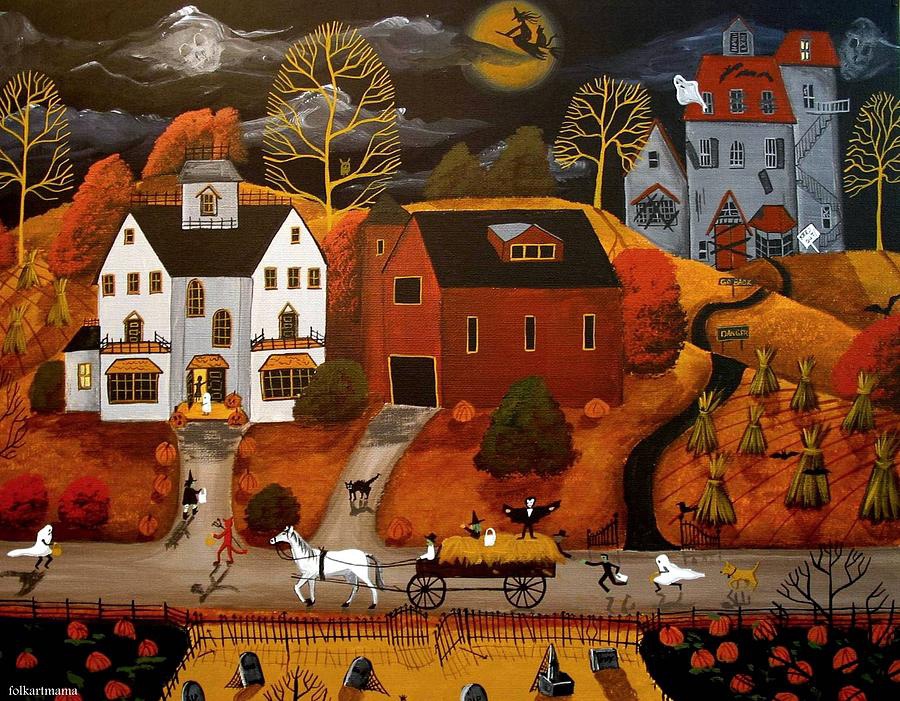
A harvest moon rises from a cloud over a hillside of corn, as a chill breeze rustles the leaves down an empty street, lined with trees hunched over crawling at the ground with bear branches. Glowing pumpkins grin as you walk door to door to trick or treat. The night is like a blanket you want to hide under but you cannot if you want candy. So you keep walking, keep knocking, until you’ve filled your bucket and received your reward.

That is a picture of spooky. Something more is suggested than the mere material causes of things. There is something meaningful in the sound of moaning wind. There is something to a harvest moon not reducible to the astronomical. There is a big secret behind all the facts of the senses, and Halloween seems to whisper the riddle’s solution a little louder than during other seasons. What that secret is only God and the Saints know—the damned know, too. The living must content themselves with shadows.

I will not paint you a picture of scary, because scaring people is immoral. I can only suggest that what I mean by scary involves bodily harm. That is the difference between being spooked and being scared. The fear of ghosts, of the unknown, is what is meant by spooky. The fear of physical pain is what is meant by being scared.

It is telling that Halloween has become more and more violent precisely when it has become more and more heathen. Without the doctrine of eternity, of an everlasting destiny of either Heaven or Hell, the only alternative is to emphasize the goods and evils of this world, of the sensual delights and agonies of the body. Hence, Halloween today is merely about murder and sex. It has become a hollow shell of its former substantial reality.

But Heaven and Hell do exist, and Saints and the damned are in their respective homes. We hang in the balance. Halloween hangs in the balance. I refuse to let Halloween be perverted by the heathen into something sensual and scary. Halloween is not a holiday about the body but the spirit.

So I plan to make this Halloween as spooky as I can for my children. I refuse to scare them, but I do want to propose an atmosphere of mystery and the eerie which tinges their souls with a fear of the unknown and not merely the painful. Perhaps if they are keen enough to the things of the spirit, they will hear the secret whispered by the moaning wind, by the skeletons, ghosts, and tombstones, that is, the secret of death itself.

The Garden of God

Garden of the Gods

There is a quote attributed to St. Augustine which says, “The nature of God is a circle whose center is everywhere and whose circumference is nowhere.” Whether that is an accurate attribution or not, the quote itself is quite astounding. The BC says it more pithily though:

Q. 166. Where is God?

A. God is everywhere.

Driving through the Shawnee National Forest yesterday on assignment to take photographs, I hiked to the best spot on the forest to see fall colors. There on the rock overlooking the world was a vista alive with all the colors of autumn, the beauty of God’s creation.

Afterward, as I made my way back to the Ranger Station, a thought came out of nowhere: God was present to me always: Just a simple thought, which did not insist upon itself too much, but which had the force behind it like an earthquake.

As little town and little hill and field passed by out my window, I looked out with that simple thought in mind. If God is everywhere, all things are present to God, all things, that is, are within His compass and control. Nothing happens unless He says so, not a single sunbeam streams through a cloud without His say so. That is a mystical thought.

Anyway, as I drove with these thoughts and questions in mind, another question passed through my consciousness: “What would you have me see,” to which God–He is the Eternal Jester–presented to my physical vision not a split second later the road sign named, quite literally, Catholic Church Rd.

Not a moment after that, I noticed St. Joseph Catholic Church just off the road. Now, I could have interpreted that thought and scene as signs that I should back to Church, return to a parish near me, and be a Novus Ordo Catholic again. I could have, but then I must understand the hierarchy of information. I have demonstrable evidence from the BC–the Rule of Faith–that the present Roman church is a false sect. I know that with certainty. So the very special vision I had yesterday could not have been mystical evidence in favor of a return to the Novus Ordo.

So what was the vision? I am thinking aloud here, but I think it was the affirmation that the simple thought with which I began was true, and that God was substantiating it by direct experiential evidence. God was revealing Himself a bit. There was a moment of time in which I could peak through the veil thinly concealing His awesome reality. I have had such experiences before, what I think Thomas A. Kempis calls the Divine Visitation. They are gifts, and I surely did not deserve such a visit.

“God is everywhere,” the BC teaches us. What do we make of that from day to day? How do we behave, what do we think, with that earthquaking thought? These are thoughts to ponder. A profound joy follows the Divine Visitation, which gives proofs of its origin. I encourage you all to give the BC lesson on God’s immanent locality time for thinking on it.

Whoever named the gem of the Shawnee had it all wrong. The better name would have been, The Garden of God, but then that name would have applied to everywhere.

Baltimore Catechism Now on CatholicEclipsed

Home Alone Catholic being examined on his catechism by the Church.

Harping on the Same Old Tune

For those who have been reading this blog for any period of time, you will no doubt be aware that I have relied heavily upon the catechism as the chief foundation and formation of the faith. And where else should I look for instruction?

Q. 159. If we shall find only the “chief truths” in the Apostles’ Creed, where shall we find the remaining truths?

A. We shall find the remaining truths of our Faith in the religious writings and preachings that have been sanctioned by the authority of the Church.

The Baltimore Catechism is one such document that has been sanctioned by the authority of the Church. It is true that there are many good and holy things to read out there, and I am not one to say we should only read the catechism. But I have encountered far too much error, far too much deviation from the teachings of the Church, from far too many “learned” people, even those with a website and hundreds of web articles to their names, not to insist upon a return to fundamental and simple truths found in a catechism.

I harp on the same old tune of the catechism for the same reason that I recite the rosary over and over or sing the Salve Regina over and over or do anything else of our holy religion repetitively. I do so because that is what Mother Church would have me do. I can honestly say I do not have the catechism memorized. Not even close, and I probably never will. That is difficult to do as an adult. But it was the expectation of the Church for children to learn their catechism by heart, and to be able to recite verbatim their lessons, say, on the Trinity.

So I will not say that those reading this–presumably adults, probably even middle-aged or older–must learn their catechism by rote. But I do insist that one should become intimately familiar with all the lessons of their catechism, to take time throughout the weeks of one’s life, suitably on Sunday, to read a lesson, meditate on it, and think on it often throughout the work-week.

To help facilitate that end, I have taken the time to do what I should have done a long time ago. I have put the complete Baltimore Catechism on this website as its own page, which you can access through the main menu.

Knowing our catechism has always been the duty of Catholics, but today when the crisis of faith has reached a pitch of intensity rivaling the shrieks from Hell, it is infinitely more incumbent upon us as Home Alone Catholics to study and even memorize what we can of our catechism. How shall we combat the error, for instance, of those who say that Sedevacantist chapels are licit in the time of necessity? The BC answers:

Q. 1004. Can bishops, priests and other ministers of the Church always exercise the power they have received in Holy Orders?

A. Bishops, priests and other ministers of the Church cannot exercise the power they have received in Holy Orders unless authorized and sent to do so by their lawful superiors. The power can never be taken from them, but the right to use it may be withdrawn for causes laid down in the laws of the Church, or for reasons that seem good to those in authority over them. Any use of sacred power without authority is sinful, and all who take part in such ceremonies are guilty of sin.

No Sedevacantist clergy were ever authorized and sent by their lawful superiors to administer the sacraments. That is the death knell for all the independent chapels and missions operating outside of Rome. Further, the BC states “Any use of the sacred power without authority is sinful,” which covers even those times of necessity.

What about the Recognize and Resist (R&R), the Remnant, OnePeterFive, LifeSiteNews, and such like? How does the BC respond to those who say authority must be recognized but resisted if that authority errs or legislates what is unlawful or harmful?

Well, actually, there are two glaring errors here, both of which are about as un-Catholic as Martin Luther. The first is that the Catholic Church could possibly legislate anything harmful or erroneous. The BC states:

Q. 528. How do you know that the Church can not err?

A. I know that the Church can not err because Christ promised that the Holy Ghost would remain with it forever and save it from error. If, therefore, the Church has erred, the Holy Ghost must have abandoned it and Christ has failed to keep His promise, which is a thing impossible.

The Church can no more err in faith or morals as a lead balloon could fly. It defies the laws of spiritual physics. Because the Church is the Mystical Body of Christ, it is blasphemy to say, as the R&R crowd do say, that the Roman Pontiff and the Second Vatican Council taught error.

Q. 572. From whom does the Church derive its undying life and infallible authority?

A. The Church derives its undying life and infallible authority from the Holy Ghost, the spirit of truth, who abides with it forever.

The second error of R&R is the idea that one can resist a legitimate authority. The BC defines authority as follows:

Q. 523. What is authority?

A. Authority is the power which one person has over another so as to be able to justly exact obedience. Rulers have authority over their subjects, parents over their children, and teachers over their scholars.

Q. 524. From whom must all persons derive whatever lawful authority they possess?

A. All persons must derive whatever lawful authority they possess from God Himself, from whom they receive it directly or indirectly. Therefore, to disobey our lawful superiors is to disobey God Himself, and hence such disobedience is always sinful.

Q. 525. What do you mean by the authority of the Church?

A. By the authority of the Church I mean the right and power which the Pope and the Bishops, as the successors of the Apostles, have to teach and to govern the faithful.

Anyone who knows their catechism couldn’t fall for R&R because it is intrinsically non-Catholic. It is Catholic to submit to legitimate authority like a pope, bishop or priest, because these are lawful superiors, and to disobey them would mean disobeying God.

The only reasonable conclusion to make is that the Second Vatican Council was not Catholic, because we know the council taught error which is a thing impossible for the Catholic Church but quite within the realm of possibility for a non-Catholic sect headed up by a non-Catholic heretic.

Q. 547. In whom are these attributes found in their fullness?

A. These attributes are found in their fullness in the Pope, the visible Head of the Church, whose infallible authority to teach bishops, priests, and people in matters of faith or morals will last to the end of the world.

It defies Catholic Sense to say John 23, Paul 6, JP2, B16 or Francis 1 are possessed with the infallible authority to teach the Church in faith and morals when these men have done all they can to spread error in the faith and promote false worship.

I could go on and on refuting the errors of the day from the BC, and no doubt I shall continue to do so in future posts as long as my fingers are able to type. But my point here is that we have to have a firm grasp of the fundamentals of the faith before we can profess to know or to teach or to dispute with the heretic, apostate, or infidel.

May God reward a prayerful study of the catechism with grace and wisdom enough to fight the good fight and keep the faith till the end.

BC Logo

The Catechism as Map

Finding Our Way Out of the Woods of the Apocalypse

Once there was a Boy Scout group backpacking in the forest with their leader who, I am sorry to say, broke his leg and died because infection.

The Boy Scouts were in a bad way, having no idea where they were. Some thought they knew where to go to get out of the woods, following streams or paths, but others weren’t so sure.

After much deliberation, with factions formed, some in favor of streams, others paths, and still others in favor of smoke signals and staying jolly put, a quiet little boy raises his hand amidst the throng and meekly proffers what appears to be a mere piece of paper on which is scrawled some lines.

The eldest of the troop comes over to the little boy and asks what the heck he thinks he is doing. The little boy answers that it might be a good idea to use the map which fell out of the leader’s pocket when he fell down and broke his leg or whatever.

This not so well crafted moral tale has a moral. There are those with whom I meet here online who have their own ideas about the Apocalypse, and about what is going on, and other theological or prophetic speculation not unlike the boys who wanted to find a way out of the woods by following trodden paths or streams.

But I tend to think that kind of thinking is tricky and ultimately lands one in Protestant territory, if not in profession at least in spirit. That explains why there have been a few people who subscribe to the idea that there hasn’t been a pope since Pius IX or that Baptism of Desire is heretical or that marriage before non-Catholic witnesses is invalid.

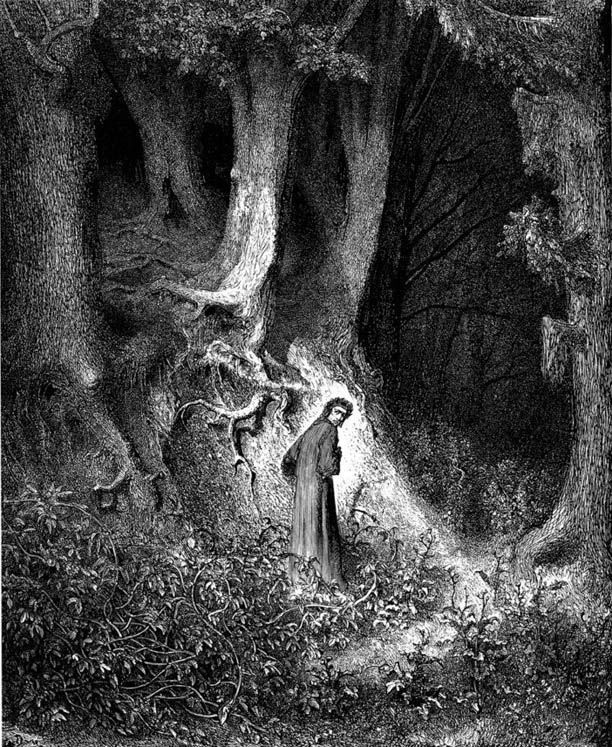
Instead of consulting the map left by the leader, the catechism, which defines in clear delineation and definition the things we are to believe and do to save our souls and get out of the “forest dark,” people follow winding streams or paths deeper and deeper into the gloom of the wood, where the light scarcely falls.

We have a map. Let’s use it. Instead of going off in search of the way, let’s just use the way given to us, the way that was written for us laity, to understand what we are to do today. Will every single question we have be answered? No, but then not every question asked is important. But the catechism—make it any you please, just pre-1958–will serve you better than any other text to learn your faith.

Home Altar for the Home Alone Catholic

Home Alone Catholics Need Home Altars

Home altars are vitally important to the spiritual health of our family. When we gather together as a family at the home altar, we show God that we are willing to be present in public worship, to offer prayers to God in communion with each other. This post is as much a reminder of that for myself as it is for those who may be reading this.

Many try to answer to the crisis in the Church–and anyone who is sufficiently catechized is well aware of the nature of the crisis–by offering solutions that don’t work and aren’t Catholic. Over at TheThinkingHouseWife, Laura Wood said it well when she said, “This is all the inevitable unfolding of the principles of Vatican II and of a false hierarchy, which has abdicated its authority. The only answer is to pray at home, availing ourselves of Spiritual  Communion and Acts of Perfect Contrition, — avoiding the false solutions of Traditionalists who set up chapels without any authority and the blatant schisms and heresies of “Orthodoxy” or Protestant sects.”

We can’t be Sedevacantist chapel goers, offering prayers to God through illicit clergy. That won’t do. And it goes without saying we can’t go to Orthodox chapels unless we fancy being schismatics. And Protestantism is enticing to those who think Christian worship can be reduced to pop melodies and sugary-sweet lyrics about God, but for people who think that divine things are somehow sacred, that won’t do either.

What is needed, then, is a space and place to offer to God public acts of worship even if that is done in private. The answer, of course, is a home altar. Here we can offer to God our thanks for His daily blessings, as well as offer our tears and petitions, and, above all, we can offer praise and worship through St. John’s Mass (links are not endorsements!) and the Holy Rosary.

I said that this post was as much a reminder for me as it was information for you. You see, I have been neglecting my public prayer with my family ever since I started working. I really commend those working men who can be the spiritual leaders of their families as well as the breadwinners. It is a difficult juggling act. The cares of the world pull on a man’s mind away from the spiritual necessaries by the demand of the physical necessaries. That is why a home altar is so important.

Our home altar (featured above) is placed in the middle of our home really. It isn’t tucked away in some corner of the house, which would be ideal for contemplative prayer and devotion to be sure. Our altar is front and center, and harkens to us to come there and offer prayer throughout the day. The Angelus is a good prayer practice to get into, because it is traditionally said three times a day.

We pray the Mass of St. John, which is really just the offertory and spiritual communion, on Sundays as a family. And we pray the Rosary on Sunday as well. We used to pray the Rosary every day, and do so always at the altar, but it has become increasingly more difficult to pray the Rosary daily since our cares, worries, and work have increased–we as a family we tend more toward Martha than Mary:

“Or by Mary who sat and heard our Lord’s words, is signified the contemplative life; by Martha engaged in more outward services, the active life. Now Martha’s care is not blamed, but Mary is praised, for great are the rewards of an active life, but those of a contemplative are far better. Hence Mary’s part it is said will never be taken away from her, for the works of an active life pass away with the body, but the joys of the contemplative life rather begin to increase from the end,” (St. Gregory).

How to Furnish Your Home Altar

Whether we are called to the active or the contemplative life, however, we all need a home altar as Home Alone Catholics. The number one most important thing that we can furnish our home altars with is devotion. The second is candles–you simply cannot have a Catholic altar without candles. Wax candles get expensive, so think about investing in electric candles. Your kids will love changing out the dim ones for bright ones every evening–you have to do it during the evening because that way the light is fresh and bright all through the night for anyone who may want to sneak over to the altar for a midnight votive offering.

In addition to devotion and a good set of electric candles, or wax candles if you have the cash, is a bell and incense. “The devil hates everything beautiful and the bells are specifically used to draw attention to the divine worship of God,” (An Exorcist Explains Why the Devil hates Bells So Much). There is something enchanting about the sound of a bell ringing over the crying of an infant or the washing of dishes in the sink. Get a good bell, one which has a silvery smooth ring to it. Ours is a cheap one, but it has a solid ring to it which can be heard throughout our home, even through doors and the noise of rambunctious children.

I do not know much about incense other than that I use frankincense and myrrh and charcoal and a brass censer. I do not know why, for instance, incense tends to transport my soul from time and place into the Holy of Holies like a wormhole or something. But it does. If you have never prayed with incense at home, do. It will change everything.

The altar itself can be something actually like an altar or just a table. Children will appreciate an altar that is shorter as will short adults, so think about that when picking out the best piece of furniture to offer your daily prayers at, preferably while kneeling–because that is what Catholics do.

To keep your altar fresh and inviting and decorative throughout the year, consider alternating between the seasons on each Ember Day. We have pumpkins, leaves, and autumn decor in our baskets right now. The kids love to arrange them. Our winter baskets are especially splendid and charming. The baskets beautify the altar but they also allow the contemplative soul to ponder the meaning of pumpkins, and other fruits of the Earth, while praying: “If you do not think it extraordinary that a pumpkin is always a pumpkin, think again. You have not yet even begun philosophy,” (Miracles and Modern Civilisation).

And one more thing: don’t forget the Crucifix.

I hope I have made it sufficiently plain (if to no one else then at least to myself) why home altars are indispensable to Home Alone Catholics today and how fun they can be. Please share your own ideas of your home altar in the comments section.

What and Where is the Catholic Church?

The following email was sent to me by a thoughtful and faithful Catholic man named simply Mark. He has some interesting ideas about the Church today which invite reflection and discussion. I post his email here in hopes that readers will wrestle with the ideas presented here, namely, what the Church is and where it is. Oftentimes we modern people see the world in terms of visible realities—what Mark says in his own idiosyncratic way as “sentient.” Instead, we should ask what the Church is in terms of the invisible reality that is far more powerful and essential to the structuring of reality itself than matter, e.g., fine silken cloth for vestments, carved oaken furniture for altars or chairs, or marble, brick, and stone of church buildings versus supernatural life of grace by which the will and intellect of man is moved toward God and the good. Doing so we will be more on our way to see by faith instead of human sight, and so see the signs of the times and prepare ourselves for the Bridegroom.

Mark writes:

Almighty God so willing, we will now continue in finer clarity. Amen. “What and where is the Church today?” Your website gets no traction not because it is not utterly compelling to read, or listen to, rather because there are no authentic Christians/Catholics (as the terms are comingled from their metaphysical essence) left to find interest in the reading of truth, as all but all are simply not who they believe themselves to be, with their itchy ears, most basically understood then as,- we are now living the greatest preternatural deception,- while at the summa and summit of the power of Satan, allowed for by Almighty God, this world has ever known or will know. Amen.

Now then, to develop intellectively this reality of the magnum opus of satanic deception, which we have lived and are living since 1958 October, while under, “…the operation of error to believe lying:…” (2 Thess 2:10), we have to be utterly cognizant of separating the accidents from the substance, with pristine clarity in our minds, of the 2 realities (that is the Church conceived by the Son of God and the other church instituted by not the, “miracles”, as their genesis is divine, rather, “…according to the working of Satan, in all power, and signs, and lying wonders.” (2 Thess 2:9), while worked through his Antichrist as the efficient cause, in the sentient understandings perceived) as they actually are, while properly understood metaphysically from their potency and act, matter and form. With that foundation then, we know as a matter of divine revelation the quid of the thing which Christ Jesus deemed, His Church. Amen.

   To answer now directly this query, as to the quid of the thing we call the Church, conceived by the Son of God and instituted under the power of His Holy Ghost, we contemplate the Holy Magisterium, perpetual in its esse’.  The One Holy Roman Catholic and Apostolic Church is now, as She was then (prior 28 Oct. 1958), and will be unto the Second Coming, perfectly preserved as immutable and impregnable in Her Substantial form.  Period and end.  We know this with apodictic certitude as infallibly taught in, “Satis Cognitum”.  We turn now then to His Holiness Pope Leo XIII, 29 June 1886, section 3., “Satis Cognitum”:

       “And, since it was necessary that His divine mission should be perpetuated to the end of time, He took to Himself Disciples, trained by Himself, and made them partakers of His own authority.  And, when He had invoked upon them from Heaven the Spirit of Truth, He bade them go through the whole world and faithfully preach to all nations, what He had taught and what He had commanded, so that by the profession of His doctrine, and the observance of His laws, the human race might attain to holiness on earth and never-ending happiness in Heaven.  In this wise, and on this principlethe Church was begotten(all color emphasis mine).  If we consider the chief end of His Church and the proximate efficient causes of salvation, it is undoubtedly spiritual; but in regard to those who constitute it, and to the things which lead to these spiritual giftsit is external and visible.  The Apostles received a mission to teach by visible and audible signs, and they discharged their mission only by words and acts which certainly appealed to the senses.  So that their voices falling upon the ears of those who heard them begot faith in souls-‘ “Faith cometh by hearing, and hearing by the words of Christ” ‘ (Rom. x., 17).  And faith itself – that assent given to the first and supreme truth – though residing essentially in the intellect, must be manifested by outward profession – ‘ “For with the heart we believe unto justice, but with the mouth confession is made unto salvation” ‘ (Rom. x., 10). In the same way in man, nothing is more internal than heavenly grace which begets sanctity, but the ordinary and chief means of obtaining grace are external: that is to say, the sacraments which are administered by men specially chosen for that purpose, by means of certain ordinances.”

And now as to the ubi of the thing we call, “The Church” (as yet section 3. “Satis Cognitum”, continued)

  “For this reason the Church is so often called in Holy Writ a body, and even the body of Christ – ‘ “Now you are the body of Christ” ‘ (I Cor. xii., 27) – and precisely because it is a body is the Church visible: and because it is the body of Christ is it living and energizing, because by the infusion of His power Christ guards and sustains it, just as the vine gives nourishment and renders fruitful the branches united to it.  And as in animals the vital principle is unseen and invisible, and

is evidenced and manifested by the movements and action of the members, so the principle of supernatural life in the Church is clearly shown in that which is done by it.”

And so there we have it, dear Robert, as to both the quid and the ubi, of the thing we know as the Catholic Church, and with apodictic certitude, to be precisely as pristinely just exactly what and where She is, and to the iota of the iota, without a singular movement of change in Her Substantial reality as Her foundation, since conceived by Christ Jesus and instituted then by His Holy Ghost. Amen. Alleluia. One more small part then from, “Satis Cognitum”, now section 15., so as to give you apodictic certitude, while in pristine clarity, as to this common query of, “but I thought we had to have a Pope until Christ comes again on the Last Day?”. And now Pope Leo XIII, from section 15., Satis Cognitum: “….But it is opposed to the truth, and in evident contradiction with the divine constitution of the Church, to hold that while each Bishop is individually bound to obey the authority of the Roman Pontiffs, taken collectively the Bishops are not so bound. For it is the nature and object of a foundation to support the unity of the whole edifice and to give stability to it, rather thanto each component part; and in the present case this is much more applicable, since Christ the Lord wished that by the strength and solidity of the foundation the gates of hell should be prevented from prevailing against the Church. All are agreedthat the divine promise must be understood of the Church as a whole, and not of any certain portions of it. These can indeed be overcome by the assaults of the powers of hell, as in point of fact has befallen some of them.”
And so, before I close for now, dear Robert, let us sum up what has been achieved in this response to your two questions of, “what and where?”. There are now, and since 28 October 1958, two churches in the sentient cosmos which call themselves, “Catholic”, while at once one of them actually is the Church conceived by the Son of God, and this One yet finds its wellspring in His Substantial Being, as Being Himself, as His Mystical Body and Bride, as it always has and will, as the, “Church”, was never found in a building, rather it has always, everywhere, and only, been found freely in the operation of the will of those who have received, and are yet receiving, the perfectly gratuitous Gift of the supernatural virtue of the divine and Catholic Faith. Amen. Alleluia. This One True Church no longer controls the metaphysical accidental forms of what once were the sentient aspects of Christ’s Church, while they indeed were aspects of Her sentient reality for 1958 years, from Her institution at Pentecost unto the loss of Her Juridical as Hierarchal aspect on 28 October 1958. Amen. We know with apodictic certitude that this Church is known, while in the sentient material reality, as infallibly taught by Pope Leo XIII, and as follows, while first quoted above, and now again: “the principle of supernatural life in the Church is clearly shown in that which is done by it.” Thusly, we know that the Catholic Church today, as prior October 1958, and unto the Second Coming, is known by the acts of those who belong to Her: “…and for Thy sake I also love my neighbour as myself. I renounce every thought which is contrary to that love of one another, by which men are known to be the disciples of Thy Son; I forgive all who have in any way injured me, and I beg Thy grace and mercy for all the world.” (Manual of Prayers for congregational use. Imprimatur: V. Cantineau, Vic. Gen., 27 April 1923). Amen. Alleluia. As our Blessed Lord and Redeemer, the Christ commands: “By their fruits you shall know them” (Mt. 7, 16). And further then, “A good tree cannot bring forth evil fruit, neither can an evil tree bring forth good fruit. (Mt. 7, 18). Every tree that bringeth forth not good fruit, shall be cut down, and shall be cast into the fire. (Mt. 7, 19). Wherefore by their fruits you shall know them.” (Mt. 7, 20)
Lucifer’s trick, dear Robert, is to get us to think of Christ’s Church as though it is a physical place, as though the Mystical Body of Christ, His Bride, is actually composed of those metaphysical accidental forms of the buildings, garments, sacramentals, etc. over the entire world; those same objects that were occupied and used by Catholics the world over, when the Vicar of Christ was present in this world, as he was the visible sign of the Unity of Faith and the Unity of Communion in the public sphere, in this now barren and desolate world. Amen. The supernatural society of Heaven on earth, NEVER HAS BEEN a place, rather there were only places where those who held the supernatural virtue of the divine and Catholic Faith could gather, for the proper public worship of Almighty God, while under the absolute Authority of the Vicar of Jesus Christ. Amen.Analogically, and as you well know, we eat the flesh of the cow, yet we do not become the cow. The substantial form of the beast remains, while the material reality is consumed, taking upon itself then, the substantial form of the one who consumes. In like kind, the buildings never were, nor could they ever be, the Catholic Church in se, as they were only the sentient realities of the Church. They no longer belong to Christ’s Church, as they have been passed on, as the flesh of the cow, yet and of course, the Substantial Being of His Church is Him, as it could only ever be. Amen. Alleluia.