It has been awhile since my last post. Since I have been busy trying this whole working man thing, I have had little time for the blog. The reason is, I suppose, that I feel sometimes as though either I have said all that needs saying or there aren’t really many people out there who are so radical as to be actually Catholic.
Be that as it may, I did want to slip on here and type out a quick post to say hello, and to offer a word of caution regarding this website as well as others.
You see, when we decided to stay away from non-Catholic clergy, and by extension non-Catholic fellow parishioners, we laid upon ourselves a heavy burden, one which our Lord in the desert felt so immensely we could hardly compare or comprehend. His friends were the Angels in his isolation. Do we befriend the Angels in our isolation and desert walk?
There is a danger that, in separating ourselves from the false communion of non-Catholics, clinging to God, His Church, and true doctrine, we become so self-referential and isolated and lonely that, if we do not become crazy, we drift back to the Novus Ordo parish nearest our house, for nothing other than the hospitality and friendship awaiting us there.
I will not say these are bad. We were made for each other, human beings, and we do not thrive and become happy separated. Still that does not mean we have to surrender our religious principles. Let me explain.
All of us, from the lonely old man to the young lady, we all have habits of mind and hobbies we enjoy. We like to think about things, and do things that we are good at or would like to. I know among you with whom I have corresponded over the years that there are musicians, poets, historians, artists, and so much more.
If you feel lonely, do not seek out comfort where you are to compromise your holy religion. Go to where there are other commonalities. Cultivate friendships with fellow artists or musicians. Start up a historic society in your town with monthly meetings at your library. In sum, get out there. But don’t return to the place you are surely to lose your soul or wrack up years in purgatory through spiritual lethargy inculcated there!
Another word of warning. Do not depend upon websites and website personalities—even like this one—to fill that human contact void. The danger is, if and when an error, sometimes a very grievous error, is published on a website you very much like the author of, you will think the error less than, or not an error at all, and be deceived into thinking a lie.
That is the danger, that in your isolation as a Home Alone Catholic, you may succumb to the wiles of a cult leader. I need not name names. I myself may be that cult leader for you, which I would rather delete this website than let happen. I only keep it up because I think the risk of that is relatively low, since I try to keep things at a very low threshold of intellectual demand, so people don’t get confused and so I don’t make any of those grievous errors.
Home Alone means home alone. We may not have any real Catholics nearby to commune with, and those on websites may be compromised for one reason or another. But that doesn’t mean we cannot have a kind of secular communion with our neighbors who may like backgammon or cribbage as much as we.
So, if you are feeling lonely and isolated in the desert this Lent, good! It means you are closer to imitating our Lord. But don’t think it is a compromise to your Catholic faith to be a friend to a non-Catholic.
Besides, it might just be an opportunity to evangelize.
One “wokism” which the world is enthralled with is cultural appropriation, and socially crucifying anyone who does it. But the one culture which has any rights to be up in arms about any inappropriate appropriation of its identity is the one culture as silent as a lamb – while the rest of the cultures of the world howl like she-wolves in the outer dark.
For those who don’t know, cultural appropriation is when one culture, say, a predominately white European American culture, calls its team mascot by the name of another people, or uses images associated with that people – even when that people is native to the land of said white European American culture. This habit of copying or using other cultures is considered a kind of exploitation, especially when it involves the religious symbols, fashions, language or music of a people.
One hot-topic item has been the exploitation of the Native American warbonnet, a ceremonial headdress worn by decorated and honored Native Americans. As one Cherokee academic, Adrienne Keene, said in The New York Times, speaking of non-Native Americans wearing warbonnets:
“When it becomes a cheap commodity anyone can buy and ear to a party, that meaning is erased and disrespected, and Native peoples are reminded that our cultures are still seen as something of the past, as unimportant in contemporary society, and unworthy of respect.”
Keene has a point. Surely sacred garments, or anything sacred of a culture, shouldn’t be reduced to a “cheap commodity,” because the sacredness of the artifact is reduced to insignificance. Perhaps it would be wrong of the world to commercialize Christmas, that is, Christ-Mass, or decorate Easter eggs, the symbol of the Resurrection, or exchange St. Valentine cards, host Halloween parties, or, heaven forbid, wear green t-shirts in remembrance of Saint Patrick who vanquished Irish paganism from the green Isle over 1500 years ago.
I could go on and talk about how the world has stolen so much more from Catholic culture, like hospitals, universities, science, law, art, and, well, everything else in Western Civilization, only that would be foolish, because these things were not stolen by the world but given to the world by God through the Church. The Catholic Church, unlike wokism, is very generous with its gifts of grace.
Saint Patrick, for instance, was given to Ireland – and eventually the world – by God in the fifth century, to liberate the Irish culture from false gods like Crom Cruach who demanded human sacrifice. One religious symbol of Saint Patrick’s spiritual conquest of Ireland is the shamrock.
Friday March 17 marks the death and feast day of Saint Patrick. Even as early as the end of February, shamrocks began to sprout up, as by magic or miracle, in grocery store checkouts. But this clover becoming a universal symbol for everything Irish is not understood absent any mention of the Holy Trinity – the only reason for its significance at all. Without the Catholic Faith in the Holy Trinity, the shamrock is a piece of grass or weed, hardly the stuff of cultural iconography.
So, come Friday please attend a St. Patrick’s Day parade and party, and wear green and wave your shamrocks and drink beer – which the monks saved for you, by the way, from the dark ages – as much as your heart’s desire. As a Catholic and not a “wokester,” I don’t mind a wink. That’s because beer, shamrocks, and the color green don’t belong to me, but the Catholic Church which gave these things significance and gave them as gifts to an ungrateful world.
Come to think of it, Saint Patrick doesn’t belong to the Irish, either. He belongs to God.
The Lord commanded us to love God and to love our neighbor as ourselves. We were told that all the law is based on these two commandments. But, there is another law everyone ought to equally obey, and that is, Thou shalt talk to thy neighbor.
This past Sunday, I was strolling my son around our little neighborhood, and, having successfully seen no one along the way, I was turning the corner for home when I caught sight of my neighbor working on his truck. Instantly a sense of discomfort shot through me like a syringe of icy saline, for I noticed that he noticed me and was prepared – against all common decency and unspoken mores – to stop and talk to me.
I am not shy. I do not find talking to people difficult – I am a journalist after all. But when it comes to talking to neighbors, I get queasy in my stomach, like I am a little boy talking with a new old uncle. Why is this?
One reason might be that, just like the old uncle, the neighbor knows a little (or a lot) about me, even though he hasn’t met me, unlike a complete stranger on a bus or at a grocery store, who knows no more of me than Adam. There is a loss of privacy with our neighbor, which makes talking a little awkward, since we think we know something about each other already, and we know they know something about us. We observe our neighbors closely – it is something of a habit or hobby of mine, though I seldom if ever talk to them. When we do, though, we learn that no amount of observation prepares us for what we might learn in a five minute chat on the street.
I learned of my neighbor what I could not possibly discover by observation – or on Halloween. I learned his name, for starters, his age, and that he was retired from the Navy, just like me! He was a medical deep sea diver. And just watch “Men of Honor” to get an idea of how awesome Navy divers are – a lot more awesome than Navy journalists, let me tell you. I also learned that he was a truck driver, and had moved to the area because his daughter wanted him and his wife to move to the area. He met his wife in the Navy, and she was a medical corpsman, too. He lived in the deep south, Mississippi if I recall correctly, but you couldn’t tell it by his accent. I learned these things, and so many more unconscious or nonverbal things about my neighbor which make up a general outline of his character.
And he learned from me that I was medically retired from the Navy with kidney disease and that I am a reporter and photographer for The Southern, and perhaps a good deal about my character. Though this exchange only lasted a few minutes, the transaction of biographical and psychological information paid off. I feel more neighborly now, and look forward to the next time I see him out and about, so I can wish him a happy day by his first name.
I know that avoiding neighbors isn’t just some idiosyncrasy of mine, for the simple reason that none but a few of my neighbors have stopped to say hello and introduce themselves. One did so only to ask when the cable was going to be installed; another to see about a fence install. Usually, Trick-or-Treat night gives us the opportunity to get to know our neighbors better. But this past year, almost no one was passing out candy in our neighborhood, and the ones we talked to who were were dressed up as bloody clowns, so we really couldn’t get a sense of them.
Many think the Greatest Commandment means giving food or shelter to the poor, which it does, of course. But perhaps there is more to the Law of Love than satisfying our neighbor’s bodily needs. Maybe we are called to get to know our neighbor, too, to take a few minutes out of our busy lives to acknowledge the existence of our fellow human beings and take some interest in their lives as well.
Come to think of it, can one even love God or our neighbor if we don’t talk to either of them?
Editor’s Note: Below is my first article for a new weekly column, Come to Think of It, I write for The Southern. I’d like to publish it here on CatholicEclipsed, because I think my readers will enjoy it. So enjoy.
A few years back I bought a bow, because I felt like every man should be able to defend his home and country, and because I was afraid of firearms and thought bows more safe and less frightening—and because I wanted to be like Robin Hood. But I was quickly cured of that misconception after I fired my first volley, the sound of which scared the heck out of me. Though my name was Robin, I was no Robin Hood. I sold the bow to the pawn shop and bought a less physically demanding but more effective weapon: an AR-15.
It is with tragic irony that the reasons given for banning assault weapons today by our political princes are the same reasons given by princes of old to command owning them. Take for instance, the English longbow. Because of its rapid rate of fire—ten arrows a minute—and effective range—about 300 yards—the longbow was the most lethal weapon during the Middle Ages. The law of the day even required every able-bodied man to train with one. The longbow laws made England powerful and instilled fear in her enemies. Now, I ask, is it not reasonable to assume that if we ban assault weapons, which are modern-day longbows, America will become weak?
I think the gun debate revolves around a general failure to grasp the essentials of the controversy, which should not only be about self-defense but about the defense of one’s country.
The Founding Father George Mason once said, “To disarm the people…[is] the most effectual way to enslave them.” Bans on assault weapons will not make America safer, because it is by Americans owning such weapons that makes America safe.
Another Founding Father, James Madison, said, “The right of the people to keep and bear arms shall not be infringed. A well regulated militia, composed of the body of the people, trained to arms, is the best and most natural defense of a free country.” The reverse is also true: A poorly equipped militia, with no training in contemporary weapons of war, is the worst way to defend a country.
I would like to ask Gov. Pritzker, and those who support this assault weapons ban, what are the weapons the unorganized militia of Illinois are supposed to wield if not assault weapons? When the Red Storm rises like a Tom Clancy Novel, and Illinois is drowned in a wave of war, what weapons will weather it?
What does the law say? The Government Information website states concerning United States v. Miller:
“After reciting the original provisions of the Constitution dealing with the militia, the Court observed that ‘[w]ith obvious purpose to assure the continuation and render possible the effectiveness of such forces the declaration and guarantee of the Second Amendment were made. It must be interpreted with that end in view.’ The significance of the militia, the Court continued, was that it was composed of ‘civilians primarily, soldiers on occasion.’ It was upon this force that the states could rely for defense and securing of the laws, on a force that ‘comprised all males physically capable of acting in concert for the common defense,’ who, ‘when called for service. . .were expected to appear bearing arms supplied by themselves and of the kind in common use at the time.’”
Further, The Court stated, “Miller holds that the ‘Second Amendment guarantees no right to keep and bear a firearm that does not have ‘some reasonable relationship to the preservation or efficiency of a well regulated militia.’” I think the law would agree with that assault weapons are a means by which to properly equip a militia for war.
If America is invaded in twenty years, and the unorganized militia—all able-bodied men 17-45 not in the National Guard or the Naval Militia—is called forth to defend the State of Illinois, what arms will they bear? If this assault weapons ban lasts, and our sons have no modern weapons of war like assault weapons, how will they be able to defend this land?
Since purchasing my AR-15, I have fired it precisely once—I thought a bow was scary and loud! But the political climate today is cold to put it mildly. War is not a bygone bogyman of a more barbaric age—the last century should put us in no doubt about that. Just as in Robin Hood’s time, when England suffered a century of war and was saved by the longbow, so America may suffer the same tomorrow. In that dark hour when heroes are needed to defend democracy and freedom, who will be strong enough to stand and fight and save America?
Come to think of it, perhaps it’s time to take my sons back out to the range.
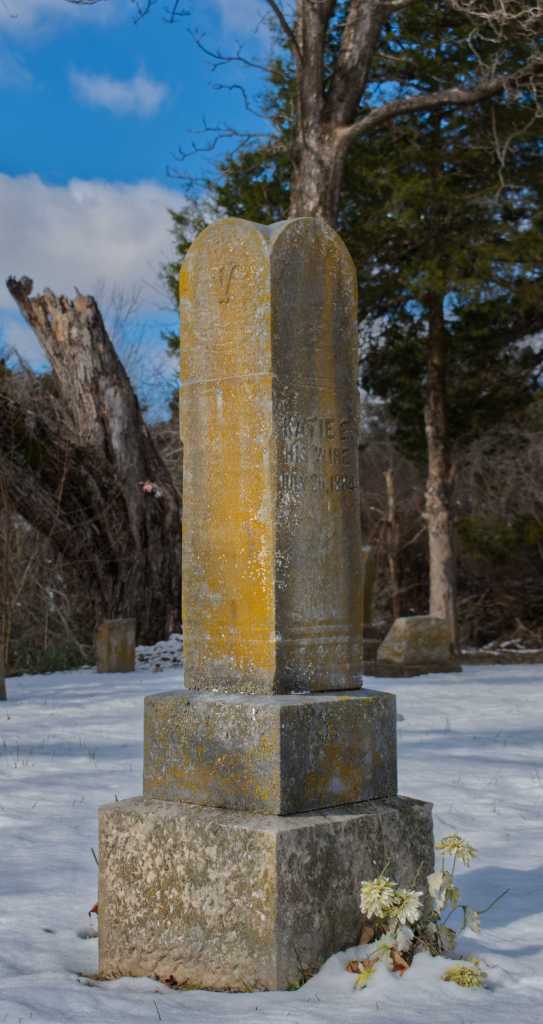
The gravestone of Katie E. “His Wife” sits in the cold but sunny day at Howard Cemetery. Katie’s remains were interred just a year after the cemetery was established.
Editor’s Note: I shot the photographs and wrote this meditation for what I thought might be a photography journal column with the publication I currently work for. Unfortunately, I am paid to be a journalist and not to be an artist, which means I am supposed to be writing stories and taking photographs about artists and art as a journalist, not making my own art as an artist. I think that this post is art, if only one will allow it to move them to the aesthetic, philosophical, and theological realm of thought and feeling. And, for those inclined toward the mystical meaning of existence, perhaps this post even rises to the height of news–since, after all, the story and photographs are about interesting people.
Humans have been marking graves for at least the past 5000 years, beginning with the Celts and Romans. Since then this mysterious ritual has been observed in almost every culture throughout the world. From Buddhist Dharma Wheels figuring the eternal reality of the Now, to Christian Crosses signaling the Heavenly hereafter, gravestone makers help families memorialize their most precious beliefs and keep their loved ones’s memories alive.
One such place where the dead are remembered is Howard Cemetery, which was established on the farm of Abraham Howard in 1883 with the burial of his grandson, Thomas A. Howard, which I happened to find quite by accident.
I was out driving, letting the road and beautiful sights direct my steering wheel, when I decided to drive beyond Hurst into the country to look for a nostalgic subject—I was in a wistful frame of mind. I turned off the main road, because a sign indicated a cemetery was nearby. After about a quarter mile of gravel road, over a railroad crossing, past black cows munching hay, and coal mines all around, I pulled into a little secret and cozy cemetery nestled in the woods.
Peter’s gravestone leans under the weight of years in the cold cemetery. Peter’s most precious biographical info he wanted time to recall was his membership with a local lodge. Pete was 65 when he passed into the ages of ages.
After an appropriate crossing and a few Ave Marias said for the faithful departed over whom I was about to trod, I reverently knelt in the icy snow blanket covering the cemetery grounds and got to work. All that could be heard was the crunching of the snow beneath me and the clicking of my camera.
What impressed me most was the tangible silence of the place. It was calming, mournful, and yet filled with what I can only call a moment filled with memory. Here were all these people beneath my feet who walked and talked over a hundred years ago and now were still and silent as the gave. And here I was remembering them with my camera. I read the names: Katie: His Wife, 1884;Peter: Lodge NO 715 K of P, 1851-1916;Esta: 1916, and so many more.
I can almost see Katie now in the kitchen: a devoted wife in a blue flower dress with a red apron, pulling corn muffins from the oven.
Or Peter, the jokester perhaps who alway knew where the best and coldest beer in town was, loyal as a hunting hound, hard but not cruel, wise in his own way, who lived a full but humble life.
Then there’s poor little Esta. She died before ever becoming a woman. Maybe she was like Beth March in Little Women, sweet and mild, and disposed to noble suffering and resigned to a brief candle of life.
A gravestone sits in shadow and light, marked Esta Harrison, born Aug. 27, 1903, and died Nov. 18, 1916. Esta was not yet a woman when she died.
The truth is, I don’t know who these people were, but I know that they were people just like me, with hopes and fears, joys and sorrows. Though I never knew them, I remember them all the same, and in doing so I remember that I shall join them when my brief hour here has ended and time becomes eternity.
It is the trend today to assume that the Roman Catholic Church shall be as it ever was until the coming of Christ. There has been much discussion, and very good data to support such a doctrinal assertion. I for one tend to sympathize with those who think so, and would be inclined to believe it myself, were it not for the problem of proof.
The proofs are lacking in the supposition that there must always be Shepherds and Teachers until the end of time, and that the Church shall remain unchanged. The problem is, what calls itself the Church, and what has an appearance of being so, has been changed in its fundamentals in doctrine and discipline, while admittedly retaining the veneer of the hierarchical structure of the Catholic Church. This is but surface deep, and within which there does not dwell the Holy Ghost, as is evident by the evil fruits of the Post Conciliar Sect.
Unfortunately, many have been confused by this outward appearance, coupled with the doctrinal suppositions that the Catholic Church must exist as it always has with Shepherds and Teachers until the end of time, and so, have defected by returning back to the Novus Ordo, or who have chosen never to leave.
I do not fault these individuals, because these are issues which are very confusing, and those to whom I allude I assume are pure intentioned and of good will, I have no doubt. But confusion is confusion, and error error, and so we must compare what has been said before to the present, in order to make some kind of sense of our predicament.
Moreover, these signs shall show forth the great anger and displeasure of the Almighty at sinful men. The heavens now announce the glory of God, as the Prophet David says: “The heavens show forth the glory of God, and the firmament declareth the work of His hands.”(4) “But then,” says Barradius, “they shall declare the anger of God against the wicked.”(5) For He will cause all creatures to rise up against them; by making the stars to lose their light, He will, so to speak, shut up the windows by which any light might penetrate to the earth, that He may smite in the dark without mercy, as Isaias prophesies: “Behold, the day of the Lord shall come, a cruel day, and full of indignation, and of wrath, and fury, to lay the land desolate, and to destroy the sinners thereof out of it. For the stars of heaven and their brightness shall not display their light: the sun shall be darkened in his rising, and the moon shall not shine with her light.”
All that could encourage a pious Christian and console him in such tribulation shall then be removed; for this cruel beast in his daring pride shall set himself up as the true God and claim to be adored and to have churches built in his honor. “And the king shall do according to his will,” says the Prophet Daniel; “and he shall be lifted up, and shall magnify him self against every god.” (9) All the temples consecrated to Our Lord shall be pulled down and desecrated, the sacred images destroyed, spiritual books burned, all preachers and priests made away with, and the use of the holy sacraments and the celebration of Mass utterly abolished: “And arms shall stand on his part, and they shall defile the sanctuary of strength, and shall take away the continual sacrifice: and they shall place there the abomination unto desolation.”(10) Such are the words of the Prophet Daniel. Thus for about four years, the duration of the reign of Antichrist, the public celebration of the holy Sacrifice shall be nowhere tolerated in the whole world; not a single crucifix shall there be that one might comfort himself in his sorrows by looking at it.
What is very curious about these statements, is that Father Hunolt does not sound like he is placing before the reader some bold new theory which had never been heard before. On the contrary, Father Hunolt was well-known in his day for his orthodox and inspired sermons. He simply states the following facts of eschatology (study of the End Times):
No spiritual consolation during the tribulation.
All consecrated churches and alters shall be destroyed, as well as sacred images, books.
All priests done away with.
Use of holy sacraments and the Mass abolished.
Continual sacrifice shall be taken away.
During Antichrist’s reign, public celebration of holy Sacrifice shall not be tolerated.
Not even crucifixes shall be seen to comfort.
Thus we see a startlingly similar picture emerging from this summary of what must be a perennially held interpretation of the prophecies of the End Times found in the Bible. What is very peculiar to point out is that, though some may be a wee bit exaggerative (like number 1 and 7), almost all of these points of prophecy coincide, not with Sedevacantists, not with Novus Ordoites, not with Recognize and Resisters, but with Home Alone Catholics. But what in particular concerns me in this post is the point about the cessation of the sacrifice, which Traditionalists and those of the Novus Ordo, as well, reject or believe has not come to pass–as if not now, then when!
I shall let these quotes from Hunolt just sit there for your meditation. Imagine you were sitting in the pew of some German church a few hundred years ago, and heard Father Hunolt speak these things, and thinking what it might be like to have no priests and no Mass and no church. Not so hard to imagine, is it?
Next, I would like to take a quote from a letter Saint Augustine wrote to Bishop Hesychius, entitled “The End of the World,” which Saint Augustine liked so much he decided to republish as a chapter in his City of God.
For the Church is the sun and the moon and the stars, to which it was said, Beautiful as the moon, chosen as the sun (Sg 6:9)…For, when the sun is darkened, and the moon does not give its light, and the stars fall from heaven and the powers of the heavens are thrown into confusion (Mt 24:29; Mk 13:24-25), as this passage is expressed by the other two evangelists, the Church will not be seen. At that time, when the wicked persecutors rage beyond all limit and without any fear, as if the happiness of the world were smiling upon them, they say, Peace and security (1 Thes 5:3), stars will fall from the heavens, and the powers of the heavens will be thrown into confusion, because many who seemed to be resplendent with grace will yield to the persecutors and fall, and some very firm believers will be thrown into confusion, (Ep. 199.39).
Here Saint Augustine says that “the Church will not be seen.” The sun, moon, and stars are the Church. Hence, “And immediately after the tribulation of those days, the sun shall be darkened and the moon shall not give her light, and the stars shall fall from heaven, and the powers of heaven shall be moved…” could equally be read as “…the Church shall be darkened and the the Church shall not give her light, and the Church shall fall from heaven…”
Those who insist that there must always be Shepherds and Teachers until the Second Coming and Final Judgment, must reconcile these teachings of eminent preachers and teachers in the Church who say otherwise. Those who are confused about these issues must not be led astray, they must not “yield to the persecutors and fall.” Those who would return to the Novus Ordo–or never leave–are the ones who yield to the persecutors of the real Church, the body of unshaken believers who have held the Faith whole and inviolable.
We who keep the Faith must pray for perseverance and not be tempted to believe that He is to be found in the closets or Tabernacles of the Novus Ordo, or anywhere else. Christ is to be sought today in prayer in the spirit, since His sacramental presence has been taken away as a punishment for our sins. Pray the Rosary everyday if you can, and ask our Lady to make your will strong, that you may keep the Faith of our Fathers and not yield to the Antichrist.
I am excited to share with you a scholarly write-up on a very important subject, the so-called necessity of having Shepherds and Teachers until the end of time. Everything in theology revolves around words, and here Mr. B.E. Strauss does an adroit job at bringing out what is important in the words many bloggers of the Traditionalist ilk have bantered back and forth without neat considerations taken. He bases his sound reasoning on Holy Scripture, Sacred Councils, and eminent Fathers and Doctors of the Catholic Church.This is an issue affecting Home Alone Catholics and Sedevacantists, as well as Traditionalists, one of which, Mr. Eric Hoyle, has felt so strongly about that he has returned to the Novus Ordo, because he believes there must be Shepherds and Teachers until the Second Coming. Mr. Strauss is offering an alternative interpretation to the Vatican Council language of the same, albeit, not his own interpretation, but rather one rooted in actual teachers in the Church.Read the Appendix. That is where the gold is.
If this topic interests you, I recommend going over to Galaxy Forum, and discussing it there. Leave your comments as well, and be sure to thank Mr. Strauss for his contributions to the CE Log!
Even to the Consummation of the Age
By B. E. Strauss
Pastor stultus, et imperitus, haud dubium quin Antichristus sit; qui in consummatione mundi dicitur esse venturus. Without any doubt, the foolish and unskilled shepherd is Antichrist, who is said to come at the consummation of the world.
St. Jerome, On Zechariah
The idea that the Church shall have a pope, bishops, seminars, etc. until the literal last day of the world, until the Lord returns, is widespread and plays a significant role in debates between Catholics about consequences to be drawn in the face of the Great Apostasy that has become visible since the robber council of the 1960s. Looking at original Latin documents and writings of the Magisterium, the Fathers, Doctors and Saints, and the Vulgate as well as other editions of Holy Scripture, a different picture comes to the fore. As a matter of fact, the Vatican Council solemnly teaches that the Lord promised shepherds and teachers until the consummation of the age which, according to Catholic commentary, begins with the revelation of Antichrist who is announced to reign before the return of the Lord. Hence, apostolic succession seems to have come to an end already, and we deal with shepherds of vengeance:
Zech 11:15-16 And the Lord said to me: Take to thee yet the instruments of a foolish shepherd. For behold I will raise up a shepherd in the land, who shall not visit what is forsaken, nor seek what is scattered, nor heal what is broken, nor nourish that which standeth, and he shall eat the flesh of the fat ones, and break their hoofs.
1: The Consummation of the Age
The term consummatio saeculi is St. Jerome’s translation of the Greek term syntéleia tou aionos, which appears exclusively in the Gospel of Matthew. Holy Scripture is full of other terms for the same events, which are announced over and over again. Some of these terms are dies novissimi (latter days), dies ultionis (days of vengeance), dies visitationis (days of visitation), and tempus tribulationis (time of tribulation). Whether day or days or time or times, all these terms describe the time of the reign of Antichrist, which is to happen in the second half of the last of seventy weeks of the prophecy of Daniel:
Dan 9:24 Seventy weeks are shortened upon thy people, and upon thy holy city, that transgression may be finished, and sin may have an end, and iniquity may be abolished; and everlasting justice may be brought; and vision and prophecy may be fulfilled; and the saint of saints may be anointed.
St. Jerome quotes a series of commentaries of other Fathers on the seventy weeks in his commentary On Daniel. The first sixty-nine weeks are before the first coming of the Lord, where each prophetic week lasts 7 years. The last week is split into two halves. So far, there is wide consensus. Understandably, with respect to the rest there is less agreement. Prophecy generally is not fully understood until after things happen. It seems that the first half of the last week signifies the bimillennial time of the Church up to Antichrist, the second half the time of the reign of Antichrist.
The Apostle Paul uses the related term consummatio saeculorum, i.e. consummation of the ages.
Hebr 9:26 For then he ought to have suffered often from the beginning of the world: but now once at the end of ages [consummatio saeculorum], he hath appeared for the destruction of sin, by the sacrifice of himself.
The consummation of the ages denotes the last of all ages of the world, the age of the Church. This last age consummates the ages that came before, and it is itself consummated by the consummatio saeculi, by the consummation of the (last) age.
Proving the point of this article, many Fathers and Doctors of the Church equate the consummation of the age and the time of Antichrist:
St. John of Damascus, An Exposition of the Orthodox Faith, Book IV It should be known that the Antichrist is bound to come. Every one, therefore, who confesses not that the Son of God came in the flesh and is perfect God and became perfect man, after being God, is Antichrist (1 John 2:22). But in a peculiar and special sense he who comes at the consummation of the age is called Antichrist. newadvent.org
Several (screen) pages of further quotes which show that many Fathers and Doctors equate the time of Antichrist and the consummation of the age can be found in the appendix below.
2: The Gospel of Matthew
The term consummatio saeculi appears six times in the Gospel of Matthew. The first three mentions occur in the context of the parable of the cockle of the field:
Mt 13:39 And the enemy that sowed them, is the devil. But the harvest is the end of the world [consummatio saeculi]. And the reapers are the angels.
Mt 13:40 Even as cockle therefore is gathered up, and burnt with fire: so shall it be at the end of the world [consummatio saeculi].
Mt 13:49 So shall it be at the end of the world [consummatio saeculi]. The angels shall go out, and shall separate the wicked from among the just.
The quotes are from the Rheims New Testament of A.D. 1582 revised by Bishop Challoner A.D. 1749-1752 Consummatio saeculi is translated as end of the world each time. The next two mentions occur in the Olivet Apocalypse:
Mt 24:3 And when he was sitting on mount Olivet, the disciples came to him privately, saying: Tell us when shall these things be? and what shall be the sign of thy coming, and of the consummation of the world [consummatio saeculi]?
Mt 24:14-15 And this gospel of the kingdom, shall be preached in the whole world, for a testimony to all nations, and then shall the consummation come [consummatio]. When therefore you shall see the abomination of desolation, which was spoken of by Daniel the prophet, standing in the holy place: he that readeth let him understand.
Mt 24:14-15 has just consummatio but refers to consummatio saeculi in 24:3. The last mention occurs in the last verse of the last chapter of the Gospel of Matthew:
Mt 28:20 Teaching them to observe all things whatsoever I have commanded you: and behold I am with you all days, even to the consummation of the world [consummatio saeculi].
In translations the original Latin term consummatio saeculi is most frequently rendered as end of the world. Consummation of the world is less frequent, and consummation of the age is comparatively rare. This is also the case for translations of original Latin versions of Catholic commentaries and other writings including magisterial documents quoting the above verses. Also, the situation is similar with respect to translations to Spanish, Portuguese, French, German and probably more languages. The Latin Fathers use finis saeculi, finis mundi, and consummatio mundi beside consummatio saeculi, only if they don’t directly quote one of the listed Verses of the Gospel of Matthew.
3: The Indefectibility of the Church
Ecclesia a perfectione sua fulget in decore justitiae usque ad tempus Antichristi. By her perfection the Church sparkles in the adornment of justice up to the time of Antichrist.
Scivias Hildegardis, Visio undecima
The indefectibility of the Church has been a topic treated by theologians for centuries. A.D. 1870 the Vatican Council supplied them additional definitive teaching on the topic. Particularly, the existence of shepherds and teachers even to the consummation of the age was emphasized. As far as I am aware, theologians don’t seem to care much about what exactly consummation of the age means. E.g. Ludwig Ott writes
Grundriß der Katholischen Dogmatik. Der Fortbestand der hierarchischen Gewalten folgt notwendigerweise aus der von Christus gewollten Indefektibilität der Kirche. Die den Aposteln gegebene Verheißung seines Beistandes ,,bis ans Ende der Welt” (Mt 28,20) setzt voraus, daß das apostolische Amt in den Nachfolgern fortbesteht.
The continuance of the hierarchical authorities follows necessarily from the indefectibility of the Church, willed by Christ. The promise of his aid, given to the Apostles, until the end of the world” (Mt 28:20) presupposes that the apostolic office continues in their successors.
Such statements can be read as if the hierarchy of the Church had to be up and running until the moment of the second coming of the Lord. On the other hand, Bl. Hildegard of Bingen has a different perspective (see quote above).
4: The Vatican Council
Both dogmatic constitutions of the Vatican Council, Dei Filius (April 1870) and Pastor aeternus (July 1870), begin with a reference to Mt 28:20 behold I am with you all days, even to the consummation of the age. The dogmatic constitution on the Church of Christ emphasizes the will of the Lord …
Pastor aeternus, Vatican Council: The eternal shepherd and guardian of our souls … willed that … in his church there should be shepherds and teachers even to the consummation of the age.
… while the dogmatic constitution on the Catholic faith calls it a promise:
Dei filius, Vatican Council: The Son of God, redeemer of the human race, our lord Jesus Christ, promised, when about to return to his heavenly Father, that he would be with this church militant upon earth all days even to the consummation of the age.
In both cases, the original Latin of the Vulgate usque ad consummationem saeculi (Mt 28:20) is used, which means up to the consummation of the age.
The sacrosanct Council neither explains what exactly the consummation of the age is, nor does it say anything about shepherds and teachers during the consummation. But there is not only no reason to expect true shepherds and teachers during the consummation of the age. On the contrary, biblical prophecy, as expounded by the Fathers and Doctors of the Church, announces false shepherds and teachers as well as Antichrist, sent by the Lord, sitting in the holy place, slaughtering, selling, and devouring the sheep.
I’ll leave the reader with the quotes in the now following appendix.
About the Author
Mr. Strauss is a Catholic layman who believes to be witness of the days of vengeance, that all things may be fulfilled, that are written (Lk 21:22). Professionally he is an engineer, freelancing since the 1980s.
Appendix
A. Fathers and Doctors equating the consummation or the end of the age or the world and the reign of Antichrist
A.1 Ps. Hippolytus
De consummatione mundi is a discourse on the consummation of the world which is said to be a 7th century adaption of De Antichristo of St. Hippolytus of Rome. The consummation is presented as a time of seduction followed by the second coming of the Lord.
De consummation mundi, Section 2 For I shall unfold to you today a narration full of horror and fear, to wit, the account of the consummation, and in particular, of the seduction of the whole world by the enemy and devil; and after these things, the second coming of our Lord Jesus Christ.
Quoting two prophets, Isaiah and Osea, the author identifies their descriptions with the raging of Antichrist during the consummation.
De consummation mundi, Section 4 And what else is this burning wind from the east (Osea 13:15), than the Antichrist that is to destroy and dry up the veins of the waters and the fruits of the trees in his times, because men set their hearts on his works? For which reason he shall indeed destroy them, and they shall serve him in his pollution.
The terms day of the consummation, times of the consummation, time of the consummation, and last day of the consummation are used synonymously. In that time, false Christs will arise. E.g.:
De consummation mundi, Section 9 Wherefore also in the last day of the consummation, it must needs be that false Christs will arise again.
St. Cyprian of Carthage is considered the pre-eminent Latin writer of Western Christianity until Jerome and Augustine.
Testimonia adversus Iudaeos Apud Esaiam: Et erunt vobis hi omnes sermones sicut sermones libri qui signatus est: quem si dederis homini scienti litteras ad legendum, dicet: Nonpossum legere, Signatus est enim. Sed in illa die audient surdi sermones libri ; et qui in tenebris et qui in nebula sunt, oculi caecorum videbunt (Isa. XXIX, 11, 18). Item apud Hieremiam: In novissimo dierum cognoscetis ea (Hier. XXIII, 20). Item apud Danielem: Muni sermones et signa librum usque ad tempus consummationis, quoad discant multi, et impleatur agnitio ; quoniam cum fiet dispersio, cognoscent omnia haec (Dan. XII, 4, 7) .
Comparing Isaiah, Jeremiah, and Daniel, Cyprian equates that day (Is 29:18), the latter days (Jer 23:20), and the time of the consummation (Dan 12:4). In that time, not the wicked but learned people will understood prophecy: the deaf shall hear the words of the book (Is 29:18), in the latter days you shall understand his counsel (Jer 23:20), the learned shall understand (Dan 12:10). (Note that Cyprian is ignorant of the Vulgate, where Dan 12:4 reads usque ad tempus statutum (even to the time appointed) while Cyprian quotes usque ad tempus consummationis (even to the time of the consummation).
The Opus Imperfectum in Matthaeum is an uncomplete early commentary on the Gospel of Matthew. Up to the 16th century the author was thought to be St. John Chrysostom. The Opus is extensively quoted by St. Thomas Aquinas in the Catena Aurea.
The consummation of the world is presented as the time of tribulation, when the Church will be destroyed like Jerusalem has been destroyed A.D. 70.
Opus Imperfectum in Matthaeum, Hom. XLIX Sicut illi tale facinus commiserunt, quale numquam commissum est, nec est committendum: sic et super illos talis sententia venit, qualis numquam venit, nec veniet. Haec aptius est de consummatione mundi suscipere, cujus figura fuit tribulatio illa. Tunc vere talis erit tribulatio, qualis numquam fuit.
For just as they committed such a crime as has never been committed nor ever will be again, so also such a sentence came on them as never has come nor ever will. But it is more fitting to understand this about the consummation of the world, which was prefigured by that tribulation. Then there will truly be a tribulation as never was.
Opus Imperfectum in Matthaeum, Hom. XLVIII In consummatione enim gentis Judaeae Jerusalem destructa est, quae tamen videbatur esse Jerusalem, non autem vera erat. In consummatione autem mundi Ecclesia aut desolata, aut desolanda est: adhuc tamen illa quae videbatur Ecclesia, non autem quae vera erat, aut est.
For at the consummation of the Jewish nation Jerusalem was destroyed, which still was perceived to be Jerusalem but really was not. At the consummation of the world the church will either be desolate or to be made desolate: That is, that which is perceived to be the church, not that which truely was and is the church.
Rupert of Deutz, Commentaria in duodecim prophetas minores mlat.uzh.ch
Haymo Halberstatensis, Enarratio in duodecim prophetas minores mlat.uzh.ch
Another example:
Commentaria in Isaiam. In consummatione mundi, quando orbis redactus fuerit in solitudinem et obtenebratus sol in ortu suo et luna splendorem suum non dederit, tanta fient ab Antichristo signa atque portenta, ut iniquitate crescente, refrigescat caritas multorum, ad decipiendos etiam si fieri potest electos Dei.
In the consummation of the world, when … the sun will be darkened …, so many signs and wonders will be made by Antichrist …
The abomination of desolation of Mt 24:15 is identified as Antichrist in the Church.
Commentaria in Matthaeum, 24:15 “Cum ergo videritis abominationem desolationis, quae dicta est a Daniele propheta, stantem in loco sancto, qui legit, intelligat.” … Potest autemsimpliciter aut de Antichristo accipi … stare in loco sancto, hoc est, in Ecclesia.
“When therefore you shall see the abomination of desolation, which was spoken of by Daniel the prophet, standing in the holy place: he that readeth let him understand.” … This also can simply be understood of Antichrist … standing in the holy place, that is in the Church.
St. John of Damascus says that Antichrist comes at the consummation of the age.
An Exposition of the Orthodox Faith, Book IV It should be known that the Antichrist is bound to come. Every one, therefore, who confesses not that the Son of God came in the flesh and is perfect God and became perfect man, after being God, is Antichrist (1 John 2:22). But in a peculiar and special sense he who comes at the consummation of the age is called Antichrist.
Carolus Magnus, Holy Roman Emperor, says that Antichrist will arrive at the very end of the age (finem saeculi extremi):
De imaginibus, Liber Primus, Caput XX Adventum vero Antichristi, finem saeculi extremi, discrimen iudicii et aeternam bonorum gloriam, poenamque reproborum, concordi utrumque Testamentum veritate profatur.
The actual arrival of Antichrist, at the very end of the age, the judgment separating, the eternal glory of the good and the punishment of the reprobate, is truely spelled out in bothtestaments concordantly.
Remigius of Auxerre, commenting on Gen 15:14, says that during the end of the age Antichrist will rage.
Gen 15:12 And when the sun was setting, a deep sleep fell upon Abram, and a great and darksome horror seized upon him.
Commentarius in Genesim, 15:12 Solis occubitus finem saeculi significat, quando per Antichristum tenebrosus horror, id est persecutio vel perturbatio futura est.
The setting of the sun signifies the end of the age, when due to Antichrist there shall be gloomy trembling, that is persecution or confusion.
Anselm of Laon is the founder of a school of scholars who produced the Glossa ordinaria, an interlinear and marginal gloss. The Schola says that Antichrist rages in the consummation of the age.
Glossa ordina, Liber Iudith, CAPUT II. VERS. 17. – “Descendit in campos.” Damascus potus sanguinis interpretatur, in qua principes gentium exprimuntur, who thirst for the bloodof the faithful: qui sitiunt sanguinem fidelium: maxime in tempore messis, id est, in consummatione saeculi debacchante per latitudinem orbis furore Antichristi.
“Went down into the plains.” Damascus is understood to be a drinking of blood, in which the princes of the Gentiles are pictured, who thirst for the blood of the faithful: above all in the time of the harvest, that is, in the consummation of the age when the madness of Antichrist is raging all over the world.
A nice chap left a few comments over on Galaxy Forum, which I encourage you to check out if you have not already. Eugene wrote about when the world would end, and I commend him for thinking on such things, because it is a holy practice. We must consider our end and the world’s, because it is in contemplating our death that we draw closer to holiness. At the same time, though, there must be a healthy balance between living and preparing for the future, even if it never comes. All life is filled with uncertainty, and we who keep the faith oftentimes find it easy to dwell upon the end a little too much, because we so desire the Second Coming of Christ to set things right that are so terribly wrong in world.
I know for me and my family, this was a spiritual habit of mind which, thankfully did not prevent us from planing for a future. We are still planning, and even more now that I have decided to work again–or, as I joke with Laura, for the first time. Still, as the above photograph indicates, it isn’t really work to go out into beautiful places in the world and take poetic pictures of lake fog, or sit down and talk with interesting people, and write stories on what I recall. That is just fun.
I come to you today, not with any planned idea on what to write about, which I apologize for. I want to produce great content for you all, but I lack certain inspiration to determine what that content might be. Perhaps there is a problem which faces you, a nagging question which unsettles your sleep, which you cannot seem to resolve. Maybe if you shared your questions, I could offer my services to help you come up with answers.
I suppose I am a little dry because, like many of you, I am fairly settled in my convictions about what Catholicism is–and what it is not! I know there are those out there who think there must always be shepherds until the end of the world, because, as the argument goes, God so wills it. I have already written on this idea before, but, needless to say, I do not begin my inquiring into the truth of reality from theory but rather from fact, and from fact deduce a theory. But whether there are bishops hiding in plain sight or in the bushes somewhere, this much is clear: the Novus Ordo headed by Francis is not the Catholic Church, and any supposition to the contrary is confounding bald fact with erroneous theory.
Like many of you, I am looking up into the sky, awaiting the consummation and the Son of Man on the clouds of Heaven. When that is, no one knows save the Father. Every day, at least for me and my family, is an attempt to live a normal life while struggling with the elephantine reality that we live during the ending of the world, the final act of creation, the Apocalypse. That is heavy. If you are having a hard time adjusting to the the reality and living a quasi-normal existence, don’t feel alone. You are not. Though we do not frequent messaging forums with any regularity and numbers, we Home Alone Catholics are numerous and struggle with the same heavy burden of the spirit.
Well, I feel like I have rambled enough during this post. I will try to produce some content in the coming weeks, once I get adjusted to my new hobby–journalism and photography–which I actually get paid for. It is crazy. And if you have any nagging questions or concerns, please, share them in the comments. I look forward to your emails and comments. They encourage and inspire me!
I would like to begin with an apology. I am sorry to all of my readers–few as they may be–for not having written for some time. You see, I am going through some big transitions in the Robbins home: my wife Laura is pregnant with our seventh (blessed be God!); and I am looking to get back into journalism with local job prospects which I hope to have finalized within the next week or so–either a news paper journalism or television news producer, which ever seems to be the best fit for the family; on top of that, Laura and I (mostly Laura) have our classical homeschool underway, which takes up most of the family’s time. These considerations mixed up with the fact that, as of late I have become disillusioned by the mission of this website, because it just seems to be having so little effect. I feel as though I should be reaching more and more people through the weeks, months, and, yes, years (going on two now), but my reader stats are just so very low. It can make me feel sad and not up for producing more content.
That is, until I get a little Christmas package (featured above) of spiritual and artistic goodies that warm my heart and remind me that I am not here for the numbers. Heck, if I wanted numbers alone, I would go and run a blog which speaks to the worldly-minded. But I run a Catholic blog, and that means setting myself apart from the world–where all the numbers are.
But what CatholicEclipsed lacks in numbers it more than makes up for in people like the Canadian Catholics whose heart and art I displayed above. I also recently received a heartwarming email from a good friend I found through this website who is very holy in my eyes and most assuredly on the road to sainthood. There are friends I have spoken with on the phone, texted, and emailed, who have been dear Catholic friends from afar, who I know pray for me and my family as I do for them. They read this blog, and so I must write with them in mind.
I guess what I am getting at is that this blog has been an opportunity to get to know good Catholics who have kept the faith and who have persevered during these days of evil. Though we are isolated and few, we true Catholics who keep the faith, who keep sacred the sacraments (and choose not to defile them by receiving them illicitly), who pray at home and pray the rosary, have a true Christian charity toward each other, which perhaps is best and most felt during this upcoming Christmas season.
As the New Year draws nigh, I would like to rededicate myself to providing content for you all out there who read this website, those who are my brethren in the faith. I would like to provide more valuable content for you, while at the same time most likely working outside the home on my journalism job. This would obviously mean that I could not provide valuable content on a very regular basis, as in every day, but perhaps on a weekly basis is doable. We will see what God’s grace has in store–for all is grace and we are but dust without Him. Besides, if Mr. Anonymous Introibo (who is–he tells me–a very busy lawyer) can produce very good and informative articles every other week (he has guest writers ever other week or so), I think I can manage something.
If you would like, I would love to hear if you have any fun or festive Christmas plans this year. Please leave your comments below. And if you haven’t subscribed to the CE Log, do so. Like I said, I plan to be producing some great content this coming year, so you don’t want to miss out.
I hope you all have a very merry Christmas. I leave you with a poem by one of my favorite Catholic writers/thinkers/mystics, the great GKC. Read the poem while meditating on the painting by John Singleton Copley, The Nativity.
The House of Christmas
There fared a mother driven forth
Out of an inn to roam;
In the place where she was homeless
All men are at home.
The crazy stable close at hand,
With shaking timber and shifting sand,
Grew a stronger thing to abide and stand
Than the square stones of Rome.

For men are homesick in their homes,
And strangers under the sun,
And they lay their heads in a foreign land
Whenever the day is done.
Here we have battle and blazing eyes,
And chance and honor and high surprise,
But our homes are under miraculous skies
Where the yule tale was begun.

A Child in a foul stable,
Where the beasts feed and foam,
Only where He was homeless
Are you and I at home;
We have hands that fashion and heads that know,
But our hearts we lost – how long ago!
In a place no chart nor ship can show
Under the sky’s dome.

This world is wild as an old wives’ tale,
And strange the plain things are,
The earth is enough and the air is enough
For our wonder and our war;
But our rest is as far as the fire-drake swings
And our peace is put in impossible things
Where clashed and thundered unthinkable wings
Round an incredible star.

To an open house in the evening
Home shall men come,
To an older place than Eden
And a taller town than Rome.
To the end of the way of the wandering star,
To the things that cannot be and that are,
To the place where God was homeless
And all men are at home.
For less than a hundred dollars, one can have a framed print of William-Adolphe Bouguereau’s masterpiece, Song of Angels. The obvious advantage of such a cost-affordable gem of Western and Catholic art is the price tag. For the cost of a good steak dinner for two, one can have in a room in the house nearly the same aesthetic pleasure as an aristocrat from the 1800s who would have had to pay tens of thousands.
Now, I know there are those who dispute the aesthetic advantage of prints over originals, since the differences of surfaces are different. But these differences are, well, superficial. To the artist–I humbly submit to you that I know a thing or two about art, being an amateur artist myself–these differences are more pronounced, but to the casual art appreciator, they are imperceptible.
Art has become, through commercialization and technological innovation, ever more accessible to the common man without a Rolls-Royce in the drive, and I think this is a very good thing. The only difficulty is that it is hardly appreciated and taken advantage of. Let me explain.
When one goes into a Hobby Lobby, for instance, there he is met with décor art, with seaweed mermaids and seashells and lifeless beach scenes. These are not made my man but machine and motor. They smack of a vague and lifeless landscape, devoid of personality, movement, or vibrant life-giving pigment. They are, in short, not art, but décor.
Such decorations are welcome, and I have a piece or two in my own home, purchased before I learned or was interested in art. But now, that I am no longer a child but a man, I have left off the things of children. There are those who have not, and I do not blame them. For the same forces, the mechanical and commercial, which have made art ever more accessible have also made reproductions of true art inert and irrelevant. There are whole warehouses filled with gilded framed prints of masterpieces just waiting to be purchased, but contemporary markets do not have the appetite for steak, but only hamburger, or rather tofu-burger.
But the accessibility of reproductions of fine art is a very good thing, whether it is appreciated and taken advantage of or not. Often times when I am praying the Rosary, I will look up at the Song of Angels, and my devotion is touched by filial affection, moved to feel what I express with my heart and lips. That is the power of devotional art: it incarnates the spiritual. And, for just a Franklin or two, one can have a fine gilt framed piece of religious art.
The Cons
Having offered a word or two as the advantages of having fine art works available to the masses, it remains to be said why this may prove disadvantageous, which may be stated in many reasons, but I shall confine myself to three: with respect to the art, with respect to the viewer, and with respect to art in general.
To the first, the artwork as such, the piece hanging in a museum for instance, is a work of human hands, a sub-created entity with a material reality which is quite lost upon the reproduction, which a machine produces. The oil surface, for instance, is something that very few people have ever even seen, let alone appreciated, yet this is one quality that many artists prize as the work of an authentic piece of art, the jewel-like surface, the way light penetrates the glazed surfaces (with oil paintings, there are multiple layers or surfaces which reflect back light), and glows from within. These beauties are wholly lost in a reproduction, and people are not even aware that such qualities exist, unless they have studied art and visited museums. True, like I said above, these qualities of surface are imperceptible to the casual art appreciator, but casual appreciation is not an ideal. The ideal is rather, if not expert, at least a studied appreciation of art. Reproductions make this imperfect, because they leave the living materiality of the work of art aside, and only capture its form.
Next, there is the viewer, which I have slightly touched upon. With reproductions, the viewer takes for granted the thing in itself, since it is not really the thing in itself at all, but a replica. It is the difference between meeting an actor playing Lincoln and meeting the man himself. In the first instance, one admires the words and gestures of the actor portraying Lincoln, such as in Daniel-Day Lewis’s moving performance in Lincoln. But that is only the superficial form of Lincoln. The smell of his aftershave (if he ever shaved) is not there, nor is the very being and soul of the man Lincoln, who many believe to be the savior of America. He was a walking piece of art, and all we have are replicas, either in film or photography and paintings. We do not have the art itself. We have a piece of art of art.
Finally, art for art’s sake, as it were. Art suffers from reproduction, because the whole point and pleasure of art is the uniqueness of every piece. Reproductions try to get around this pride of art by limiting prints, but that is next to impossible with the advent of ever more accessible digital prints. Art becomes just another commodity to be produced and sold, which is a kind of profanation of art. Art is the person and the world mediated through matter. Take away the matter, and the person and the world are left hollow, a mere seashell without the music inside.
Overcoming the Difficulty
As Catholics we have the richest and most fecund tradition of art of any culture or people in the history of the world. The artworks of Catholic culture are incomprehensible, and I am not one to say one should only go to museums to appreciate and cultivate an artistic sentiment. There is such a thing as a via media, which would allow for both the reproduction of the artwork while at the same time not being completely satisfied with it. If taken meditatively, one may see an allegory in the reproduction of art. All art, even original works in oil on canvas, are reproductions of earthly and heavenly realities. They are not the things themselves, the living and breathing and moving dramatispersonae, but only stick figures composed in a still life for all eternity. Yet they are something still, which have the power to move us emotionally, intellectually, and spiritually, even being lifeless pigments and oil–and so too reprints. Though not the thing itself, the artwork, reproductions of fine art capture the form if not the matter of the thing and communicate that to our souls. You can cultivate an appreciation of the matter by going to the museum. But that doesn’t mean you cannot derive good in such formal beauty of the reprints.
So, if you find that you have a few bucks lying about, and want to enrich your walls and your soul with some timeless Catholic artwork, do so, and leave off the things of a child and be a man.





 Catholic Eclipsed