I have completed my critique of the Material-Formal Thesis of Bishop Sanborn, and have published it over on the QUASI STELLAE page. I reproduce it below with the CE Log signature colorizing which you have come to know and love–or else merely tolerate.
By way of comment on the overall conclusion of the article “On the Form and the Matter of the Papacy,” I would say this: Sanborn’s thesis, that there is a material-formal distinction of the papacy, is not wrong, as there really is a material-formal distinction of the papacy. What is wrong with the thesis, is that it confuses what the material and formal principles of the papacy really are. I argue that the formal principles of the papacy are designation and jurisdiction, as these really are formal with respect to the subject, which is a material principle. Further, I argue that the matter of the papacy is not merely a man of sound mind but a man of faith.
The material-formal thesis offends both faith and reason, which is nothing other than our Catholic sense. It has stood for too long without the metaphysical grounds upon which it is based being challenged. I do not claim to have done a perfect job in challenging those metaphysical grounds, but I do believe I have shown adequately that the material-formal thesis cannot stand as argued, because it violates both metaphysical principles, which are known by reason, and theological principles, which are known by faith.
Another objection to the material-formal thesis, besides the ones already articulated in the following articles, is that it is not understandable by the vast majority of those who desire to be members of the Catholic Church. This is a consequence, not of its density and difficulty of subject-matter, which is metaphysics, and which difficulty is real and to be expected, but rather because the material-formal thesis owes its near incomprehensibility to its contrariety to Catholic sense, which is to say, to its absurdity. Even those most elaborate truths, when the terms are explained, become intelligible. Indeed, those truths which are complex, i.e. admitting of a multiplicity of principles whereby an essence of a thing comes to be and is known, are more intelligible in themselves, though with difficulty is the total of their truth understood. But, incomprehensibility may be through a complexity of principles or through a confusion of principles, the latter of which, I would argue, is what makes the material-formal thesis difficult to understand. Simply put, the Cassiciacum Thesis disturbs the heart because it does not rest in the truth but rather rests in falsehood.
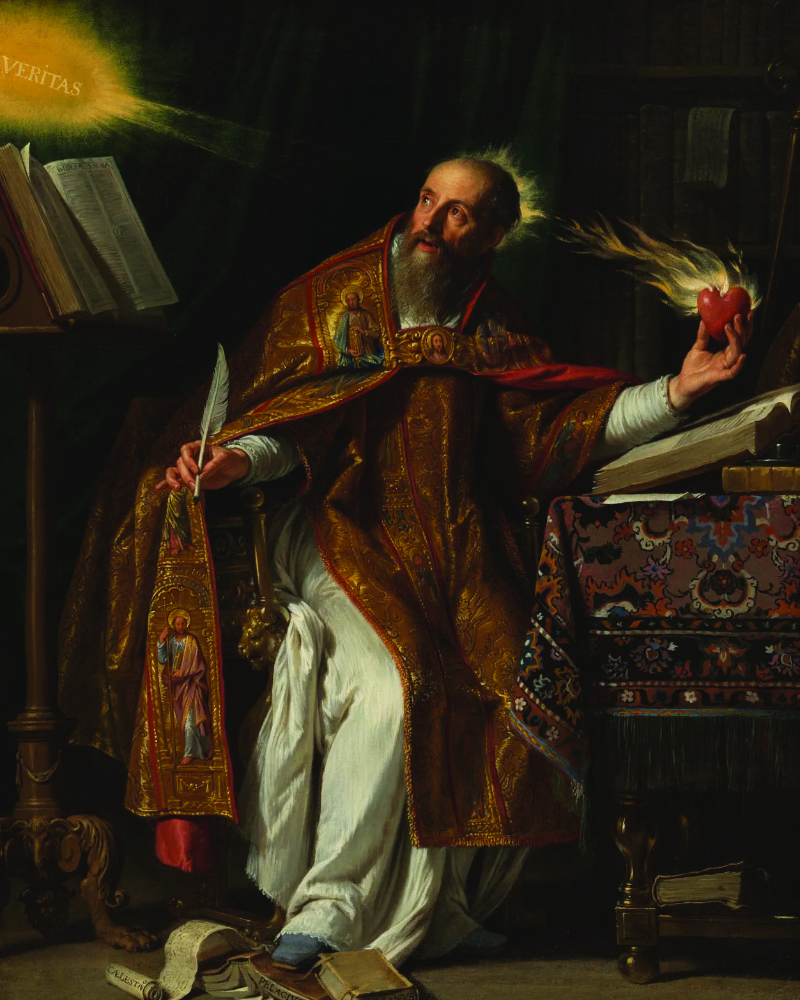
Cor nostrum inquietum est donec requiescat in Te.
Saint Augustine
On the Form and Matter of the Papacy
(In Three Articles)
As all things which are exist either on account of themselves, or through another, and, insofar as things do exist in the concrete of our experience, these must exist as a composition of two principles, namely, form and matter, and, since the subject matter under investigation in the present is of the papacy as it is understood in the concrete, that is, as to its formal principles found in matter, in order to know under what conditions a man is said to be in possession of the papacy, and indeed, to be the pope, the following points of inquiry are here undertaken:—
(1) Whether the form of the papacy is the conjunction of the accidental forms of designation and jurisdiction? (2) Whether the material part of the papacy consists of a man of faith? (3) Whether a pope is a designated man of faith with authority to govern the Church?
FIRST ARTICLE
Whether the form of the papacy is the conjunction of the accidental forms of designation and jurisdiction?
We proceed thus to the First Article:—
Objection 1. It seems that the formal principle of the papacy does not consist in both designation and jurisdiction, since the proper object of designation is to select a lawmaker, whereas the proper object of jurisdiction is to make laws. Hence, designation is not fittingly ascribed as the formal principle of an authority, but rather should be considered as the material principle, that is, as that which receives power or act, just as matter receives form which is its proper act.
Objection 2. Further, designation, being a potency principle in relation to jurisdiction, seems to be unfittingly described as a formal principle in relation to a subject, insofar as potency does not perfect potency, since a subject is in potency as it relates to the act of a formal accident which perfects it. Therefore, designation is a potency principle, not a principle of act, and so not a form of the papacy.
On the contrary, It is written, (Matt. 16: 18-19): And I say to thee: That thou art Peter; and upon this rock I will build my church, and the gates of hell shall not prevail against it. And I will give to thee the keys of the kingdom of heaven. And whatsoever thou shalt bind upon earth, it shall be bound also in heaven: and whatsoever thou shalt loose upon earth, it shall be loosed also in heaven. Now designation and jurisdiction are formal principles of the papacy, as is evident by the fact that God both designates and gives jurisdiction, as is clear from the above. That thou art Peter, is an act of designation, or a naming, which comes from the Incarnate Word of God, and that jurisdiction presupposes and depends upon a designation, which jurisdiction is granted by the words, And I will give to thee the keys of the kingdom of heaven, etc. Therefore, both designation and jurisdiction are formal principles of the papacy, both by virtue of their cause, which is God, and with respect to their necessary composition and order to each other in a subsistent subject.
I answer that, the form of the papacy is the conjunction of the accidental forms of designation and jurisdiction in the subject of the power of the papacy. With respect to the subject of the papacy, these accidental forms are both formal principles and material principles, the formal principle being jurisdiction, the material designation. But, just as these accidental forms are ordered to the subject, they are ordered also to each other, as designation is prior to jurisdiction and without which jurisdiction cannot be. The papacy as far as its formal cause is concerned is the conjunction of the act of designation with the accompanying perfection of jurisdiction. Yet, even in a sense, the act of designation presupposes the act of jurisdiction. For example, the power of designation belongs to a cardinal to elect a pope by virtue of his membership to the Body of Christ and by virtue of his designation as a cardinal-elector, yet which designation required a prior act of jurisdiction by one who could so designate, which alone is the pope. Hence, it is clear that the accidental form of the papacy, or any authority, such as a cardinal-elector, presupposes both designation and jurisdiction, just as St. Peter and the rest of the Apostles were designated and given the power of jurisdiction symbolized by the Keys of the Kingdom of Heaven.
Reply Obj 1. The proper end of the act of designation is not the making of a lawmaker, which is but the intermediate end of his action, but rather the making of law which is the final end of his action. Consider an example: a voter in the United States has the power of designation by virtue of his citizenship. He casts his vote for a representative, one which will serve his community well by drafting and voting on laws which will increase the common good of his community. The voter does not only act to elect a lawmaker, which is proven by the fact that he would not vote if there were no one in whom he had confidence to work for the common good of his community. Rather, he votes for a lawmaker for the potentially good laws that lawmaker will make. Thus, the voter, as an agent of designation, acts according to the end of making law, which is properly called authority or jurisdiction. Therefore, the formal power of designation is not separable from the act of jurisdiction with respect to its final cause, that is, the purpose for which it exists.
Reply to Obj. 2. Designation as an accidental form with relation to the subject of the papacy is not a potency principle but the first act whereby a man of sound mind and faith becomes a pope, and as such should be considered as a formal principle. With respect to the accidental form of jurisdiction in the subject of the papacy, designation is a potency, or material principle in relation to jurisdiction, whereby the man designated pope so acts.
SECOND ARTICLE
Whether the material part of the papacy consists of a man of faith?
We proceed thus to the Second Article:—
Object 1. It seems that the material part of the papacy does not consist of a man of faith, for even St. Ambrose while he was yet a catechumen and so not counted among the faithful was designated to the episcopacy of Milan. But the papacy is nothing else but the episcopacy of Rome. Hence, since a man need not have faith to be designated a bishop of Milan, neither then does a man need faith to be designated bishop of Rome.
On the contrary, the Theologian teaches, “One should say that Christ is the foundation through himself, but Peter insofar as he holds the confession of Christ, insofar as he is his vicar,” (Commentary on Matthew, 1384).
I answer that, faith is that upon which Christ builds His church, as is evident by the words, And I say to you that you are Peter; and upon this rock I will build my Church, and the gates of hell will not prevail against it, (Matthew 16:18). Now, a foundation is a kind of matter, and, since not the man himself, Peter, but his confession or faith in Christ is that upon which Christ builds His Church, that is, the foundation or matter, so then does the matter of the papacy essentially consist in the faith of Peter and his successors with the same, and not merely a man.
Reply to objection 1. Though St. Ambrose was designated to the episcopacy of Milan without baptism, and so not counted among the faithful, this in no way implies that the saintly man was without faith. On the contrary, that the people of Milan desired Ambrose to be their bishop even while he was a catechumen demonstrates his faith. For, inasmuch as Ambrose loved God, and desired baptism, he was sanctified without baptism by his faith. For no one can love what one does not believe in. As the Theologian teaches, “Secondly, the sacrament of Baptism may be wanting to anyone in reality but not in desire: for instance, when a man wishes to be baptized, but by some ill-chance he is forestalled by death before receiving Baptism. And such a man can obtain salvation without being actually baptized, on account of his desire for Baptism, which desire is the outcome of “faith that worketh by charity,” whereby God, Whose power is not tied to visible sacraments, sanctifies man inwardly. Hence Ambrose says of Valentinian, who died while yet a catechumen: “I lost him whom I was to regenerate: but he did not lose the grace he prayed for,” (Summa Theologiae, III.68.2).
THIRD ARTICLE
Whether a pope is a designated man of faith with authority to govern the Church?
We proceed thus to the Third Article:—
Objection 1. It seems that a pope is not a man of faith designated with authority to govern the Church, for a man without faith only posits an impediment to the reception of the form of authority as such, and not to the form of designation, which is the right to exercise authority but not the power to exercise authority. Authority as such comes directly from God, whereas the right of the use of authority, which is designation, comes from the Church. Hence, it is possible that a man who does not have faith may be designated pope by the Church, for designation does not require faith, even while a man so designated does posit an impediment to receiving the power of authority from God. Therefore, a man without faith may be designated pope without authority, which man would be called pope materially but not formally.
Objection 2. Further, insofar as designation, or the right of electing, is not jurisdiction as such, on account of the different objects, viz., the object of designation is the continuation of the hierarchy, whereas the object of jurisdiction is the making of laws, it follows that he who has only a designation to elect electors, but not the power to make laws, nevertheless is able to designate electors to elect a pope, even if these same electors have not the faith, just as a man without faith may receive the right of designation, for he who has is able to give, according to the contrapositive of the axiom, nemo dat quod non habet. Therefore, he is designated pope by those who have a right of designation.
On the contrary, It is written (Luke 21:31-32) “And the Lord said: Simon, Simon, behold Satan hath desired to have you, that he may sift you as wheat: But I have prayed for thee, that thy faith fail not: and thou, being once converted, confirm thy brethren.”
I answer that, it is altogether impossible for a man without faith to be designated pope without the form of authority, for designation stands in potency to the act of authority, which perfects it, as was shown in the preceding article (Article 1. Reply to Object. 2.). The pope, designated and with jurisdiction, is in act in relation to men he decides to designate as cardinals. There must be a proportion between this act of designation by the pope, which act is exercised through the power of jurisdiction—thus proving the dependency of designational acts on jurisdictional acts—by the pope on the men just as God acts on a man to be pope, both with respect to the act of designation, and jurisdiction, as was proved by the words, thou art Peter, etc. The difference being however that the act of designation is mediated by a long succession of popes acting on men in designating them cardinals who in turn designate popes, whereas the power of jurisdiction is given to the man designated to be pope immediately by God but dependent upon a designation which is dependent on God also, but through the succession of designated designators. Thus the source of both jurisdictional power, which is not mediated by men, and designation, which is mediated by men, is the same, namely, God. A man who is disposed to receive the designation of the papacy is by that very act able to receive the perfection of that designation, which is the power of jurisdiction. The distinction between the two powers is as form is to matter, not a distinction of essence. To be designated to an office is to be in the possession of the right to exercise the power of that office. The right of designation is the matter from which but not by which a man exercises authority of jurisdiction. But the power itself of ruling is given concomitantly with the power of designation, yet the right precedes the use of the power as matter precedes form and potency precedes act—yet act precedes potency, as all matter is in act, without which act matter cannot be. The authority, exercised as a power, gives form to the right of the power, whereby it comes into act in a subject. Therefore, he who has an impediment to the reception of the use of authority necessarily also has an impediment to the right of authority, for right is prior to use, and use is dependent upon right. But the right to the power of the authority depends upon faith, as was shown above (Article 2), as form depends upon matter, since faith is the necessary matter which the form of designation perfects. Therefore, a pope is a designated man of faith with authority to govern the Church.
Reply to objection 1. As was shown in the body of the article, designation, or the right to use the power of authority, indeed comes from the Church as through a succession of designated designators, yet not ultimately, as to the first cause of the right of designation, which is God. Hence, the right of designation depends upon authority which grants the right, for nemo dat quod non habet. But this right of the use of authority is granted on the grounds of faith. It follows, then, that he who is without faith does not receive the right of designation. Therefore, a pope cannot exist materially only, if he lack faith, which is the matter of the papacy, for then he would be and not be at the same time in the same respect, that is, in respect to the matter of the papacy, which is the faith—which is absurd.
Reply to objection 2. Though designation is not in the proper sense jurisdiction, as there exists a distinction between right and use, nevertheless, right depends upon use, as matter depends upon form, as designation depends upon authority to be designated, for all acts of designation are acts of jurisdiction, just as all acts of jurisdiction are acts of designation, insofar as use presupposes right also, as form presupposes matter. Therefore, he is not designated pope by those who do not have authority to designate.
 Catholic Eclipsed
right!! but arent u making my point??– my point being– sedevacantism is a ‘half-truth’.. it contains truth yet its not the whole story..the whole story being– not only do we not have a valid Pope, its much worse than just an empty chair..we also have a fals epope– jewish bergoglio– posing as a valid pope.. much much worse than just an empty chair..
sedevacantists want to live in a simpler world than what reality is, so its much easier to deal with..i.e. just split off and go schismatic and swear they are the real Catholic Church.. its too simplified, its not reality..popeMichaels’ pipe-dream..
LikeLike
As I commented on the other post, I speculate and wonder if material-formal was deliberately created as another distraction.
I do remember reading some of the original texts (there’s one on the “Most Holy Trinity Seminary” site, I don’t know if it was the absolute original), and the objection raised above that they’re not intelligible to the average person I think holds ground. The theory strikes me as philosophical hair-splitting and unnecessary.
This was the article (PDF): https://mostholytrinityseminary.org/wp-content/uploads/2019/09/Cassiciacum-Thesis-2019-Script-Fr-D.pdf
An older source of this text to compare to see if anything was changed was Griff Ruby’s site, the “lucien.zip” text file for download: http://the-pope.com/articles.html
“A lengthy article (over 200K uncompressed, with 136 footnotes) on “The Cassiciacum Thesis” by Fr. Bernard Lucien, translated by Rama Coomaraswamy, M.D. This Thesis deals with the idea that the post-Vatican II “popes” (particularly Paul VI and John Paul II), even while being heretical, can nevertheless be “material” popes and maintain the hierarchial structure within the Catholic Church, even though in reality they are not members of it.”
(I think they are the same articles but I don’t remember)
A few problems have also surfaced. There’s the simple argument that the election of a heretic is just invalid, and does not create a “material pope”. This would exclude the material-formal thesis as being possible. I don’t remember what their argument is in response to this, but their motivation is to preserve some kind of lineage of Church offices, to keeping the Church going. The Church still persists “materially” in their view – but this still doesn’t really solve the problem, as formally much of the Church is not preserved in their view.
From Lucio Mascarenhas, just an average guy from India, who was a “pope” Michael follower, I find some info on people close to Thuc and des Lauriers that says that the original theory held that certain papal elections were valid based on there being Pius XII cardinals involved in the elections:
(general article list from which I found this): http://www.geocities.ws/prakashjm45/michaelinum.html
Specific article in question: “”The Cassiciacum Thesis”—The Apostolic See ‘Occupied’
OR The Case Of A Schizophrenic Theology!” (Einsicht 2003) http://www.geocities.ws/prakashjm45/einsicht12.2003.html
Quote from article: “According to the conception of des Laurier, as published in the Review, Cassiciacum, Monsignor Wojtyla was legitimately elected pope, pars minor y sanior, because about 10 cardinals created under Pius XII were present: He is papa materialiter. ”
des Lauriers was the creator of the material-formal thesis. So, there are no more Pius XII appointed cardinals, so this theory would have also ended for that reason.
Another reason this theory would have ended, is because it also originally was in reaction to Paul VI becoming a “pope who fell in to heresy”. It was held that he was a true pope, but then because he fell in to heresy, he became a “material pope” only. This theory is basically unable to be resolved in my view, because the Church has never really given a decision on what would be done with a pope who fell in to heresy. But we believe heretics never became pope in the first place, which is a different scenario. Also, when Paul VI died and they tried to elect a new heretic as pope, then again sedevacantism would prevail as the correct view. The new election would be invalid, and there is no “material pope” created. If Paul VI was a true pope who fell in to heresy, it is uncertain what is to be made of his “papacy” during that time. But most sedevacantists after some years simply have accepted he never became pope in the first place, nor did his predecessor.
So again, the theory should not stand. It persists because various “independent clergy” or the laymen following them are trying to make some argument for how “independent clergy” can have jurisdiction from this “material pope”.
Some of the writing I have seen in favor of material-formalism, seems to make non-arguments. Like one traditionalmass.org article in favor of sedeprivationism seemed to speak negatively of conclavism (in ways that suggested they didn’t read much of the arguments in favor of conclavism). At the same time, I thought they seemed to wonder how the Church could elect a pope without cardinals, or “material cardinals”. The Church did so for a millennium with typically clergy but also sometimes laymen participating though, so again sedeprivationism’s “material cardinals” theory isn’t needed for there to be a future papal election. Nor would it be needed for the theory that the world will end soon without there being another pope. (I’d have to try to find the specific article, I thought it was by “bishop” Sanborn)
LikeLike
Ezekiel, thank you for your comments. I would only caution against objecting to the thesis on the grounds that it is, as you say, “philosophical hair-splitting.” In the ultimate analysis, all thought is philosophical hair-splitting, otherwise known as making distinctions. One should not object to the thesis because it makes distinctions, but because it makes the wrong distinctions.
LikeLike
Addition: one of the Sanborn articles I had in mind is probably in the external links on the sedeprivationism wiki page – https://infogalactic.com/info/Sedeprivationism#External_links
LikeLike