Perpetuo Pia: Become a Contributor to CatholicEclipsed!

I am but one man among so many who are more educated, eloquent, and enthusiastic about the Catholic Faith. I would like to open up CatholicEclipsed to contributors, readers like you who have something say, who would like to air out a topic of interest facing us Catholics today. The mission of CatholicEclipsed is “to expose the agents of darkness who now operate to obscure the Catholic Church by shedding light on what the Church actually is and teaches, and to provide an online haven for those who find themselves feeling alone and isolated just for being faithful.” The comments section was envisioned as way to fulfill the second part of this mission, to be a place where pray-at-home Catholics could discuss the article’s themes or propose side-topics. And, though this is still a possibility, and I welcome such discourse in the combox of the articles, I think it is time to expand CatholicEclipsed’s appeal and readership by increasing the number of contributors.

I have already done so with my wife, who is by far more intelligent and knowledgeable in the faith than I am, and who writes far more clearly–she is actually my editor-in-chief! So look forward to more articles from Laura Robbins, when she can fit them in to her very busy 24-hour career as a stay-at-home Catholic mother and wife. But I am excited to have new contributors, new voices, personalities, people who love the faith and have a knack for writing out their thoughts and a desire to share them with fellow Catholics around the world. Imagine 1Peter5, but only actually Catholic. That is what I was thinking with this expansion project for CatholicEclipsed.

As a contributor, you will retain author attribution, but the content would be subject to editing, both grammatical and content-wise if needed, and formatting style. This is standard practice for publications and contributing authors. Of course, clear communication of any content correction would be made prior to publication, and the contributor would have the right to reject the correction and retract the submission. All these details would be worked out on a one-on-one basis, with myself working with the contributor, but the bottom line is that I want the contributor’s best, and this takes a collaboration between the writer and the editorial team to make that happen.

A word more on content corrections: About those things which Catholics may have considerable disagreement, I am liberal. About those things which we must adhere to with a firm and unshaken faith, I must be firm. To help in the editorial task of ensuring doctrinal soundness, I will simply use the Baltimore Catechism, not my private opinion as to what is or is not Catholic. So prospective contributors need not worry that their hard work will be censured on account of the arbitrary whims of the editor. All that is to say, there will be considerable leeway as to what will be entertained on CatholicEclipsed, while holding ourselves always to the standard of the BC, which I don’t foresee anyone objecting to.

Topics which I would love to have submitted for review and possible publishing are as varied as spiritual meditations while gardening to doctrinal disputations on the Summa Theologica, to anything else you may think important to talk about, which touches upon our holy religion. There could be an art criticism column from a Catholic perspective, which addresses contemporary artworks and movements in light of traditional art forms. There could be a cooking columnist whose recipes are inspired by Catholic cuisine in Indonesia. There could be a contemporary science beat, which covers the latest scientific interests that may intersect with the faith, like evolution or life on Mars. The possibilities are endless, really, because our Faith touches all matters of living.

As to the first part of the mission of CatholicEclipsed, that of exposing the agents of darkness eclipsing Catholicism, contributors are very much welcome, but I kind of see myself as covering that beat. I was thinking about revamping the Sect Spect Report, not just video, but perhaps a podcast and a written form, which would retain the sardonic humor while being a bit longer than the five minute video productions of the past.

So, if you think that fellow Catholics would benefit from your personality, thoughts, reflections, and insights into living the Catholic faith today, or comments on the culture in light of that faith, please, I want to hear from you! There are so many of you out there with special knowledge, whether in science, or culinary art, politics, crafts and gardening, in all the varied spheres of human knowledge and action, and who, above all, have a profound zeal and love of the faith, such that you are not willing to compromise one iota of the law for convenience sake, or worldly gain, social respect, or anything less than God’s grace. You are strong in the faith, and you make those around you stronger by your presence and persistence and witness. In a word, you are Perpetuo Pia, the forever faithful followers of Jesus Christ and the devoted sons and daughters of Mary, and so your contribution to CatholicEclipsed is very much wanted and needed!

Submit your article through COMMS for review and possible publication! Upon acceptance, I will contact you. If accepted, you may be asked to write a short BIO for our readers to get to know you a little more. I look forward to hearing from you!

Three Blind Mice: Freud, Jung, and Newman (Not That One)

I smell desperation in the world of R&R Catholicism, which is really a false flag operation conducted by Freemasons.

I wanted to know what OnePeterFive was up to these days, and take a respite from writing articles strictly covering controversies with Sedevacantists and Home-Aloners. I clicked on the article, “A Psychological Approach to Understanding Sedevacantism”, and was pleasantly amused at the attempt of the author to be a sophisticate and erudite essayist, able to take on, not directly (who does that anymore?) but indirectly the movement of the sinister sedevacantism.

The author, Robert V. Newman, tells us that he is a professional writer, who has studied science, history, and Spanish as an undergraduate, earned a Masters of Arts in literature and linguistics, and is currently pursuing a doctorate in English and literary theory. And all that comes through in his article.

Newman begins by setting the tone for the entire piece, which is one clad in esoteric psychological terminology with the veneer of understanding and knowledge, but which is little more than the child’s game of imagination. We are told that, in the “First Vertex: Transference,” we, being meek and unhealthy mice of the earth, look upon the pope as our savior, refuge, and sure guide in this tempest-in-a-teapot existence without whom and through which we blunder so blindly. Newman writes:

“Our vulnerability and perceived impuissance dissolve in the aura of this “godlike man,” to whom we transfer our fears and doubts, subconsciously hoping to thereby understand, escape, or control them and the cosmic forces that seem to impose them so ruthlessly upon us.”

All of us, from the little old lady drinking her tea and watching Jeopardy, to the young buck strutting through the university laden with postgraduate books on the medieval metaphysical poets, are in the throes of an existential crisis, if we recognize that the See of Peter is vacant on account that the man who claims to be the pope is a heretic. Well, actually, Newman doesn’t quite say it so succinctly. He says this:

“Is not the pope’s exalted centrality the very principle of his Luciferian fall from glory and supremacy to ignominy and illegitimacy? Despite the apparent paradox, ultramontane Catholicism is a singularly conducive environment for the growth of Sedevacantism, and this environment is vitalized by psychological transference.”

Hence, given the existential crisis we made for ourselves believing that the pope was some lionized figure upon whom we should put all our earthly cares and woes, we naturally desired to make him infallible, inerrant, and incapable of letting us down, or, to coin a phrase, to make him the Rock upon which we would build our faith. How psychotic of us.

Next, Newman turns to the the “Second Vertex: The Mana Personality,” whereby we are to understand that the man with the mana is looked upon as a heroic figure with gifts of healing, saving, and royal leadership. This next stage in most simple terms is where a Catholic who recognizes that the Chair is Vacant (because he is delusional, if you recall), looks to another for the assurances his quivering mind needs to get on with existence. He turns to the Sedevacantist priest or charismatic layman who proposes the idea that Sede vacante is a fact, to find a safe harbor for his dilapidated mind, collapsed by the “khaos” of meaning all around him–yes, Newman used the Anglicized Greek form of “chaos,” just to show that he knows how to read a dictionary’s etymological entry. It is on account of this second stage that the Sedevacantist turns to and relies upon the Mana-Man. One of Newman’s associates who themselves has personal associations with Sedevacantists has this to say about the Mana-Man:

“It’s important to note that even if the sedevacantist denies it, the theory of sedevacantism … would not in itself be all that convincing if it weren’t backed and personified by a charismatic sedevacantist clergyman or layman confidently putting it forward.”

I suppose that the Mana-Men who are commanding so much charism as to convince whole swaths of Novus Ordo Catholics to abandon ship and seek safe harbor somewhere else from the existential meltdown of the Second Vatican Council sect are to blame. Mario Derksen of NovusOrdoWatch, the late Anthony Cekada, and Donald Sanborn come to mind. The irony perhaps of this assertion is that, apart from Cekada, who is dead but who did command some considerable charisma while alive, neither Derksen nor Sanborn (in my humble opinion) are at all charismatic or fit to be described as an “old wise man…a protean figure, assuming such roles as king, hero, healer, and savior.” One is liable to fall asleep listening to Sanborn talk, and Derksen goes out of his way–far way out of his way–to suppress any personality of his at all, only recently having shown his rounded, boyish face in front of his mesmerized fans on CatholicFamilyPodcast.

All that is to say is that, in this second stage of the Sedevacantist delusion, it is practically untenable to say that anyone looks upon anyone in the movement as a sage. The individuals involved who would even make good candidates for the mana-man role are quite boring, humdrum characters, without charm, personality, or sophistication. It is rather what these men say that influences minds to give their assent, but that is a topic too near the truth that it is best we move on to the third and final stage in this psychological approach to understanding Sedevacantism.

The “Third Vertex: The Allure of Gnosis,” is the secret knowledge of the Mana-Man, the crystal-ball-like knowledge only he posses, which drives the unwitting (and delusional, don’t forget that) Novus Ordo Catholic turned Sedevacantist into a follower of the gnostic guru. As Newman explains, Sedevacantism is Gnostic as such:

“At this point I must be forthright and suggest that Sedevacantism is an intensely gnostic movement, insofar as its doctrine and praxis reflect a colossal ecclesial meltdown that is largely unknown and, in the final analysis, unknowable. Gnosis, of the Sedevacantist variety or any other, is a wily enemy whose psychological effects may become cumulative or cyclical. For Catholics engaged in the spiritual life, the consequences could be grave indeed.”

Yes, the “colossal ecclesial meltdown” is “unknown” and actually “unknowable,” because, don’t you know, no one has a subscription to OnePeterFive in which the colossal ecclesial meltdown is chronicled on a daily basis. This is a classical example of how a man may have a hundred thousand words in his head and yet not a single thought. Such is the product of University English programs. Anyway, it is simply bizarre to say that the crisis in the Church, or the knowledge requisite to begin to understand it and combat it, is gnostic, in the sense that only a few have access to it. Anyone who is willing to crack open a book–perhaps this book–will begin to see and conclude that what the Second Vatican Council taught, what the post-conciliar popes taught, what Francis did last week, is not Catholic.

We arrive at the near end of the article, and Newman is feeling pretty good about himself, such that he is willing to make an argument now, at least he thinks he is making an argument:

“I will now offer my only direct argument against Sedevacantism. I make no attempt to augment the voluminous collection of theological, philosophical, historical, and juridical discourse on this topic. I will simply propose that ecclesiastical defects of such apocalyptic magnitude—decades without a pope, an entire hierarchy in via exstinctionis, countless laymen who think they’re priests, a world full of invalid sacraments—cannot be established through intricate, indeterminate arguments based on theology, philosophy, history, or canon law. Such knowledge must be widely disseminated, manifestly imbued with divine authority, and so compelling as to convince any Catholic who is sincerely awake to the life of the Church. Otherwise, it’s gnosis, and there is no place for gnosis in the mystical body of Him who said, I will utter things hidden from the foundation of the world.”

Just a second ago, Newman said that the crisis and its anatomy was “unknown and unknowable,” but now we learn that there is a “voluminous collection of theological, philosophical, historical, and juridical discourse on this topic.” That is a very curious admission, Newman, don’t you think? But for all that, I actually think Newman says something true, when he says, “ecclesiastical defects of such apocalyptic magnitude…cannot be established through intricate, indeterminate arguments based on theology, philosophy, history, or canon law.” No, Newman, the Great Apostasy can be elucidated by knowing one’s catechism. When Newman says that “such knowledge must be widely disseminated, manifestly imbued with divine authority, and so compelling as to convince any Catholic who is sincerely awake to the life of the Church,” he is beautifully and wonderfully taking the words out of my mouth. But Newman, being an erudite sophisticate naturally has no pretensions to having been properly catechized, so the idea that the catechism would satisfy the requirements he puts forth simply doesn’t occur to him. The catechism is, 1. widely disseminated, as like no other document, 2. manifestly imbued with divine authority, being a magisterial text, 3. compelling for any Catholic who has faith, because it was designed to form the faith of any Catholic, sophisticated or simple. The catechism is whatever the reverse of gnosis is, I guess Divine Mysteries for Dummies.

With the triangularity of delusion complete, the three vertices of psychosis Newman the English-Lit PhD student has just propounded–without any credentials in psychology, or psychoanalysis, or any social science to speak of–we are left with this gem of thoughtlessness:

Nevertheless, the durability of Sedevacantism, both as a movement and as a personal belief system, surprises me, because it so viscerally and traumatically expresses what psychology and medicine call thanatos, the death drive. Adherents of Sedevacantism are professing and pronouncing the progressive organ failure of their own Church; theirs is a vision of senescence and demise, of cellular dissolution—a dismal prognosis for the mystical body of which they themselves are members. The Church is suffering grievously, besieged and abused and poisoned by enemies within and without, and yet she is gloriously and passionately alive. In her surfeit of sorrow she is beautiful, and I love her.

Not only are Sedevacantists–simply those who believe that the Chair of Peter is vacant–delusional as to the the actual importance of the Chair of Peter (transference), the reliance upon an authority figure or sage (Mana Personality), and the secret knowledge that personality possesses (Allure of Gnosis), but they also have some kind of death wish called (again with the Greek!) a “thanatos.” So, not only are Sedevacantists nuts, they’re also spiritually suicidal.

The Sedevacantist sees that the Church is without her visible head on earth, the pope, without whom she cannot have the three attributes ascribed to that See the pope occupies, namely, authority, indefectibility, and infallibility, without which the four marks of one, holy, catholic, and apostolic could not exist, by which the Catholic Church is identified and known, all because the thing calling itself the Catholic Church, the church Newman says is beautiful and which he loves, is actually and quite literally the spiritual whore of Babylon with whom all the kings of the earth have fornicated. But I am not surprised that Newman does not see her for what she really is, since he is more interested in seeing the world through the blind eyes of the intellectual mice among men, Freud, the atheist and Jung, the pantheist.

Newman concludes his “essay” by admitting the following:

“Proponents of Sedevacantism are not merely imagining things when they discern an abomination of desolation in the holy place. Their claims are not baseless but rather are built upon grave doubts about the state of the Church, and these doubts are not unreasonable.”

Here we witness the devolvement of an uneducated intellect attempting an essay in a discipline beyond his comprehension. We have been told throughout that the Sedevacantist is delusional in three different ways, which form a triangularity of despair and wish for spiritual death, but now, after all, don’t you know (our author forgot Sedevacantists are delusional), those who propose Sede vacante as a theory are not imagining things (not delusional) when they see that there is, in fact “an abomination of desolation in the holy place.” Further, we are assured, the claims made by Sedevacantists are not even “not baseless but rather are built upon grave doubts about the state of the Church,” and these doubts (Newman has lost his own marbles now) are “not unreasonable”! We have been led along this pseudo-psychoanalysis in believing that the Sedevancantists are nuts and have a death wish, but now, at the end, we are assured that their doubts are not unreasonable, their eyes are opened and they do in fact see that their Church is desolate. What boiled brains does it take to string along so many contradictory notions in a single, short “essay” is beyond my ability to fathom. But, it is just par for the course for the English Literature student trying his hand at thought. Moving on, Newman ends with this earth-shattering, mind-altering conclusion:

“Unfortunately, the psychological dynamics of the Sedevacantist experience do not favor constructive resolution of the ecclesiological doubts that all post-Conciliar Catholics must confront.”

So now the Sedevacantists’ doubts which arose, as you will recall, from thinking too highly of the man called the Vicar of Christ, and, once that bubble was popped by the Post-Conciliar popes, which made the said Sedevacantist seek out answers from the guru or yogi-type who had gnostic knowledge and charismatic charm, are considered as something normal which “all post-Conciliar Catholics must confront.” Wait, what? I thought that the “psychological dynamics of the Sedevacantist experience” were peculiar to, well, Sedevacantists, who themselves thought way too much of the Papacy? Now we are told that the Sedevacantist way of thinking (now we are not sure how that is any different from any other Catholic’s way of thinking), do not simply “favor constructive resolution” of said doubts–which are themselves normal and not in anyway delusional, and which we all must confront.

Having hit a wall with using his intellect, Newman now concludes his masterful demonstration of the inanity of R&R ideology by coming home to where he feels most at ease and comfortable, that is, in the imagination. Quoting the religious poetry of Dante, Newman writes:

“The predicament of Sedevacantists is comparable to that of Dante in Paradiso, canto VII:

But I now see your understanding tangled
by thought on thought into a knot, from which,
with much desire, your mind awaits release.

The poet reminds us, however, that doubt, though challenging, is not a purely negative phenomenon; quite the contrary:

Therefore, our doubting blossoms like a shoot
out from the root of truth; this natural
urge spurs us toward the peak, from height to height.

…Let us pray for clarity in these dark times, and I will rejoice if this essay helps even one person of Sedevacantist persuasion to say with Dante,

And though the doubt I felt there was as plain
as any colored surface cloaked by glass,
it could not wait to voice itself, but with

the thrust and weight of urgency it forced
“Can such things be?” out from my lips, at which
I saw lights flash—a vast festivity.”

Doubt, so far from being delusional, is rather positive and productive, apparently even capable of attaining to a mystical vision of Heaven, wherein we see lights flashing in the festal pageantry of the Celestial banquet hall. No, Newman, in your blindness you do not see Heaven but Hell on Earth, and the flickering light is but the unholy candles of the altar to the Abomination of Desolation–the Novus Ordo Missae–lit by the girl in shorts and flip-flops, awaiting the real Mana-Man who is all to ready to quote, not teachings of Jesus, but gnosticism of Ghandi from the pulpit.

But, since Newman is so found of quoting poetry to explain a spiritual crisis, let me end this article (I dare not call it an essay) by quoting a familiar poem perhaps he’s heard before:

Three blind mice.

Three blind mice.

See how they run.

See how they run.

They all ran after the farmer’s wife,

Who cut off their tails with a carving knife,

Did you ever see such a sight in your life,

As three blind mice?

The explanation of the enigmatic poem is about as apropos as a pot holder to a boiling pot:

Attempts to read historical significance into the words have led to the speculation that this musical round was written earlier and refers to Queen Mary I of England blinding and executing three Protestant bishops. However, the Oxford Martyrs, Ridley, Latimer and Cranmer, were burned at the stake, not blinded; although if the rhyme was made by crypto-Catholics, the mice’s “blindness” could refer to their Protestantism, (“Three Blind Mice,” Wikipedia).

Freud, the atheist, Jung, the pantheist, and Newman, the Post Conciliarist, did you ever see such a sight in your life as these three blind mice?

The Fairytale of Independent Catholicism

Steve Speray Trying to Convince Me to be Sedevacantist

In a back and forth on Steve Speray’s website, I asked: “Under what condition do you think sacraments would be “impossible” if not now, when there are no known canonically sent priests?” to which Steve responded: 

“There’s this thing called death, which makes it impossible. That’s why we have Baptism of desire in case of dying without baptism. The same would apply to Confession. Death would make it impossible. There are, of course, other circumstances such as the Japanese living without priests at all for hundreds of years. The reason why they have the desire clause under the necessity of receiving baptism and confession is to stress the importance of the sacrament but also that it’s possible to be saved without them both. It answers the question, what if?” (Emphasis added).

Did you catch that? Steve admits that, when there are no priests, the sacraments would be impossible. This may sound like a small admission, but it actually completely destroys any argument for necessity to lift the laws regarding the requirement for canonical mission and appointment to lawfully exercise holy orders. In simple terms, men do not need to break the laws of the Church, or, as Steve would have us say, let the law cease on account of necessity, to receive the sacraments, because the law itself already provides for the kind of necessity we find ourselves in. The law does not say that, in the case of necessity, one may ignore the law (because it is no longer binding), and go and get oneself some holy orders and exercise the sacerdotal ministry without being sent by any lawful superior. The law does say that, in the time of necessity when it is impossible to receive the sacraments, one’s desire for them satisfies as a substitute for the sacraments themselves, as even Steve’s own article mentions, albeit in a footnote:

“As Christ instituted the Sacraments and bound them up with the communication of grace they are necessary to us for the achievement of salvation (necessitate medii), even if not all are necessary for each individual. The efficacious reception of a Sacrament can, in case of necessity, be replaced by the desire for the Sacrament (votum sacramenti) (hypothetical necessity),” (Emphasis added).

But I would like to turn my attention to these mysterious Japanese Catholics Steve refers to. That there were hundreds of years without priests in Japan–the lifting of the ban of Christianity in Japan was in 1873 and in 1644 was recorded the last missionary martyr, the number of years the Japanese Catholics were without priests is over two-hundred thirty–is not important. The time has nothing to do with the possibility or impossibility of receiving the sacraments. That there were no priests who were available to receive sacraments from is all that matters. But if time had anything to do with it, it would show that, even after a grave number of decades without priests, the Japanese still refused to do what Sedevacantists think they had every reason to do without the excuse of so long a lapse of time, something like two decades instead of twenty.

So what did the Japanese do without priests? Whatever they did besides what a quick search on the internet reveals, they didn’t make themselves priests. The most unorthodox among them turned the ancient practice of veneration of the saints into pagan ancestor worship, but they didn’t make priests for themselves. They transmitted the faith orally through biblical stories and prayers, and the Hidden Christian communities actually appointed lay leaders for religious services, but they didn’t make priests for themselves. These Kakure Kirishitan had Mizukata, or “secret posts,” to which were assigned Catholics who would baptize the children of the underground community, but they didn’t make priests for themselves. The reason being, of course, is that the many missionaries who had planted Catholicism there in the fertile soul-soil of the Japanese, though during a hostile weather of civil war, must have inculcated the notion that, even when things got tough, you let the laws of the Church guide you, instead of thinking you know better.

And that is perhaps the point of this whole thing, isn’t it? I mean, isn’t it that the Sedevacantists think they know better than the Church? They are not guided by the Church by their own admission, for if they have determined that the law has ceased to bind them, then their only authority becomes, not the law, since it has ceased, but their own human prudence, what they have determined to be expedient in this time of necessity. Thus, we see that not only are holy orders expedient for the remnant Church, but also seminaries, because, logically, one must have seminaries to have priests, right? Further, it becomes expedient to have convents as well, because we need our nuns to teach our children via the latest and greatest telecommunication technologies, don’t we? And so many other ways in which the law, having ceased, as caused religious anarchy, or the exact contradiction of holy orders.

At the end of the day, after all the arguments have been heard, a picture emerges as to what this is all really about, and it is perhaps not what you may think: This is about power. I do not mean the poor laity who believe in the clergy want power, or are motivated by a desire for power, because they are the subjects. I mean that the clergy, for all their denial of authority, actually hunger and thirst, not after righteousness but after spiritual, and, let’s face it, physical dominion. As the BC teaches:

984. The Church possesses and confers on her pastor, the power of orders and the power of jurisdiction; that is, the power to administer the Sacraments and sanctify the faithful, and the power to teach and make laws that direct the faithful to their spiritual good. A bishop has the full power of orders and the Pope alone has the full power of jurisdiction.

The idea of power is inextricably linked to holy orders, because that is precisely what it confers, the power to do and to arrange spiritual and temporal things according to one’s own will–since the laws of the Church, you will remember, no longer cease to bind. The office of priest is both an office of power and also dignity, the very highest dignity of all offices, because it was instituted by the most dignified, the Most High:

996. Christians should look upon the priests of the Church as the messengers of God and the dispensers of His mysteries.

999. We should show great respect to the priests and bishops of the Church: 
   1. Because they are the representatives of Christ upon earth, and
   2. Because they administer the Sacraments without which we cannot be saved. Therefore, we should be most careful in what we do, say or think concerning God’s ministers. To show our respect in proportion to their dignity, we address the priest as Reverend, the bishop as Right Reverend, the archbishop as Most Reverend, and the Pope as Holy Father.

The Sedevacantist priest is looked upon as a messenger from God, and one who holds within his own venerable and consecrated hands the power to save you. He is also to be looked on as a dignitary of God, and ambassador from Heaven. For the spiritual man, the faithful Catholic in the pew, the priest is more important than the president of the United States. How is that not an ego boost? How does that for even the most pure of hearts, not tempt one to think more highly of oneself than what is perhaps just? And how, and perhaps this is the point, is it not utterly necessary for the good of souls to ensure such power of holy orders is not conferred on an unworthy man by the safeguards established by the Church, written into the Code of Canon Law, promulgated in Ecumenical Councils, and time and again repeated both in Holy Scripture and by Roman Pontiffs down through the ages, that, unless a man be sent, he should not presume to act in God’s name.

I am sure I will get a lot of backlash from this assertion that what is really at the back of all this is a quest for power. People will accuse me of rash judgment, of being uncharitable toward Sedevacantist priests, who are good-willed and pure intentioned and only want to help their fellow Catholics out by assuming the role of priest in their lives, and provide them with the sacraments. I am sure there are those who do so, but the majority, probably not the minority, do not. And as for those men who went and got themselves consecrated bishop, you really have to wonder if not every single one was after power. With the exception of McGuire of Saint Gertrude the Great who was named by the late Daniel Dolan as his own successor, have not all the Sedevacantist bishops sought out their own episcopal consecration? How un-Catholic does it get? Instead of the Bishop of Rome sifting through candidates for the episcopate and approving proven and holy men for the bishopric office in the Church, these supposedly Catholic men with supposed vocations from God rush half-demented men like Thuc or more than half-heretical men like Lefebvre for consecrations, and perpetuate the cycle from generation to generation, and we are naively to believe that they have the care of souls in mind? Pardon me, but I’m not so credulous to believe men are so good as all that, whenever outward appearance proves that they are only after power and the privilege of office.

I wonder now, coming to my conclusion of this post, whether there isn’t something more to this power thing than I even realized at first. I wonder if it’s not at all a mere coincidence that there seems to be a disproportionally large number of American Sedevacantist bishops to any other nation in the world. The word is Independent Catholicism and Independent Priests. Funny how I never saw it before: Japan, which has never been truly free from dictatorial rule, never had a mind to think they could do anything without Rome, even baptize, whereas America, which had its origins in a handful of men who desired above all power and who declared independence of the lawful authority of the Crown for too much tea tax, is also the very same nation today which has a handful of men saying that they are independent priests and bishops. The question is, independent of what? The answer is this crown.

Independent Catholicism is a fairytale, a story of make-believe and make-yourself-priests, which has been told to children in the faith for far too long. It is time to stop telling stories, and get back to telling the truth: We are in the Apocalypse. The Great Apostasy has already happened, and we are living through its aftermath. There are no known priests in the world, because God has preordained it to be so, and no matter how much we might want there to be sacraments to help us, these, with the priests, have been taken away as a punishment for our sins. Those who say that they are priests and bishops of the Catholic Church are liars and thieves who have not entered by the gate but have climbed over the wall. They did not come to us in the name of God; they came to us in their own name: I am come in the name of my Father, and you receive me not: if another shall come in his own name, him you will receive. 

Powered by

Journey to the Center of Gravity

It was at about the same time that I started to question the status quo of the Novus Ordo that I happened upon the theory of geocentrism. Now, I am sure many of you are quite familiar with the writings and video productions of Robert Sungenis, the leader of the resurgent theory of old that the earth is still and stationary. What I would like to say in this post, is a kind of airing out the linen of my own mind. What I have to say here is not a defense or denial of geocentrism, but a psychological meditation on a broader phenomenon. 

Like I said, when I first starting realizing that there was something up with the Novus Ordo, because I started to pay attention to what the “Pope” was saying, and was reading articles from LifeSiteNews, The Remnant, etc., I was also becoming acquainted with geocentrism. Now, I am not sure that the accidental conjunction of the two theories being present to my mind had any influence on the cause of the effect, but I distinctly recall thinking about how everything revolves around the earth, not in a dry and scientific way, since I lacked the basic scientific training to even conceive of things in such a way, but in a spiritual sense, if not (I dare say) mystical sense. I understood—so I thought—that the heavens indeed revolve around the earth, because this is where Christ was incarnate, where He died, and where He rose from the dead, and from where He ascended into Heaven. The picture was complete in my mind, and geocentrism as a theory was taking on all the hallmarks of a decided dogma. 

Was I wrong to allow the religious awakening in me to inform and colorize the scientific awakening—if one can call waking up in a dream an awakening at all. I believe the problem came from not understanding how the Church understands science and faith, first of all, and secondly, that I did not understand how the Church related to the issue of geocentrism as a scientific theory, neither of which issues I will deal with directly here, for that is not entirely my point at present. That there is a distinction between truths of the faith and truths of science, everyone believes. That there must be overlap between these two categories is quite obvious.

But how the Church determines where that overlap is, and, if there be a conflict, how to resolve such, is most briefly answered by St. Augustine, quoted by Pope Leo XIII, in Providentissimus Deus:

Whatever they can really demonstrate to be true of physical nature, we must show to be capable of reconciliation with our Scriptures; and whatever they assert in their treatises which is contrary to these Scriptures of ours, that is to Catholic faith, we must either prove it as well as we can to be entirely false, or at all events we must, without the smallest hesitation, believe it to be so.”   

Whether or not the theory of geocentrism is and has been proven false, is not in my personal competence to say. I am interested in the topic for sure, and I have heretofore promoted the belief in a still and stationary globe on the assumption that the new geocentrism represented what the Church teaches. I was woefully wrong on that point. A friend of mine sent me a link to several articles in the Dublin Review written in the 1800s. I have started to read them, and the interesting thing to note on my initial look-over, is that this idea is recurrent: Galileo was not condemned for his Copernican theory, because there were several top scientists and Churchmen of the day appointed to top posts who held the view, as well. What I also learned of interest was that Kepler himself was offered, if my memory serves, the top astronomy post in Rome, who himself openly taught and advocated the heliocentric model. I encourage those who are interested to take a deeper dive into those Dublin Review articles. But the point I really want to stress which I learned from them is this: the heliocentric view was never denounced as heresy by the Church, according to the historical record presented in the Dublin Review.

Those who are interested in diving into the topic of geocentrism from Robert Sungenis’s work would do well to also check out the website GeocentrismDebunked.org, which has many articles about the science involved.  I am not sure if Sungenis believes that the heliocentric model is heretical or not, or teaches that or not. I would have to watch his presentations again to know. Nor am I saying that geocentrism is false and the heliocentric model is true, but there are historical facts which support the view that the heliocentric model is both the established model in science but also the accepted view of the Catholic Church, as a quick look into the subject on Wikipedia would prove:

“In 1822, the Congregation of the Holy Office removed the prohibition on the publication of books treating of the Earth’s motion in accordance with modern astronomy and Pope Pius VII ratified the decision:

‘The most excellent [cardinals] have decreed that there must be no denial, by the present or by future Masters of the Sacred Apostolic Palace, of permission to print and to publish works which treat of the mobility of the Earth and of the immobility of the sun, according to the common opinion of modern astronomers, as long as there are no other contrary indications, on the basis of the decrees of the Sacred Congregation of the Index of 1757 and of this Supreme [Holy Office] of 1820; and that those who would show themselves to be reluctant or would disobey, should be forced under punishments at the choice of [this] Sacred Congregation, with derogation of [their] claimed privileges, where necessary,” (“Geocentric Model,” Wikipedia). 

Thus we see that the Catholic Church is not opposed to the heliocentric model. On reading the Dublin Review articles, one is struck by the conduct of the Churchmen during the Galileo affair being positively enthusiastic about the theory. There is a lot going on with all that surrounds this issue of geocentrism, and I am not interested in embarking on that sea voyage just yet, and certainly not in a short post like this. But I do want to use it as an occasion to address a broader and more profound issue facing us Catholics today, and that is on the question of reality and reason, and where faith plays into it—if and when, or ever. 

At present there is a vacuum of meaning in our lives. For those of us who pray at home and who do not belong to a religious community as such, though we belong in faith to the Body of Christ and His Church, we are perhaps more susceptible to succumb to false teachers and false prophets, both in the spiritual order but also in the secular. You see, when we belonged to the Novus Ordo, like it or not, there was security of mind. We knew what the truth was, because our priest taught us when we asked. We knew in a roundabout way what the “Church” taught, because we had read our Catechism of the Catholic Church, and we believed it—for all its blundering and modernist speech, there are truths in it after all. We did not worry about whether the earth was flat or round, hollow or solid, moving or immoveable, young or old, because we ourselves were sure of where we stood on it. It is only when the proverbial rug was yanked out from under us that we did not know where we stood anymore on so many issues. It was only when we realized that a heretic could not be pope, or an ecumenical council could not promulgate heresy, that we started to get shaky under our feet on other issues as well. It is to that psychological-spiritual phenomenon that I would like to offer a word on. 

You see, we mustn’t lose our heads because we almost lost our souls living in a sect from hell. Coming out of Babylon was hard enough, being scattered to the four winds like so many war refugees and exiles. We must keep our reason in the common things of experience, and in commonsense and trust that, though we may very well be living during the reign of the Antichrist, we don’t have to believe that everything is lies and deception. This is hard, like I said before, because we who are out in the wild with our Lady are deprived of that social structure and habitation for a healthy mind. The temptation is to believe that there is a connection between the certain truths of the faith which we have reasoned from to arrive here in the desert, and those half-truths or speculations of either religion or science which we come to find were not so, and which then casts shadows of doubt on the certain truths of the faith we relied upon but which we mistakenly connected with opinions in religion or science. That is my fear for us, that when we discover that the earth is round and rotates and revolves around the sun, we will call into question certain truths which had nothing to do with cosmology or the Church, for the reason that we mistakenly connected them.  

So that is what I am warning against here. It may be that the earth is very old, very round, and that it moves around the sun and around its own axis, and that these views of the natural order are completely compatible with the dogmas of the Catholic Church. I have not investigated the question in any seriousness whether they are in fact compatible, but if it is proven that these are facts of our experience, St. Augustine tells us we should unhesitatingly believe them.

We mustn’t make the mistake of fideism, the false (and heretical) belief that reason and faith are separate entities, that faith is independent of reason, or that reason is subservient to faith. There are mysteries in our religion, no doubt, which reason cannot in principle explain, because they depend for their effect on the will of God as cause, which is in principle incomprehensible, just as being itself is incomprehensible, because the principle of existence is God Himself. That is not what I am talking about. I mean that there is a new fideism in the air in light of both a distrust of the world under the current spiritual crisis and reign of the Antichrist, and in light of all the competing theories of everything, geocentrism being just one subject out of a hundred. Science is in crisis just as much as the faith is in crisis, but there is sure ground in science just as much as there is sure ground in faith. The difficulty–and thrill and adventure–is discovering both again as if they were new. I am proposing that we make a journey to the center of gravity, to where all things are held in balance and harmony, in equilibrium, that the fact we have no pope or lawful pastors to teach, govern and sanctify us, does not mean that a thousand other things we once believed true are false.

Teresa Benns Warning

Men Studying Theology in a Medieval University

Teresa Benns of BetrayedCatholics contends that “Ott is not a trustworthy source of theology and should not be used, certainly, in defending truths of faith,” (“Ludwig Ott warning, etc.”). Benns makes this preposterous claim just before citing a book review which essentially states the following facts:

1. Fundamentals of Catholic Dogma is a digest 

2. Digests are not adequate to teach theology in-depth because of their concision

3. Ott’s work has “remarkable qualities,” with “obvious scholarship”

4. Denzinger references are used, as well as Sacred Scripture and journals

5. Direct quotations of magisterium are not given 

6. “Because of its brevity,” could mislead seminarians 

7. Work is adequate to pass theological examination for seminarians

8. May be used as a quick reference, though not a complete treatment of subject

The obvious reason why Benns exaggerates this book review into a claim that Ludwig Ott is persona non grata, is that it is either Ott or Benns. You have to make your choice, because where Benns holds x, and Ott y, you must either choose one of the two. It cannot be both. Now I know some of you read Benns’s latest article and thought, “Yea, makes sense to me. Ott is a not reliable. He doesn’t even quote directly from the magisterium! How about that! Nope. Only the Pope!” And Benns would reinforce that notion by the following paragraph: 

“So it seems that those who are trying to shoot down what is written on this site need to substantially step up their game if they want to be considered credible writers. And what is more important, they need to stop telling people that they can rely on the opinions of theologians versus those of the magisterium, which is exactly what King criticizes Ott for doing. Now you see why so much is quoted from the magisterium here, and from Holy Scripture.” 

First off, “step up my game?” What are we, in high school still? I am not credible because I quote from an accepted theologian of the Catholic Church who has written a conspectus of theology the likes of which no one has ever achieved, which even Benn’s own book reviewer states was a formidable task, and was a remarkable work of concision, all because said work is inadequate to study theology?! The most that one should take from the book review is that Ott’s work is not necessarily best suited for upper-level seminary studies in theology. I say upper-level, because even the book reviewer states that Ott’s digest would be able to give the seminarian enough information to pass examinations. 

But, as for “stepping up my game,” perhaps it would behoove my readers to know, and Benn’s readers as well, that, unlike Benns, who has never seen the inside of a university before, least ways ever written an examination paper on any subject, let along theology or philosophy, I happened to have done so, so my street-cred is proved by my credentials, if it comes to arguing about “stepping up one’s game. Robert Robbins credits in higher eduction: 150 (all cum laude); Teresa Stanfill-Benns credits in higher eduction: 0. I point out this because I know exactly what the book reviewer is talking about, insofar as university examinations are concerned in the subject of theology and philosophy. I had near enough credits in theology, most of which were in the honors program, to earn a minor in theology. I shared the university classroom with seminarians with whom I was acquainted and would often talk. We took the same examinations in philosophy, so when the book reviewer states that a digest would not be adequate to teach theology in-depth but adequate to pass an examination, I understand what is being stated, whereas Benn does not, because she’s never been there or done that. 

But I am most interested in this supposed criticism of Benns’s that Ott does not directly quote from the magisterium but relies, among other sources, upon the Denzinger. I say this is interesting because on Benns’s own website, she has a page dedicated to indexing primary sources, and Sources of Catholic Dogma, by Henry Denzinger is listed on the index. Now, apparently the Denzinger is good enough for Benns, but it is just woefully insufficient for Ott. This is the most ridiculous and hypocritical thing I think Benns has written in a while, and it must be seen as such, because the root cause behind it is what I have been trying to get readers of this blog to see: Benns holds herself higher than theologians, because she thinks she is a theologian! 

Nothing in the book review that Benns quoted could possibly leave the reasonable man the idea that Ott’s Fundamentals of Catholic Dogma is not trustworthy to defend the faith. The book review never says Ott’s work is not trustworthy. He simply says that the work, as a digest, is not adequate to teach seminarians theology at any deep level. That’s it! Now, Benns piggybacks on the notion of inadequacy and blows it into a hot ball of air that it cannot be relied upon, because it does not quote directly from the magisterium, but only—wait for it—the Denzinger, which is exactly what Benns does! What are we to conclude, then, that the Denzinger is not reliable, or perhaps that since Benns and Ott use the Denzinger, and since Ott is supposedly untrustworthy, that Benns is untrustworthy, as well? 

Benns goes on in her article, quoting Msgr. Fenton: 

“The private theologian is obligated and privileged to study these documents, to arrive at an understanding of what the Holy Father actually teaches, and then to aid in the task of bringing this body of truth to the people. The Holy Father, however, not the private theologian, remains the doctrinal authority. The theologian is expected to bring out the content of the Pope’s actual teaching, not to subject that teaching to the type of criticism he would have a right to impose on the writings of another private theologian.”

I really like how Benns thinks this quote from Msgr. Fenton proves anything for her side. What it states is that theologians have the duty to study the writings of the popes, and to expound upon what they teach for books of instruction written for the people! That is precisely what I said in my previous post: the theologians are the teachers of Catholic truth. The popes, as Fenton observes, are the authority, that is, the source of those teachings! Fenton is saying that the authoritative magisterium of the popes is mediated by the theologians for the benefit of understanding for the people. “The theologian is expected to bring out the content of the Pope’s actual teaching…” That is, to expound upon papal teaching in books of instruction, like Fundamentals of Catholic Dogma, for instance. 

The quote states something else: “…[theologians ought] not to subject that teaching to the type of criticism he would have a right to impose on the writings of another private theologian.” Benns, who thinks she is a private theologian, imposes her criticisms on established theologians, which she would have right to do, if it were only true that she herself actually was a theologian. But no amount of books in one’s own library makes one a theologian. Studying theology, like countless seminarians did under Dr. Ott, and then passing the theological examinations and being awarded the degrees in theology makes one a theologian.   

I do not claim to be a theologian. I am just an ordinary lay Catholic like you who are reading this—unless you are one of those mysterious and secret Catholic priests who may be in existence though hidden from the world, perhaps behind the Iron Curtain. (Though I doubt this eventuality, since I have yet to receive one single reader of CatholicEclipsed from Russia. Croatia, Latvia, even Ghana, but no Russia.) When an approved theologian in the Catholic Church says that a teaching is a probable opinion, then I humbly accept that exposition, and move on, because I am not out to challenge the integrity or competence of men far above my level of eduction and understanding. But, for those who have a stake in the game, who think their place in this whole story is being challenged, they fight tooth and nail to win back accolades and esteem which should never have been theirs in the first place, because they are trying to be something they are not. 

The fact is, Benns thinks that mediated jurisdiction from God (the papal theory) has been infallibly defined. Benns writes,

“‘Only those …doctrinal teachings of the Church… which emanate from general councils representing the whole episcopate and the papal decisions ex cathedra [are infallible]. The ordinary and usual form of the papal teaching activity is not infallible.’  This contradicts papal teaching.”

Really? What does the BC teach regarding when and what teachings are infallible? 

530. The Church teaches infallibly when it speaks through the Pope and Bishops united in general council, or through the Pope alone when he proclaims to all the faithful a doctrine of faith or morals.

531. That the Pope may speak infallibly, or ex-cathedra:

   1. He must speak on a subject of faith or morals;

   2. He must speak as the Vicar of Christ and to the whole Church;

   3. He must indicate by certain words, such as, we define, we proclaim, etc., that he intends to speak infallibly.

532. The Pope is not infallible in everything he says and does, because the Holy Ghost was not promised to make him infallible in everything, but only in matters of faith and morals for the whole Church. Nevertheless, the Pope’s opinion on any subject deserves our greatest respect on account of his learning, experience and dignity. 

That is what our Catechism teaches, and that is what Ott teaches, as well, and that is what Benns implicitly denies. Infallibility, which guarantees certitude, is invoked under specific conditions. It is simply false to say that Pope Pius XII ever defined or declared that the papal theory was certain. He could have done so, if he wanted, of course. But the fact remains that Pius XII did not “indicate by certain words such as, we define, we proclaim, etc., that he intend[ed] to speak infallibly.” Any bald assertions to the contrary notwithstanding. But Benns insists that to hold such a view that the teachings found in Pius XII’s writings on jurisdiction is so certain, the denial of which teaching is actually a mortal sin! 

“It seems to be a very clear choice to believe the words of Cardinal Ottaviani, confidante of Pope Pius XII, and Ottaviani’s friend, Msgr. Fenton, over anything a theologian such as Ott, who obviously exhibits minimalist tendencies, might claim. Pope Pius XII’s decision is sententia certa (theologically certain) — implicit in Scripture and Tradition, as this teaching truly is — not probabilior. To deny this is censured as a theological error and constitutes a mortal sin against ecclesiastical faith.”

There you have it, folks. Benns, the private laywoman who is not even a college graduate, let alone a doctor of theology in the Catholic Church under an actual reigning Roman Pontiff, got it right, but Ott who was such a theological doctor and rector of a prestigious and ancient Catholic institution of theological research, got it wrong. Cannot we perceive the gross arrogance in the comparison, and the utter rash judgment that Ludwig Ott (and this author) is guilty of mortal sin against ecclesiastical faith, and this coupled with the fact that the Fundamentals of Catholic Dogma received both a Nihil Obstat and Imprimatur in 1954, which means precisely that it does not contain anything that would lead people to sin? I may go out on a limb here and say that that may constitute some kind of sin, not against faith of course, but perhaps against charity.  

Benns closes the section of bashing the theologian Ott by an appeal to obedience to the pope, as if Ott (or this author) were not being obedient to the pope simply because he taught in a theological digest (and I repeated it) that a teaching of the pope was, though authoritative and more probable, nevertheless not certain because it wasn’t definitely decided. Benns’s plaintively concludes: 

“So who loves the pope? Sadly, it would seem that very few at all truly love him today, for very few obey him without question.”

How disingenuous and absurd a claim! Because Ott’s reading of Mystici Corporis does not jive with Benn’s reading, then somehow Ott is not trustworthy as a teacher and does not obey nor truly love the Holy Father. It is false filial devotion to the Holy Father to think every utterance of his is an infallible decree. There have ever been finely nuanced theological disputations and distinctions which the theologians of the Church have engaged in for centuries upon centuries, and the Popes have let them work things out accordingly, because that was their business. When matters of faith or morals needed authoritatively defined, the Popes raised their voices above the crowded halls of academia, and silenced the din of theologians with a definitive word and decree. Benns would have us believe that that already happened, and yet, the funny thing is, it seems the only who heard the Holy Father speak so was Benns, for all the real theologians were just carrying on business as usual.   


Powered by

Memento Mori

Oftentimes in the heat of religious controversy we lose the sense of our own mortality. We dwell in the heavens, as it were, in doctrines and distinctions as fine as angel hair, and live in ivory towers so high they nearly scrape the stars. Consequently, our own feeble flesh falls from our consciousness and we forget ourselves. We think we are only intellectual souls. We do not care for the body so much as the soul, and we hunger and thirst after righteousness. And this is all good! But I would like to remind you all reading this as I remind myself first and foremost—because I am most guilty—that we ought to think about our body, too, even if it is only to remember that it must die.

For the Catholic, memento mori is more than a mere meditation on the transience of life or the fleetingness of pleasures. “Gather rosebuds while ye may,” or “Carpe diem” sounds more like “Live, laugh, love,” or other Hallmark store slogans, compared with the crushing reality of the words. “Remember, thou art dust and to dust thou shalt return” is more like it.

But there is another important difference between the “vanitas” art genre and the Christian reality not often depicted, and that is, we are all on death row awaiting pardon or condemnation on our eternal sentence. The Baltimore Catechism is strikingly specific on this point:

1371. Christ will judge us immediately after our death, and on the last day.

1372. The judgment we have to undergo immediately after death is called the Particular Judgment.

1373. The particular judgment will be held in the place where each person dies, and the soul will go immediately to its reward or punishment.

We will face Christ as a fierce or friendly judge according to how we ourselves have treated others. Oftentimes in controversy, we think truth is higher than love. We act as though the most important thing to do in this moment is to prove how wrong our neighbor really is, and let him know about it, too. But is that really the Christian way? Truth is King, and the King of Kings, of course. But He is also love. If we forget our charity in controversy, our Lord and judge will remind us of it, and bring us back to these heated controversies like an angry prosecutor replaying our angry deeds on a surveillance camera. We should be mindful, not just that we shall die but that we shall relive our life.

There will be a particular judgment of our lives but also a general:

1374. The judgment which all men have to undergo on the last day is called the General Judgment.

And, lest you think particular here means private, the BC teaches us a very hard truth:

1375. The sentence given at the particular judgment will not be changed at the general judgment, but it will be repeated and made public to all.

The particular judgment that we received at our death, perhaps in our bedroom or on our lawn where we dropped dead of a heart attack, will be revealed for all to know. Now, perhaps I am just vain, but to me that is perhaps as terrifying as the particular judgment when only God and our angel knows how wretched we are. Imagine, the whole world, those who have lived, those who have died, your relatives, your friends, those who inspire you to holiness like your favorite saint, those who you want to be like, they will all know your dirty laundry. How horrifying. You know, it is said by Cicero, I think, that if you really want to be good, imagine a good man before you always, judging your actions. We not only have a good God-Man judging everything we say or do, we also have the entire history of humanity judging everything we say or do. How horrifying.

Like I said before, we are on death row as convicted criminals waiting to die our first death, which our first parents brought upon us, but we also await an eternal judgment, which we bring upon ourselves. There is room for some existential angst here, insofar as eternal death may be our punishment, but we mustn’t lose hope of Heaven which may be our reward. We may avoid the unbearable and unthinkable judgment if we take care here and now. The BC teaches us how to do this:

1376. Christ judges men immediately after death to reward or punish them according to their deeds.

1377. We may daily prepare for our judgment by a good examination of conscience, in which we will discover our sins and learn to fear the punishment they deserve.

Punishment and reward are not arbitrary with Christ. Nothing is for Him. We must examine our lives everyday, and especially our every word we exchange with people on the internet with whom we lack a physical bond, because we’ve never met and really have no affection for them, and because that is where we really let charity slip. God will just as harshly judge us who have been mean-spirited or spiteful, or in anyway uncharitable online just as if we had been so at the grocery with the cashier. “Words are deeds” as the great G.K.C. has said, and we will be judged on them, and we will end up in Heaven or Purgatory if we are all good or almost all good, or Hell if we are mostly or all bad. Sounds childish, doesn’t it? Well, that is the way God will judge us, with the simplicity of a child who sees only good or bad. So let us look at our words and judge them accordingly, preferably before they make it through our fingers and onto the internet.

Let me just wrap up this short meditation on our mortality in light of the online controversies which have been featured here on this website and elsewhere by saying this: it is my most earnest desire that we strive to be as intellectually astute as seraphim but as innocent as cooing doves. Our charity ought to be the halo around our truth, the gleam in the gold, the warmth in the illuminating fire, for without love, our words are worse than nothing, they are an offense, which will be used against us in the court of eternal law.

Powered by

Beware of BetrayedCatholics

Please allow me to write a cautionary word on BetrayedCatholics, and on its author, Teresa Stanfill Benns, a self-proclaimed teacher in the Catholic Church. I believe that such is necessary to avoid further scandal, and to put those who are open to hearing the truth, however painful it may be to hear it, on guard against publications from said website and author. 

Basing her contention that immediate jurisdiction is a Protestant heresy on her own interpretation of what Mystici Corporis teaches, Benns has set herself up as a kind of alternative to theologians. In a recent article, Benns wrote the following:  

“A friend recently shared the following quote from Cardinal Billot with me, and while it was not objectionable at the time Billot wrote it, prior to the issuance of Mystici Corporis, it is not something that remains true following Pius XII’s definition on the origin of episcopal jurisdiction.”

That “friend” was me. I am sure it has come as no surprise to many of you that Teresa and I are no longer on speaking terms. She has since told me never to email her again. While that saddens me, we must endure these injuries as best we can for the love of God. But I wish to demonstrate something of vital importance to our Catholic faith, and to surviving this apocalyptic epoch: we must be guided by the light of true Catholic doctrine, which means we must be guided by true Catholic doctors, or teachers. We cannot allow those who claim to be teachers misguide us, however good intentioned they may be, because our faith must be set on rock-solid teaching, not on speculation, supposition, or faulty argumentation. 

The question becomes, who are true Catholic teachers? Well, first and foremost, true Catholic teachers are the parents of their children, who use the catechism to teach their children the truths of the faith. As the child progresses into adulthood—where most of us reading this are—one may build a deeper understanding of the faith through other books intended for our instruction as laity. 

But let me backtrack for a second: I have never said, nor do I now say, that we should not read anything but the catechism. I only want to emphasize that we must progress from elementary knowledge to more advanced, and where the defense of the faith is concerned, it is best to utilize the elementary kind, because it is clearer and makes for a better demonstration and defense of the faith. 

Okay, now let us return to instruction books for further study. There is one such book which a friend of mine shared with me, and which I intend to study after I have at least read the Baltimore Catechism enough times to quote it from memory, and that is Rev. Ludwig Ott’s Fundamentals of Catholic Dogma. The work was written by Rev. Ott, a priest, theologian, professor, and rector of the Catholic University of Eichstätt-Ingolstadt, a research institute in Germany. The book was taken from a collection of Ott’s own lecture notes while teaching, and is intended for clergy as well as laity. TAN books considers the Fundamentals of Catholic Dogma to be an essential title, and one which is “widely recognized as one of the greatest summaries of Catholic dogma ever put between two covers.” 

All that is to say is that Ott was a real deal theologian and teacher in the Catholic Church, and his instructional book on the fundamental teachings of the Church is a sure guide for furthering our Catholic education, which I warmly and enthusiastically encourage all of us to do.

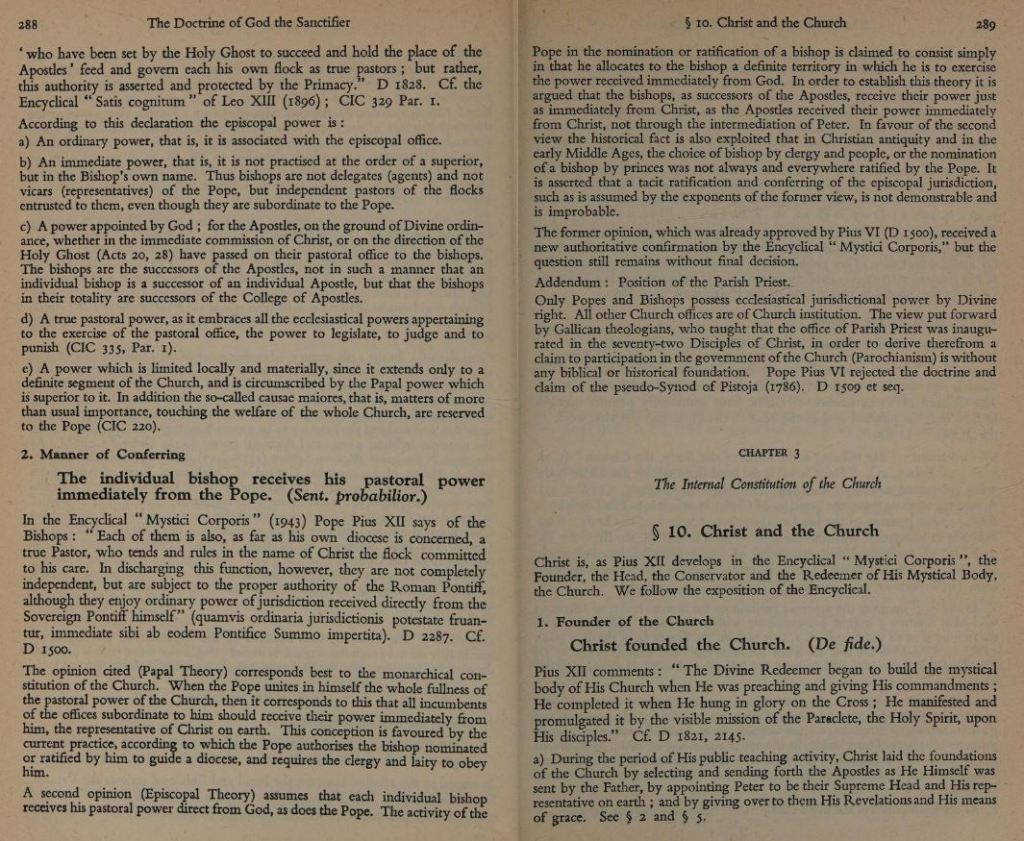
So, like I said, my friend shared a passage from Ott’s book, which I reproduce for you now, typed out for your ease of reading. The image supplied for proof of its origin is given after the text.

Excerpt from Ludwig Ott’s Fundamentals of Catholic Dogma:  

2. Manner of Conferring

The individual bishop receives his pastoral power immediately from the Pope. (Sent. probabilior.)

In the Encyclical “Mystici Corporis” (1943) Pope Pius XII says of the Bishops: “Each of them is also, as far as his own diocese is concerned, a true Pastor, who tends and rules in the name of Christ the flock committed to his care. In discharging this function, however, they are not completely independent, but are subject to the proper authority of the Roman Pontiff, although they enjoy ordinary power of jurisdiction received directly from the Sovereign Pontiff himself” (quamvis ordinaria jurisdictionis potestate fruantur, immediate sibi ab eodem Pontifice Summo impertita). D. 2287. Cf. D 1500.

This opinion cited (Papal Theory) corresponds best to the monarchial constitution of the Church. When the Pope unites in himself the whole fullness of the pastoral power of the Church, then it corresponds to this that all incumbents of the offices subordinate to him should receive their power immediately from him, the representative of Christ on earth. This conception is favoured by the current practice, according to the which the Pope authorises the bishop nominated or ratified by him to guide the diocese, and requires the clergy and laity to obey him. 

A second opinion (Episcopal Theory) assumes that each individual bishop receives his pastoral power direct from God, as does the Pope. The activity of the Pope in the nomination or ratification of a bishop is claimed to consist simply in that he allocates to the bishop a definite territory in which he is to exercise the power received immediately from God. In order to establish this theory it is argued that the bishops, as successors of the Apostles, receive their power just as immediately from Christ, as the Apostles received their power immediately from Christ, not through the intermediation of Peter. In favor of the second view the historical fact is also exploited that in Christian antiquity and in the early Middle Ages, the choice  of bishop by clergy and people, or the nomination of a bishop by princes was not always and everywhere ratified by the Pope. It is asserted that a tacit ratification and conferring of the episcopal jurisdiction, such as is assumed by the exponents of the former view, is not demonstrable and is improbable. 

The former opinion, which was already approved by Pius VI (D 1500) received a new authoritative confirmation by the Encyclical “Mystici Corporis,” but the question still remains without a final decision. 

Addendum: Position of the Parish Priest.

Only Popes and Bishops possess ecclesiastical jurisdictional power by Divine right. All other Church offices are of Church institution. The view put forward by Gallican theologians, who taught that the office of Parish Priest was inaugurated in the seventy-two Disciples of Christ, in order to derive therefrom a claim to participation in the government of the Church (Parochianism) is without any biblical or historical foundation. Pope Pius VI rejected the doctrine and claim of the pseudo-Synod of Pistoja (1786) et seq. 

There is a lot going on in this quote, but I will only mention a few takeaways from it. First, one reads that there were two (and still are two) theories as to how jurisdiction is received by bishops, either the papal theory or the episcopal theory. Ott tells us that the former theory is more probable, but that there has not been a final decision regarding it. Also, as the addendum addresses Gallicanism, Ott is teaching us that the theories, insofar as they pertain to jurisdiction of Bishops, are not Gallican, but insofar they are applied to Parish Priests are Gallican and are erroneous. 

Benns of BetrayedCatholics would have us believe that we are left with the choice between the teachings of the Roman Pontiffs and the theologians. As she says in the article linked to above: 

“‘It is not the private opinions of theologians but the official decisions of the Church by which we must be guided.’ Yet always, Traditionalists favor the opinions of these theologians even over the clear teaching of the Church.”

The problem with this is a fallacy of false dilemma, because it is false to say that I must choose the opinions of theologians or the teachings of the Church. The theologians are teachers in the Church, like Ott, who have dedicated their lives to extensive academic training in the Catholic Church, and are entrusted by the same Church to inculcate the habit of knowledge of theology in seminarians, clergy, religious, and even the laity. They work at the highest possible level of academia,—research institutes—on the highest possible subject matter, theology. The institute of which Ott was rector was founded in 1472 with the approval of the Pope Sixtus IV, who, among other things, oversaw the construction of the Sistine Chapel and the Vatican Archives. 

But there is a choice being made between two mutually exclusive alternatives, exclusive in this case of immediate jurisdiction from God being a Protestant heresy (Benns’s opinion) and immediate jurisdiction from God being one of two theories (Rev. Ludwig Ott’s teaching). You see, the choice is not between Ott or Pius XII. The choice is between Ott or Benns. 

Now, are you obliged by faith to believe Ott? No. That is silly. But I would submit that you are obliged to believe Ott over and against Benns by reason, which reason compels the dispassionate individual to prefer an esteemed and venerable theologian of the highest possible caliber of theological formation, tried and tested by strenuous academic training, and meriting a rectorship at an ancient Catholic institution of research, and who has authored a work on Catholic teaching which many claim is the best ever written, to the mere opinion of a laywoman with only a blog and a bunch of books and a high school diploma.

On Blind Guides

In his “Guiding Principles of the Lay Apostolate,” which Benns quotes from in her article, “Canonical mission granted to the laity,” Pope Pius XII teaches that:

“The catechist is perhaps the classic example of the lay apostle, both by the very nature of his profession and because he makes up for the shortage of priests.”

As a catechist, one is confined to use those teaching materials the Church has provided for the purpose, namely, catechisms and books of instruction for advanced teaching—like The Fundamentals of Catholic Dogma. I am all for “canonical mission” for the laity, though it must be understood that this canonical mission is not “granted” as Benns asserts, but is mandated by episcopal power of jurisdiction, which none of us have received. But let’s let that slide. The point is, Benns, is relying on materials that are not for the laity—such as theological treatises, the code of canon law, and their respective commentaries—to teach her readers the truths of the faith. This is unprecedented and is dangerous, as is evidenced by the latest debacle of immediate jurisdiction. She believes that she has the requisite training, but where she got that idea is beyond comprehension. Guided by the principles set forth for lay apostolates by Pius XII, Benns would never have thought she had the requisite training to be anything other than a catechist:  

“On the other hand, to acquire the necessary competence, it is obviously necessary to make the effort demanded by serious training. Such training, whose necessity for teachers no one doubts, is just as necessary for every lay apostle, and We have learned with pleasure that the meeting at Kisuba emphatically stressed intellectual formation,” (Pius XII, Guiding Principles of the Lay Apostolate.)  

And later, Pius XII teaches that this training is more than just reading some books from one’s own private library: 

“The training of lay apostles will be cared for by organizations of the lay apostolate itself. These may avail themselves of the help of the secular clergy and the apostolic religious orders. We are certain that they will also have the valuable cooperation of the secular institutes. As regards the formation of women for the lay apostolate, women Religious already have fine achievements to their credit in mission countries and elsewhere,” (Ibid.) 

The point is, that such serious training and intellectual formation must happen in Catholic society, among the clergy, religious orders, and in secular institutes. Training to be a religious teacher requires more than what we have presently, because we lack the Catholic society to pull it off. That is why I believe it is safest and most Catholic to profess and defend the truths of the Faith as they are presented in catechisms and in books of instruction written for laity. 

Benns writes:

“I have my own theological library sporting some 3,000 plus volumes, culled mainly from a seminary library, and have studied some of the best theological works available from it since 1981, often clocking in hours of study per day for decades. My friends and family can testify to this, and I don’t believe that is something most can claim to have done. This is not a boast; the fruits of study can only be judged by God. But I have done my best to “make the effort demanded by serious training” as best I could, since there were no Catholic teachers.” 

One of the bad fruits of Benns’s solitary study of theology, which anyone who is reading this article may judge for themselves, not just God Almighty, is that Benns is squarely contradicted by Ott, who was a true teacher in the Catholic Church. Benns is a blind guide who thinks she is a teacher, but who lacks even the basic self-knowledge to correct some simple mistakes she has published, and who would stand by these claims, even if it means throwing away friendships forged at a distance with fellow pray-at-home Catholics, even if these claims are controverted by exceptionally credentialed and true Catholic teachers, who have left us books to learn the faith by. Let us read these instead of those false teachers who dissent from the teachers of the Church, and who offend us with doctrines at odds with what we have learned. As St. Paul puts it:  

“Now I beseech you, brethren, to mark them who make dissensions and offenses contrary to the doctrine which you have learned, and avoid them. For they that are such, serve not Christ our Lord, but their own belly; and by pleasing speeches and good words, seduce the hearts of the innocent,” (Romans 16:17-18). 

Sedes Know No Law, Nor (Apparently) their Catechism: A Refutation of Steve Speray’s Attempt to Discredit Home Alone

By Laura Robbins

I am happy to have Laura Robbins writing another guest post for CatholicEclipsed. As much as I would have enjoyed writing this article myself, my wife beat me to the punch! Let me just point out that she wrote this refutation to Steve’s article at midnight on her phone, in between nursing two infants, and after having conducted a full day of homeschooling and caring for our six young children. So, if I wore a hat, it would be off to her for a job marvelously well done. If you enjoyed this article, please let Laura know in the comments. I am sure she would appreciate the feedback–Robert Robbins.

Steve Speray wrote another article trying to refute the “Home Alone” position. But, aside from all the work it takes to cut-and-paste on my phone and the missed sleep (!), this was simple to refute. Why is it that sedevacantists think they have such air-tight arguments and yet, pray-at-home Catholics can see right through them so easily?

I’ll cut to the chase. Steve Speray refutes his own argument (all based on theologians) with this one sentence,

“This is one reason why listing a collection of theological opinions proves nothing.”

This is because we owe the theological opinions no assent unless there is a unanimous agreement on an infallible matter. We follow our pastors and our catechism. Thanks for the hard work, Steve; you made my refuting your article quite easy!

Just kidding, but seriously. Now, let’s back up here for a proper refutation. Steve’s quotes will be in green from here on out, and as always the BC is red for clarity. First, Steve’s statement that,

“…the Church has by Divine right to live and carry on its mission of saving souls through the sacraments…”

and therefore his argument that Sede clergy have rights to operate in every way that they do rests solely upon what the Church teaches about the sacrament of penance. Theologians may disagree about what constitutes danger of death for a penitent, and therefore what are the proper circumstances for a valid absolution, but that is as far as they go. I grant that penance may be valid in very limited circumstances today, but I don’t think our situation, especially in “cushy” America, constitutes a constant danger of death. That’s taking quite a liberty on the arguments used by the theologians he quotes! Therefore, assuming validity, there’s no argument for constantly giving absolution to penitents according to the opinions of theologians, and none of their opinions carries over into any one of the other sacraments. 

Next, Steve apparently forgets, or ignores, the fact that the Church exists with a THREE-fold mission: to TEACH, GOVERN, and sanctify. 

BC 984. The Church possesses and confers on her pastor, the power of orders and the power of jurisdiction; that is, the power to administer the Sacraments and sanctify the faithful, and the power to teach and make laws that direct the faithful to their spiritual good. A bishop has the full power of orders and the Pope alone has the full power of jurisdiction.

Now sacraments do sanctify, but prayer not only gives grace, the catechism teaches that without prayer we cannot be saved! 


1098. There is another means of obtaining God’s grace, and it is prayer.

1104. Prayer is necessary to salvation, and without it no one having the use of reason can be saved.

It doesn’t say that for any one of the sacraments, except for baptism, and even a desire to be baptized can save a soul in certain circumstances (see BC 654 below).

So, what do the sedevacantist bishops themselves say about their right to teach and govern? Here are some quotes you may have never heard before: (taken directly from this online trad forum).

Archbishop Lefebvre explaining that his bishops are not claiming ordinary jurisdiction:

“We are striving to act in such a way that we cannot be reproached with the bishops’ being given a territorial jurisdiction, in such a way that there is no bishop being attributed to such and such a territory.”

Bishop Daniel Dolan stated in an interview:

We don’t claim to possess any ordinary jurisdiction or the power of excommunication. We have moral authority, but we don’t boss people around. We’re sacramental bishops, and traditionalist communities simply can’t survive for very long without sacramental bishops.”

Bishop Sanborn, Most Holy Trinity Seminary Newsletter, June 7, 2002:

Bishops in these times are not truly dignitaries, since they are not appointed by the ecclesiastical authority. Bishops today function merely as priests do, that is, they are there in the emergency of Vatican II to provide sacraments to the people. The only difference is that bishops may give more sacraments than priests, and therefore their service to the Mystical Body of Christ is augmented. They merely have more to do.

St. Thomas says that the episcopacy is an extension of the sacrament of Holy Orders. It is something like putting an extra room on an existing house. The priesthood is a power over the real body of Christ in the Holy Eucharist, and the episcopacy is a power over the Mystical Body of Christ, that is, the Church. The bishop can ordain and consecrate, and in such a way sees to the extension and continuation of the Mystical Body of Christ. Because bishops have a sacramental power which relates to the Mystical Body of Christ,in ordinary times they have jurisdiction, the ability to make laws, and are dignitaries. Even auxiliary bishops, who had no jurisdiction, were given titular sees, ancient dioceses which no longer had any Catholics in them, to show the connection of the bishop to the governance of the Mystical Body. In our times, however, traditional bishops and priests lack the power to nominate to episcopal sees, even titular ones, and the function of the bishop is limited to sacramental powers.”

So, you see, as Sanborn elaborates, normally even bishops not appointed over the faithful (titular bishops) were given a see in order to show that they had governing power as a bishop. Bishops are supposed to be successors of the apostles and as such, they have jurisdiction, i.e. the ability to TEACH and GOVERN, not just to sanctify and teach the faith which baptism, prayer, and a layman with a catechism can do. The “bishop-as-sacrament-dispenser” idea is completely novel. Oops… the Sedes may have just created a heresy (or at least a theological error) just for themselves!

Here’s what the Church says with regard to Her bishops, who are always true successors of the apostles: 

507. We know that the bishops of the Church are the successors of the Apostles because they continue the work of the Apostles and give proof of the same authority. They have always exercised the rights and powers that belonged to the Apostles in making laws for the Church, in consecrating bishops and ordaining priests.

Also, the laws of the Church or even the opinions of the theologians do not give free license for bishops and priests to do what the Sedes have done. I have never read any sedevacantist who quoted a Church teaching, law, or theological opinion which stated:

  1. the Holy Eucharist can be confected publicly and Holy Communion given regardless of jurisdictional status (or excused from the law like in danger of death), or 
  2. a bishop (who doesn’t even have a diocese where he is receiving jurisdiction!) can be consecrated without a papal mandate, or
  3. bishops are able to set up seminaries or grammar schools without diocesan/Rome approval (i.e. jurisdiction), or 
  4. bishops are able to ordain rogue priests without a proper mission/parish (i.e. jurisdiction), or
  5. bishops or priests without jurisdiction  (and a proper marriage tribunal) are able to rule in the case of validity of marriages, or
  6. the faithful are not sinning when committing communicatio in sacris by going back and forth attending mass as SSPX chapels in communion with Francis and then to CMRI priests  (as when Pivarunas states to his congregation that this is not a sin), or
  7. priests and bishops can call their churches “parishes” without jurisdiction or territorial boundaries set up and approved by the Church,
  8. Etc., ad nauseam, to include all the ways sedevacantists have excused themselves from the laws of the Church.

Sedevacantists are always just asserting Ecclesia supplet or “Necessity knows no law.” I think it’s more like “Sedes know no law.”

Fourth, Steve tries to use Rev. Ott to argue the absolute necessity of the sacraments according to this quote:

“Rev. Ludwig Ott taught, ‘The Sacraments are the means appointed by God for the attainment of eternal salvation. Three of them are in the ordinary way of salvation so necessary, that without their use salvation cannot be attained. Thus, for the individual person, Baptism is necessary in this way and after the commission of a grievous sin, Penance is equally necessary, while for the Church in general, the Sacrament of Holy Orders is necessary. The other Sacraments are necessary in so far as salvation cannot be so easily gained without them.’ [1] Ott tells us on p. 332, ‘All the Sacraments of the New Covenant confer sanctifying grace on the receivers. (De fide.)’ No ecclesiastical law could be used to prevent the Church as a whole from carrying on its mission of saving souls through these life-giving sacraments.”

But if Steve knew his catechism, he would know that in Her most basic teachings, the Church actually says this:

BC 654. We know that baptism of desire or of blood will save us when it is impossible to receive the baptism of water, from Holy Scripture, which teaches that love of God and perfect contrition can secure the remission of sins; and also that Our Lord promises salvation to those who lay down their life for His sake or for His teaching.

BC 766. Perfect contrition will obtain pardon for mortal sin without the Sacrament of Penance when we cannot go to confession, but with the perfect contrition we must have the intention of going to confession as soon as possible, if we again have the opportunity.

Now, at the end of the post, Steve grants the pray-at-home Catholics sincerity (thank you, Steve!) and states,

“If the home-aloners are correct and avoided sedevacantist clergy, they have gained nothing, but the fact they followed their conscience, which both sides do anyway.”

If we are correct, Steve, we have gained everything and lost nothing! If we are correct, the sedevacantists have potentially all lost their souls by possibly not having perfect contrition and relying on invalid absolution! We have gained innumerable graces and the peace of mind that comes with following our conscience on the only path actually available. We have followed Our Lord and Our Lady into the wilderness where we are supposed to be during the apocalypse and suffered with Our Lord. 

Steve continues:

“However, if they are wrong:

     1. They lose numerous graces from the sacraments they could have received. / We gained numerous graces from the sacraments.

First, we don’t lose grace unless we sin, but we may forfeit the ability to receive more graces. And this only if we are assuming that we are able to get to the sacraments, that the sacraments are valid, and that they are licit — the whole point of this article was to show that the Sede’s are NOT licit, even if they are valid. No grace is received from illicit sacraments.

     2. Their chance of losing their souls becomes greater. / The chance of losing our souls decreases.

I argue that the Sede’s chance is greater because they are relying on not just possibly, but probably invalid absolution instead of attaining to perfect contrition, which the catechism exhorts us to even when utilizing the sacrament of penance: 

Q. 769. Imperfect contrition is sufficient for a worthy confession, but we should endeavor to have perfect contrition.

     3. Their chance of gaining heaven becomes less. / [Our] chance of gaining heaven increases.

Redundant, and therefore answered.

     4. [Their] probability of having a tougher purgatory becomes greater. / [Our] probability of having a tough purgatory decreases.

Well, first off, that’s to assume sedevacantists are receiving grace with illicit sacraments, which they don’t. And, I guess Steve is accusing the pray-at-home Catholics of sloth regarding the state of their soul because graces are received through prayer and penance, and I am also guessing Steve doesn’t know anything about indulgences, which remit (at least some) temporal punishment due to sin. All of these are mentioned in the catechism. Also, with regard to the sacrament of penance itself, the BC teaches: 

BC 802  The slight penance the priest gives us is not sufficient to satisfy for all the sins confessed:
   1. Because there is no real equality between the slight penance given and the punishment deserved for sin;
   2. Because we are all obliged to do penance for sins committed, and this would not be necessary if the penance given in confession satisfied for all. The penance is given and accepted in confession chiefly to show our willingness to do penance and make amends for our sins.

BC 803 The Sacrament of Penance remits the eternal punishment due to sin, but it doesnotalways remit the temporal punishment which God requires as satisfaction for our sins.

BC 804 God requires a temporal punishment as a satisfaction for sin to teach us the great evil of sin and to prevent us from falling again.

BC 805 The chief means by which we satisfy God for the temporal punishment due to sin are: Prayer, Fasting, Almsgiving; all spiritual and corporal works of mercy, and the patient suffering of the ills of life.

All of which, the pray-at-home Catholics have and do in spades. 

     5. They will not have lived and died in the greatest possible manner. / We will have lived and died as holy as possible with the sacraments.

This statement has nothing to do with whether one prays at home or goes to Sede clergy. This is the crux of the matter. It some ways, it seems the sedes equate the sacraments with the Church. The sacraments belong to the Church, but not everywhere they are to be found IS therefore the Church, as heretics and schismatics can have valid sacraments. Also, the sacraments are not the entirety of a Christian life. Prayer is necessary to save one’s soul, but in addition, fasting, almsgiving, works of mercy, these are the means to a holy life, not exclusively the sacraments! Is Steve trying to say that the desert hermits, for example, who didn’t receive sacraments, were not living in the greatest possible manner? What about St. Hermenegild who died a joyous martyr instead of receiving his yearly communion from an Arian bishop? Are the Sedevacantists seriously living in the greatest possible manner just because they receive supposedly valid and licit sacraments?!

     6. They will not be as close to Jesus and Mary in life and in death. / We will be closer to Jesus and Mary in life and in death.

Prayer in general, the rosary, the scapulars, consecration to Jesus through the Blessed Virgin, devotion to the Sacred and Immaculate Hearts, and so much more will lead a sincere Catholic close to Our Lord and Our Lady. And receiving the sacraments as such does not equate to efficaciousness. To receive them worthily requires a certain disposition otherwise they are not efficacious, and no grace is received. You’re assuming a lot here, Steve, although obviously done in charity. Again, sacraments are not the entire Christian life, and it’s just an empty assertion to make such a claim. 

     7. Their place in heaven may not reach the heights it could have been. / Our place in heaven becomes the highest it could possibly be, because of the sacraments.

Well, we will only know our place in heaven if and when we get there. But I don’t think the Church has ever taught that just because you receive the sacraments (whenever and however often you may or do) that you will achieve the highest place in heaven, as argued above. I can only speak for myself here, but I certainly am not one to presume upon my place in heaven, nor do I devote myself to prayer, penance, etc. in order to gain a more glorious crown. I do it out of a desire to please my God and to atone for my sins and the sins of others.

At it’s most basic level, the argument against the Sedevacantists is this: they were not sent by the Church, and they admit it! They, therefore, have no liceity, no mission, no jurisdiction, no authority, no ability to confer grace with their sacraments because:

BC 489. The Church is the congregation of all those who profess the faith of Christ, partake of the same Sacraments, and are governed by their lawful pastors under one visible Head.

BC 494. By “lawful pastors” we mean those in the Church who have been appointed by lawful authority and who have, therefore, a right to rule us. The lawful pastors in the Church are: Every priest in his own parish; every bishop in his own diocese, and the Pope in the whole Church.

BC 1004. Bishops, priests and other ministers of the Church cannot exercise the power they have received in Holy Orders unless authorized and sent to do so by their lawful superiors. The power can never be taken from them, but the right to use it may be withdrawn for causes laid down in the laws of the Church, or for reasons that seem good to those in authority over them. Any use of sacred power without authority is sinful, and all who take part in such ceremonies are guilty of sin.

How are sedevacantists a part of the Church given the definition of the Church and their bishops’ own quotes above? Answer: they are not, and therefore, we should avoid them as the schismatic, intruder bishops and priests that they are. Even if we grant them validity, they confer no grace, except for penance given in danger of death. And if the sedevacantists going to these clergy are guilty of sin, if it be mortal, they cannot receive any grace from any prayer or penance or anything else, 

BC 760 …sanctifying grace and mortal sin cannot dwell together. If there be grace in the soul, there can be no mortal sin, and if there be mortal sin, there can be no grace, for one mortal sin expels all grace.

I know this has been a long and bumpy ride. Hopefully, you made it to the end, and learned a little of your catechism along the way. And, Steve, I hope you see how grievously your arguments fail.

The lament of all material heretics: “If I just read my catechism…” When St. Peter meets you at the gate, he is not going to ask you if you read Van Noort, Ott, council canons, canon law, or even St. Alphonse Liguori or St. Thomas Aquinas. He is going to ask why you didn’t read your Catechism.  

Powered by

Responses to Comments Made on BetrayedCatholics

Below are responses to the post and to comments on BetrayedCatholics latest article, “Scaring up ghosts and calling them errors.”  It is in two parts, for the first is Laura addressing what Teresa Benns had posted in a comment; the second part is Robert (that’s me) addressing what Irene had posted in a comment. The object of these responses is to clarify our position and to defend the truth.

Before we dive into the responses, though, I wish to make it very plain and clear: I am not saying we should not read anything other than the Catechism to learn our faith. Of course there are books written for furthering our education in the faith, but I am saying that the Catechism, and the BC in particular for its convenient referencing and concise language, makes for the best defense of the faith I know of. I am also saying that we should learn our Catechism by rote, even if it takes us some years to do it, because that is what Mother Church would have us do.

1166. We have many means of learning the Christian doctrine: In youth we have Catechism and special instructions suited to our age; later we have sermons, missions, retreats, religious sodalities and societies through which we may learn. At all times, we have books of instruction, and, above all, the priests of the Church, ever ready to teach us. God will not excuse our ignorance if we neglect to learn our religion when He has given us the means.

You see, the BC speaks of the Catechism as the first means by which we are to learn our faith. It is fundamental, and since the fundamentals are what are being attacked today, I think it is best to focus on that, until we have a solid grasp of doctrine. We can, of course, supplement with sermons and books of instruction. We may even read papal encyclicals and read canon law, too; but it is altogether dangerous and presumptive to think we have understood these texts well enough to build a defense of the faith on them. I am only saying we should stick with the fundamentals presented in the Catechism as the safest and surest means of defending the faith. Why would anyone have a problem with that?

Teresa wrote: “…And BTW, I will be taking no more posts on this,” yet there she allowed Irene to post a comment afterward. I am responding to Irene here on CatholicEclipsed, because Irene was responding to my article, and so it makes sense to do so. That, and I wasn’t going to write out a lengthy response only for Teresa to have actually kept her word and not allow it to be posted.

LAURA’S RESPONSE TO TERESA 

Teresa writes:

What the popes state, (and those things that the Holy Office approves which are written by others state), is, according to the popes themselves, perfectly understandable. So who do I believe, you or them? When I quote from theologians, and I do so usually only in way of explanation, they are theologians loyal to the papacy. Don’t confuse me with Traditinalists [sic] who use them almost exclusively.

I have scanned over your most recent blog post, Robert, with its insinuations about my lack of education, and I am sorry, but you are wrong on this catechism business. This is not about me or you, but the truth. The catechism is a starting point only and not all you need to know to be saved is within its pages. Even common sense tells us that.

I know this is true because Pope Boniface VIII declares that unless one is subject to the pope and obedient to him, he cannot be saved, so there goes your theory that everything you need to know to be saved being in the catechism! How can anyone obey something he doesn’t study and therefore does not know?

Where does that catechism teach how to avoid the errors of Liberalism, Modernism and Americanism, heresies that destroyed the Church? Every error out there today, especially Traditionalism, constitutes a concerted effort to obliterate even the idea of the papacy.

Not teaching people how to avoid these errors is teaching them how to learn to forget the papacy ever existed or meant anything. You forget: the POPE was Christ’s voice on earth, not the catechism, even though it may echo Church teaching to some degree. Stay with Peter or be lost.

The ridiculousness of a recent public comment has prompted me to feel the need for a correction and clarification of Church teaching. There were so many errors, it was necessary to write a full post to correct them all. 

First of all, we need to start with a true understanding of the nature of the Church. The Church is hierarchical. A hierarchy exists to keep order, and as such, it must be treated appropriately to create that order. Stating that we must follow the pope, does not maintain the hierarchy.  To get a better understanding, I will give an example. In the military, a strict hierarchy exists, such that you are allowed to order anyone below you but to seek orders from those only directly above you, such that if a petty officer went straight to the captain (even with a serious or grave issue) he would be out of line and rightly punished. That same petty officer certainly isn’t going to be asking the captain for his own orders either. The captain speaks to the department heads (officers), the officers speak to the chiefs (enlisted) and the chiefs take it to the petty officers (sometimes with lots more steps than this in between!). Now let’s compare this with the Church. The pope speaks in allocutions and encyclicals, etc. written to the cardinals, archbishops, and bishops, the list doesn’t even mention priests or other lesser clergy, let alone laymen. The bishops direct any necessary information to the priests and the priests give any necessary information to the laity, through catechisms for instance.

Now, our commenter stated this: “What the popes state, (and those things that the Holy Office approves which are written by others state), is, according to the popes themselves, perfectly understandable. So who do I believe, you or them?” First of all, as I stated above, the pope himself says he’s writing for the bishops, not the laity. Secondly, the layman is not going to write to the pope and tell the pope to start sending encyclicals to his address, because he’s educated. Likewise, everything that the Holy Office approves. So in any age other than our digital one with everything online, how would a layman even be able to read what the pope has written? Third, of course the letters written to the bishops would be clear for those they are written to, but no pope in anything I have ever read said that he was writing for the laity or that the laity should read his letters or that the laity would clearly understand what he was writing about. Now, that is not to say that I think they are to remain unread, but we must take care and tread lightly, especially since no matter how much we have read or studied, NONE of us has done such under the counsel of a member of the clergy (except supposedly Introibo)  and none of us (including Introibo) has acquired a degree in theology under the guidance of the Church. Therefore, NONE of us has the specific training to properly understand everything that is written for the bishops who have not only such training and degrees, but also experience, and graces from Holy Orders. 

Next, just because we think something is clear, does not mean that we properly understand it. Let us not wonder too hard at this for the protestants have gone before us in determining the sense of Scripture in this way, and yet also the Scripture seems clear (most of the time) when you read it. Theologians are trained for many years in order to apply the principles to interpret rightly what the pope has said. And many things in the Church are not yet defined in such a way as to make necessary a passage being taken in a certain sense. That is why theologians do not always agree on what they write, and they usually even say so within their writings!

Lastly, who among us is competent enough in Latin to truly say that we could rightly understand what the Church has written in Her books, manuals, letters, canons, etc. All these things have been translated, yes, but which of them was translated and approved by or under the auspices of a true Roman Pontiff? As far as I know, all the translations we have are from the Novus Ordo or other modern sources. Who would be silly enough to argue a fine distinction that the pope or theologians wrote when translated by such? 

Now, the next statement made in the comment was this, “When I quote from theologians, and I do so usually only in way of explanation, they are theologians loyal to the papacy. Don’t confuse me with Traditinalists [sic] who use them almost exclusively.”

Now, just as the Protestants misunderstand the seemingly clear text of Scripture, and therefore a good Catholic would go to the Church to see how to understand a passage in the Bible, so to should we see what the Church has stated in Her teachings to see how we should understand the pope. This is why Traditionalists do it. They have the habit created from their training. What training does our commenter have to say that such a passage is clear and needs no explanation? (None.)

Also, as previously mentioned, without training (or obviously a censure from the Church) who are we to judge which theologian is loyal to the pope?! 

Next, “I have scanned over your most recent blog post, Robert, with its insinuations about my lack of education, …” First of all, as a gentle reminder, a wise person does not SCAN something and then think they have the understanding to not only comment, but pass judgment on the text. They read it, and sometimes reread it in order to understand. I can’t imagine a bishop scanning what a fellow bishop wrote and presuming to pass judgement on it. Secondly, in this democratic age, we all too often forget the strata that used to exist in society as social classes. We think that anyone can do anything regardless of their education, experience, or background and we are constantly bombarded with examples to back up the nonsense: such as Abraham Lincoln growing up in a log cabin, teaching himself the law, and becoming president of the Unites States. Lincoln was most likely a genius intellect to have taught himself and is therefore not a common man. I may be treading on thin ice with people here, but I believe (and in ages past it was understood such that) education matters, life experience matters, and God-given ability matters. Not everyone is capable of doing everything. I am reminded of this every time I go into town: the man that bags the groceries at my grocery store would not be able to “put his mind to” learning astrophysics or engineering or maybe even algebra. He is definitely not mentally handicapped, but you can tell that his cognitive level would not be able to reach those heights. Neither would the beggar on the street corner. Who among us thinks they can write as well as Shakespeare or argue like Cicero or conquer like Alexander the Great or keep the world at peace like Augustus Caesar? Therefore, to circle back, education (or the lack thereof) does matter. True autodidacts are few and far between (if they even exist at all) because education requires a master/disciple relationship with feedback in order for the student to make corrections in their understanding. 

Moving on “… and I am sorry, but you are wrong on this catechism business. This is not about me or you, but the truth. The catechism is a starting point only and not all you need to know to be saved is within its pages. Even common sense tells us that.” Now, we get the the crux of the matter and here is where it starts getting painful. This is certainly about truth, the problem is, our commenter doesn’t have it. I know that I have read, and I therefore believe, that Catechisms are infallible. Common sense tells us that. And Rome approved the Baltimore Catechism. So how could Our Mother give us error when we ask for truths of the faith to teach ourselves and our children what is required to save our souls? What did the people in ALL the times past have in order to flee from or combat the heresies of their day, ex. Arianism, Lutheranism, Anglicanism? How did the Japanese pass on the faith without even a priest?! They had their catechism, and most didn’t even have the book, they had the oral questions and answers given and memorized. What more do we need than the Catechism? (This is not to say we are not able to learn more, only that the catechism supplies all that is necessary.) What does the Catechism say about all this?

124. Our Catechism treats of religion; that is, of the truths we must believe and of the things we must do to serve God.

The commenter goes on: “I know this is true because Pope Boniface VIII declares that unless one is subject to the pope and obedient to him, he cannot be saved, so there goes your theory that everything you need to know to be saved being in the catechism! How can anyone obey something he doesn’t study and therefore does not know?”

The commenter apparently doesn’t know her Catechism and didn’t even consult one before making such a comment. Here is what the Catechism says:

489. The Church is the congregation of all those who profess the Faith of Christ, partake of the same sacraments, and are governed by their lawful pastors under one visible head.

496. Our Holy Father the Pope, the Bishop of Rome, is the Vicar of Christ on earth and the visible Head of the Church.

To be “under one visible head” is to be subject to the Roman Pontiff. They mean the same thing. And if our commenter had more Catholic sense, she would know that, and just as importantly, she would have known that was to be found within the catechism. In what age was the laity ever required to read papal or council documents in order to know their faith to be saved?! None.

Sadly, our commenter continues, “Where does that catechism teach how to avoid the errors of Liberalism, Modernism and Americanism, heresies that destroyed the Church? Every error out there today, especially Traditionalism, constitutes a concerted effort to obliterate even the idea of the papacy.”

Now, I will have to limit myself to just a few examples here in order not to create a whole post on this error alone. The BC on Liberalism:

494. By “lawful pastors” we mean those in the Church who have been appointed by lawful authority and who have, therefore, a right to rule us. The lawful pastors in the Church are: Every priest in his own parish; every bishop in his own diocese, and the Pope in the whole Church.

Being subject to your pastor and the pope takes care of every error, but since freedom of thought and conscience are two of the most important tenets of liberalism, if you’re subjecting yourself to lawful authority, you’re not free from that authority. 

Also, advocated in liberalism is freedom of religion, but the Baltimore Catechism says:

1171. The denial of only one article of faith will make a person a heretic and guilty of mortal sin, because the Holy Scripture says: “Whosoever shall keep the whole law but offend in one point is become guilty of all.”

Now, contained within these two, is the logical conclusion that if I must believe and do all that the Church teaches, I am not free to speak or write error or heresy, and therefore the teaching against freedom of speech is implicitly contained in the catechism as well. 

Now, for Modernism, I put it to our commenter to even define what it is and therefore what we need to know to fight against it since this is what the Catholic Encyclopedia had to say on the subject:

“A full definition of modernism would be rather difficult. First it stands for certain tendencies, and secondly for a body of doctrine which, if it has not given birth to these tendencies (practice often precedes theory), serves at any rate as their explanation and support. Such tendencies manifest themselves in different domains. They are not united in each individual, nor are they always and everywhere found together. Modernist doctrine, too, may be more or less radical, and it is swallowed in doses that vary with each one’s likes and dislikes. In the Encyclical “Pascendi”, Pius X says that modernism embraces every heresy.”

I have tried to read Pascendi, and I gladly admit, it’s far above me. The errors it discusses are things I don’t even understand and therefore, I know that if I could even fall into one of them, I should be considered invincibly ignorant on that account, but I assume the more likely, that I wouldn’t even fall into such complex and complicated errors since I believe all that the Church teaches and I know my catechism. 

Lastly, the errors of Americanism are pretty much the errors of liberalism (freedom of conscience, religion, speech, etc.) and therefore have been dealt with above. 

So you see commenter, if you knew your catechism, you would know that these teachings are already there for the faithful. The hierarchy may need to be put on guard against them, which is why the encyclicals were written, but that doesn’t mean that the faithful don’t already have the tools to fight for themselves. 

Now for the last part of this extremely long comment. “Not teaching people how to avoid these errors is teaching them how to learn to forget the papacy ever existed or meant anything. You forget: the POPE was Christ’s voice on earth, not the catechism, even though it may echo Church teaching to some degree. Stay with Peter or be lost.”

The catechism does teach us what we need to know as lay faithful. We are not bishops, we don’t have teaching authority, and a complex or complicated explanation of the faith doesn’t convert anybody. Those who are of goodwill will correct their error when shown the simple truth. The pope teaches the bishops in order for the bishops to keep the flock away from error and scandal, not because the pope expected all the laity to read and understand Pascendi for example and therefore start publicly arguing against it. 

The catechism teaches us about the papacy and its importance. Therefore, we don’t need to be taught about modernism in order to somehow not forget about the papacy! What an absurd thing to say! The catechism also teaches us that the pope is the visible head of the Church as stated above and it does NOT just ECHO Church teaching to some degree! It is all the laity need to know to save their souls as stated above. 

We who love the catechism, love the Church and love the Pope. Those who are ignorant of so basic a thing as the catechism (the basic tenets of the faith necessary to save your soul) and disparage it in such a way cannot and should not be listened to when speaking on anything related to Church teaching.

ROBERT’S RESPONSE TO IRENE

Irene writes:

My comment below is in regard to Robert Robbin’s article, “Need to Know” written on July 24, 2022.

It is peculiar that you would be responding to my article on another’s website. Who does that? It shows a certain lack of decorum. If you would like to take an issue with what I wrote in an article, you should address yourself to me on that article’s page. 

So, Robert, the Traditionalist “laity” don’t need to know and should just stay within the confines of the Baltimore Catechism for all their spiritual needs?

First of all, why is laity put into quotation marks? And I am not sure why you are associating what I say with Traditionalists. As I understand that term—ill-conceived and vague as it is—I am not nor ever shall be a Traditionalist. I am a Catholic who is simply promoting the BC (or any Catechism that you prefer) to form the bedrock for a defense of the faith and, yes, to provide for our spiritual needs, because that is what the BC says of itself: 

124. Our Catechism treats of religion; that is, of the truths we must believe and of the things we must do to serve God.

Does that mean that there are not other pious practices and even beliefs to be found outside of the BC? Of course there are! That is not my point. My point is to get us Pray-at-Home Catholics back to the basics, and to learn our faith from the bottom up, instead of from the top down, that is, to learn our faith from the very means by which Holy Mother Church meant for us to learn our faith, by the Catechism, instead of going in search of possible arguments against the heretics and schismatics to be found in papal encyclicals and legislation, canon law and commentaries, or theological treatises and manuals. We are untrained laity, and as such we do not have the competency to do such work.   

Where do you find in the BC the fact that Lefevbre [sic] and Thuc were never able to consecrate or ordain anyone? Is that in there? Where do these innocent people find out that their “priests” are frauds and have no power to absolve them in confession or administer ANY sacraments to them?

Yes, Irene, it is, insofar as the definition of a heretic is there, and, given the fact that Lefebvre and Thuc were heretics, and so not members of the Church, which is also taught in the BC, it is easily proven that the ordinations and consecrations of those schismatics and heretics were unlawful and sacrilegious, as the BC teaches us: 

1004. Bishops, priests and other ministers of the Church cannot exercise the power they have received in Holy Orders unless authorized and sent to do so by their lawful superiors. The power can never be taken from them, but the right to use it may be withdrawn for causes laid down in the laws of the Church, or for reasons that seem good to those in authority over them. Any use of sacred power without authority is sinful, and all who take part in such ceremonies are guilty of sin.  

Does the BC explain how in the latter days the sacrifice would cease as prophesied in the book of Daniel?

I would class the question of the prophecy of the Cessation of the Sacrifice as further reading. I do not think you believe, nor anyone, that we pray-at-home Catholics pray at home and not at Sede chapels because of Daniel’s prophecy. It is instructive to learn of this prophecy, no doubt, and I have never said that we shouldn’t read Holy Scripture and commentaries for the laity, nor other books written for us laity on other topics.  

Does it teach how to understand the meaning of Christ’s words about the false priests who would say, “Lo, here is Christ…”? Does the BC tell us how we will recognize these wolves in sheeps’ [sic] clothing? Something Christ commanded we do?

The BC.1004 teaches us to avoid those ministers who have not been sent by the Church, so, yes, indirectly the BC does teach us to recognize wolves in sheep’s clothing. As to the meaning or sense of Sacred Scripture, that is the job of Biblical commentaries not catechisms. 

I think the real issue here is that I am asking you to consider reading the Catechism instead of Teresa Benns’s untrained theological and canonical rants. That hurts you because you are friends with Teresa. You have no reasonable basis to assail what I am saying other than that you perceive that I am attacking your friend. I am not attacking Teresa, but I am putting her in her proper place, which is in the place of a laywoman without education or training in theology or canon law who has shown that she is incapable of fraternal correction, which is a dangerous thing indeed for herself and for her readers whom she may scandalize.  

“Robert, I was so happy when I learned you were a Catacomb Catholic, but now I am irretrievably saddened to see you are just another Trad. Just another Trad. Or a liberal Catholic. 

This is a slanderous outrage which you have not a single shred of evidence to back up. You call me a Trad and a liberal Catholic because I want to promote a surefire way to defend the Church and the honor of God and His mother by promoting the means by which we are to know, love, and serve God Almighty!? Frankly, this is unbecoming of a reasonable human being, let alone a Catholic.  

I had been deluded by the Trads to my great sorrow and almost lost my mind trying to find the Truth. Was led down the wrong road by Novus Ordos, Trads, “Independent priests”, SSPX charlatans, and then thankfully through what I believe to have been a miracle from God, was led to Teresa Benns where I recognized Truth immediately and have never stopped thanking God for rescuing me.

I do not deny that there have been helps that I received from Benns as well, that her website does have good on it, and that my family and I have learned from what she has written. But there are also errors on her website, and the general method that she uses to approach the crisis is beyond her competency. Who is to say that she could not have equally rescued you and me from the Trads had she simply quoted from the Catechism? Or, perhaps, if you had known your Catechism, had studied it by rote, in and out, you wouldn’t have necessarily succumbed to the sects? Or perhaps you wouldn’t have lost your mind trying to find the truth if you had picked up your Catechism and read it?  

I pray you ask to be rescued, too.

I appreciate your prayers. I am in need of conversion every day. That is why I am trying to learn my faith by reading and studying the BC. It has proven very spiritually enriching and enlightening. 

The devil is in control of the trads, liberals, modernists, etc., and will kill the souls of each one of their supporters if given half a chance. Some of us, no I say most of us, may have to recognize the devil before we can recognize the Truth.”

Irene

I know the truth, and I am learning more day by day, because I am reading the BC, which contains what it is I must know to serve God and save my soul from the Devil. The truth is to be sought for in the open pastures and beside the living streams and brooks of authorized catechisms, not in the thicket and brambles of disputations between heretics on the exact meaning or application of canonical law or papal legislation written by a layperson without training. We are sheep, not shepherds. We must go where the Shepherd has led us, and graze for truth there. If you enjoy the dark forest and think the truth is more easily found therein, then have at it. I do not think that is the safest nor the most Catholic way to go about it. Rather it is to walk in the straightforward path to truth, than to take the winding way: “Midway upon the journey of our life / I found myself within a forest dark, / For the straightforward pathway had been lost,” (Divine Comedy, Dante Alighieri).

To teach and defend the truths of the faith requires certitude, not opinions, as the BC teaches us:

1168. Such instruction should be given to those who ask it of us in a kind and Christian spirit, without dispute or bitterness. We should never attempt to explain the truths of our religion unless we are certain of what we say. When we are unable to answer what is asked we should send those who inquire to the priest or to others better instructed than ourselves.

It is my earnest opinion that the BC provides us with those certain truths of the faith which we must know to defend the Catholic faith. Let us endeavor not to assassinate the character of the messenger anymore simply because he is carrying on the mission of the magisterium by promoting the catechism.

And a final word in response to TB’s latest rant: It is simply a straw man fallacy which does not deserve a response.

Powered by

Need to Know

The first atomic device detonated on Earth happened July 16, 1945. The code name of the nuclear weapon was Trinity, after John Donne’s Holy Sonnet 14, which I happened to have put to memory in college in a poetry class. I reproduce it below for your poetic fancy. 

Batter my heart, three-person’d God; for you

As yet but knock; breathe, shine, and seek to mend;

That I may rise, and stand, o’erthrow me, and bend

Your force, to break, blow, burn, and make me new.

I, like an usurp’d town, to another due,

Labour to admit you, but O, to no end.

Reason, your viceroy in me, me should defend,

But is captived, and proves weak or untrue.

Yet dearly I love you, and would be loved fain,

But am betroth’d unto your enemy:

Divorce me, untie, or break that knot again,

Take me to you, imprison me, for I,

Except you enthrall me, never shall be free,

Nor ever chaste, except you ravish me.

What this poem has to do with fusing together heavy radioactive metals to create a critical mass of hell on earth to be used with the purpose of ending an ungodly war by mass murdering hundreds of thousands of innocent civilians is beyond me. Perhaps great sin conjures great and pious thoughts, even if only to blaspheme. Anyway, I mention Trinity for a reason touching upon a recent controversy among us Home-Aloners. That controversy may be summed up as follows: Some believe, perhaps most, that it is the duty of the faithful Catholic to learn the ins and outs of our religion, from the top down, and understanding and continued Catholic eduction, or perhaps, post-catechesis, is sought for in papal encyclical letters, canon law, ecumenical councils, theological manuals, etc. I guess what this advanced degree in Catholicism is supposed to be is anything and everything beyond what one would learn in a catechism, because whenever this author mentions the sufficiency of the catechism for the woes plaguing the Church today, he is met with admonitions to the effect that the catechism is good for children, but for adults what is needed is “a greater understanding among better educated Catholics especially regarding the teachings of the Church which Traditionalists deny.” 

So, what on Earth does this have to do with the nuclear device, Trinity? Well, the name of the device was also the code name of the project to develop the device, which project was under a strict classification for governmental data or information known as need to know. A thing was said to have this restriction when, even granting requisite security clearance to review the information, without a need to know, “that is, access to the information must be necessary for one to conduct one’s official duties,” the individual was simply left in the dark. (Wikipedia, Need to Know).

We see the necessity of this kind of security measure in the military. What would have happened—I can hardly bring myself to imagine—if this security measure was not followed and anyone and everyone who had a clearance and a competency to understand the information about the Trinity project were informed? It is perhaps no great leap of the imagination to say that the poor citizens of Hiroshima and Nagasaki would not have been the only senseless casualties of war. 

But isn’t the Church on Earth a military as well? And perhaps it is no great leap of the imagination to say that there exists this kind of information control in the Church Militant, this need to know basis for reviewing and making use of information which falls outside not only our competency, but also our duty in life. I contend that there does exist a need to know restriction on information in the Church Militant, and this is observed by hierarchical subordination from the Roman Pontiff down to the baptized child not yet of the age of reason. Just as a pre-catechism child six or younger does not know, nor has a duty to know, the rudiments of the faith found in the catechism, so too the catechized adult does not know, and does not have a duty to know canon law or theology. But even a priest, who does know and has a duty to know canon law and theology, insofar as his office demands him to know, does not know everything a bishop knows and has a duty to know and a bishop does not know nor has a duty to know everything the Roman Pontiff knows and has a duty to know. 

What would happen if a mere layman assumed the duty of knowledge of a Roman Pontiff? Answer: insubordination and anarchy and confusion of discipline and doctrine, not necessarily because the individual is malicious but because, as a natural result of having powers of knowledge not proper to the individual’s station in the Church Militant, disorder would result, both in the individual who unduly assumed powers of knowledge but also in the Church Militant societal structure itself. The hierarchical structure of the Church is like the Chain of Command in the military, which exists to order the inferior to the superior in reason. This is conducive to good order and discipline both in what is natural and in what is supernatural. Just as I do not have a right or duty or need to know the launch codes of an attack submarine as a chef in the galley, so too I do not have a right, duty, or need know how bread is miraculously changed into the Living Flesh of Jesus Christ my God and Savior. There are metaphysical explanations of this, of course, which studied theologians learn, but such things are indeed beyond my need to know as a layman in the Church Militant. Nor do I assume powers of knowledge of a theologian to do war with the heretic—like Luther, for instance—who denies certain details of this great miracle of Transubstantiation. It is enough to know that the Church teaches it, and that the heretic denies it, and that my duty is to admonish the heretic on these grounds, not reform him according to my own understanding of the Summa Theologica. It is not my lot in life to defend it on those theological grounds properly studied and understood only by theologians which explain the hows and whys of the dogma, because that knowledge is not proper to my duty, but to a theologians. 

The question then arises, what is my duty, or my need to know as a layman? Thankfully, the BC is not quiet on this point: 

124. Our Catechism treats of religion; that is, of the truths we must believe and of the things we must do to serve God.

So, since the BC provides us with the knowledge of what we are to believe and what we must do to serve God to save our souls, what else are we required to know? Can you, gentle reader, really say that you know your catechism? Can you honestly say that you know what the Church teaches, say, on when the first marriage was instituted? And whether this union conferred grace? I will give you a second to answer in your own mind…

Now, what does the Church teach us regarding this? 

1007. Marriage was first instituted in the Garden of Eden, when God created Adam and Eve and made them husband and wife, but it was not then a Sacrament, for their union did not confer any special grace.

Can you say you knew that teaching? I can say I had no clue, but then I wasn’t properly catechized. Indeed I have never been catechized, which I am trying to amend in my spare time. The point I am trying to make is that there are those who insist on knowing what is not proper to them yet oftentimes fail in knowing what they are duty-bound to know, like what is found in their catechism. They operate under the misunderstanding that the catechism is insufficient to defend the faith, because they think that it is their duty to defend the faith in the same way theologians defend the faith, when it is not. We are bound to profess and defend the faith according to our need to know the faith, which is taught in catechisms, not in theological manuals and canon law. The danger lies in trying to defend the faith like a theologian and canonist and making theology or canon law look ridiculous in the process—or rather making oneself look ridiculous—and not convincing the heretic of anything beyond the fact that your own understanding of theology and canon law is ridiculous. If only a catechism were used to defend the faith and admonish the heretic, they would have no choice but either to submit or to reject what the Church teaches is necessary for their salvation to believe or do. Thus, having no faith—the act by which we believe all that the Church teaches—they are reprobates that no amount of theological or canonical argumentation, even if competently done (which I deny is possible for anyway without training and faculties in theology and canon law), can correct or convert. 

The individual who believes the mistaken notion that a greater understanding and better Catholic eduction are sufficient to convert the faithless heretic seeming lacks the very greater understanding and better Catholic eduction that individual presumes to have. Let us, the rank and file of the Church Militant, be content with what we have a need to know, especially since that is all we need to know to save our souls and help others save theirs.             

Powered by